Arbeitsgruppe Mess- und Regelungstechnik – Mechatronik
Prof. Dr.-Ing. Oliver Nelles
2. Design of Experiments
Task
- Where to measure in order to optimally improve a model?
Difficulty with Traditional Approaches
- Unsupervised → Good for initialization.
- Whole measurement plan is designed a priori.
- Model quality is either
- not considered at all (space filling designs, etc.) or
- only variance component is optimized (D-optimal, etc.).
Our Approach
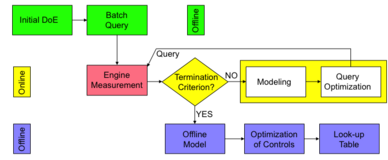
- Active learning → Feedback of model quality to DoE.
- Focus rather on dominating bias (systematic) error than on variance (stochastic) error.
- Utilizes powerful local network construction algorithms → HILOMOT.
- Incremental procedure → Measurement can be stopped anytime.
Optimal maximin latin hypercubes (unsupervised)
Optimization of Latin Hypercube (LH) Designs
- LH not necessarily space filling → Optimization required. Here: maximin or Φp.
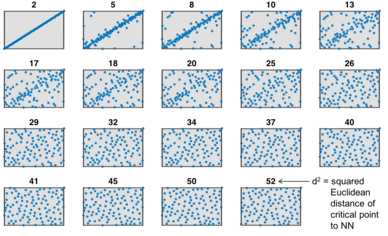
- Goal: Maximization of the critical points (closest to each other).
- Implementation: Deterministic optimization strategy.
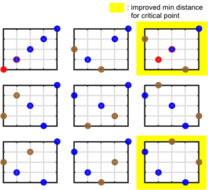
Optimization Strategy (Phase 1)
- Initialize with random LH
- Find critical points with minimal distance to each other
- Go through all critical points (red)
- Try to swap with other points (brown) in order to increase critical distance
- Check all potential swapping partners in all dimensions for all critical points
- Iterate until no improving partner can be found anymore
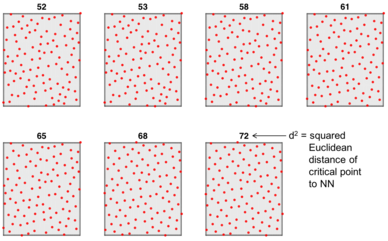
- Subsequent phase 2 improves further
Example: 5 points / 2 dimensions
LH Optimization for 100 Points (Phase 1: Improving Critical Points)
LH Optimization for 100 Points (Phase 2: Further Improvements)
Optimization of next measurement point to gather most information (supervised)
HILOMOT-DoE: Active Learning Cycle
Joint project with

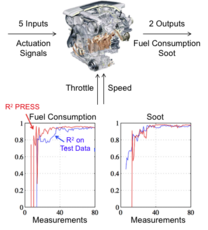
Situation
- Increasing degrees of freedom.
- More potential for optimization.
Problem
- Cost and engine test stand times overwhelming.
- Individual approaches become tedious.
- Advanced systematic procedures required.
Results
- Sophisticated models intertwined with DoE (active learning).
- Much faster engine measurement/calibration times.
- Flexible trade-off between model accuracy and required engine test stand times.