Arbeitsgruppe Mess- und Regelungstechnik – Mechatronik
Prof. Dr.-Ing. Oliver Nelles
Software (Matlab)
Software developed by our Work Group
LMN-Tool
This object-oriented Matlab toolbox covers two algorithms for building local model networks (also called Takagi-Sugeno fuzzy systems) from data:
LOLIMOT (LOcal LInear MOdel tree)
HILOMOT (HIerarchical LOcal MOdel Tree)
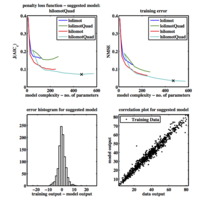
Download Matab Source Code (Version 1.5.2.1) (Non-Commercial Use only, see included licence file):
After Download rename file extension from .txt to .zip!

This work is licensed under a Creative Commons Attribution-NonCommercial-ShareAlike 4.0 International License.
LOLIMOT (LOcal LInear MOdel tree)
- Axes-orthogonal partitioning into hyper-rectangles
- Normalized Gaussian validity functions
- Orthogonal splits in ratio 1:1 are tested
HILOMOT (HIerarchical LOcal MOdel Tree)
- Axes-oblique partitioning into arbitrary shapes
- Sigmoidal validity functions constructed hierarchically
- Oblique splits in optimized ratio and direction
- Split optimization is a separable nonlinear least squares problem
- Outer loop: Constrained nonlinear split optimizations
- Inner loop: Local weighted least squares estimation of local model parameters
These are the key features of local model networks as applied here:
- Tree-construction builds an incrementally growing network
- Separation between inputs/variables that
- influence the nonlinear behavior (premise space z)
- influence the local (linear) models (consequents space x) - Local models are estimated locally with weighted least squares
- Locally worst model is split
- Good interpretability
- Possibility to transfer/adapt solutions for linear problems to the nonlinear world
- Adaption of the model in specific regions unproblematic (no unlearning!)
→ only in regions with fresh data the model behavior is adjusted
These are the key features of this toolbox:
- Object-oriented implementation with classes
- Reasonable default values allow simple usage: LMNTrain(data)
- Individual setting can be assigned by changing the class properties
Termination criterion of tree-construction is a 2x increasing AICC (default) - Dynamic models are possible with arbitrary delays for inputs and outputs
- Splitting can be performed according to the output/simulation error
- Local models are polynomials of arbitrary degree (default is 1 and 2)
- Training, validation (optional), and testing (optional) data can be used
- Splitting smoothness is set to a reasonable default value
If you want to publish your results generated with this toolbox, please acknowledge our work by citing the following article:
Hartmann B., Ebert T., Fischer T., Belz J., Kampmann G., Nelles O.: "LMNtool - Toolbox zum automatischen Trainieren lokaler Modellnetze", 22. Workshop Computational Intelligence, Dortmund, Dezember 2012.
Function Generator
The polynomial-based function generator is ment to imitate regression problems. It should be a helpful tool during the development of algorithms for experimental modeling and adjacent topics. An arbitrary amount of synthetic examples can be generated with no effort. In contrast to available benchmark data sets, important properties of the synthetic examples can arbitrarily be defined by the user, like the amount of data, the dimensionality (number of inputs), the strength of the nonlinearity, the data distribution and the noise level.
Download function generator (Matlab class) here!
After Download rename file extension from .txt to .zip!
If you want to publish your results generated with this function generator, please acknowledge our work by citing the following article:
Julian Belz, Oliver Nelles: "Proposal for a Function Generator and Extrapolation Analysis“, Innovations in Intelligent SysTems and Applications (INISTA), 2015 International Symposium on, pp. 282-287, Madrid, September 2015.
EDLS - Extended Deterministic Local Search for Latin Hypercube Design
EDLS generates an optimal Latin Hypercube design with respect to the intended distance criterion. Therefore it swaps design points to maximize the distance between the design points. Execute EDLS without parameters to run a demo (Latin Hypercube with 25 samples and 2 inputs with visualization).
Download EDLS Matlab function here!
After Download rename file extension from .txt to .m!
If you want to publish your results generated with EDLS, please acknowledge our work by citing the following article:
Tobias Ebert, Torsten Fischer, Julian Belz, Tim Oliver Heinz, Geritt Kampmann, Oliver Nelles: "Extended Deterministic Local Search Algorithm for Maximin Latin Hypercube Designs“, IEEE Symposium Series on Computational Intelligence (SSCI), Cape Town, South Africa, December 2015