A park bench that brings people together?

What if technology brought us together in our everyday urban lives, rather than isolating us from one another? This question is at the heart of the new ENACT research project, which will launch in October 2026 at the University of Siegen. What makes this project unique is that the research takes place not only in the lab or in front of a computer, but also in the theater and in public spaces. Design researcher Judith Dörrenbächer from the University of Siegen is collaborating with the Forum Freies Theater Düsseldorf. The project is made possible by a grant from the Volkswagen Foundation totaling approximately two million euros—a strong signal of support for an unusual initiative at the intersection of science, art, and urban life.
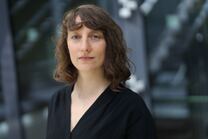
The project’s starting point is an observation shared by many: In public spaces, we are becoming less and less aware of one another, as smartphones and headphones come between us and other people. At the same time, more and more technologies are finding their way into cities—digital assistance systems and, in the future, likely various robotic technologies as well. So far, these technologies have primarily been developed and used for functional purposes, such as cleaning, delivering, or monitoring. The ENACT research project takes a different approach and asks: What social roles can technology assume? How can it mediate between people, foster empathy, or defuse conflicts? Dörrenbächer wants to develop ideas for how smart technologies can improve our coexistence in cities—at bus stops or on park benches, in public squares or on the side of the road. “We want to use technology to facilitate positive encounters between people. In doing so, we’re harnessing what makes real space so special compared to virtual space: here, different people meet each other by chance and in person,” explains the designer.
Research Between the Stage and Urban Space
Instead of focusing solely on analysis and programming, the team relies on artistic research in theater and performative interventions in public spaces. Potential futures involving technology should become physically tangible and evaluable before they are actually implemented. To this end, the project is also developing new performative methods.
One possible approach involves speculative role-playing. In improvised scenarios, participants take on different roles: they play themselves, other people, or even the technology. How might a robot react in an argument? How do people feel when a robotic system collects and shares personal memories of a specific place and highlights what connects them? Could mobile park benches facilitate “chance encounters” and “déjà vu experiences” between people, thereby breaking the ice (“Haven’t I seen you here before?”)?
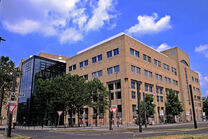
Specifically, it might look like this: What if a bus stop stepped in to mediate as soon as an argument or conflict arose among people waiting? “Technology could act as a mediator and play to its particular strengths: it’s very patient, doesn’t hold grudges, and doesn’t judge.” Perhaps such prototypes will encourage people to look up from their smartphones and put themselves in others’ shoes. “But maybe people waiting at the bus stop will also feel disturbed or patronized. Smart technology often appears neutral without necessarily being so. We approach these thought experiments with an open mind and, of course, remain critical of their risks.” The scenario is acted out by performers in various configurations. The researchers observe how people behave toward one another and in interaction with the technology.
Such staged thought experiments are intended to make possible visions of the future tangible. “Our goal isn’t to actually introduce smart bus stops into cities. Through speculative designs, we want to gain insight into which futures involving technology are desirable and which are not,” says Dörrenbächer. “Which human abilities can smart technology support rather than replace? Where does technology contribute its own unique social capabilities that we should definitely make use of?”
From Future Scenarios to a Toolkit
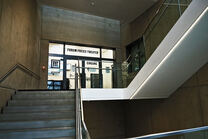
Two doctoral students will approach the project from different academic perspectives. One works with speculative design and deliberately provocative visions of the future to spark debate. The other develops interactive systems that can actually be used and experienced as prototypes. Both are working closely with artists from an international artist-in-residence program implemented in collaboration with the Forum Freies Theater Düsseldorf: Over the course of five years, ten artist projects will be created. The artists are invited to Düsseldorf, bring their own research questions and methods, and collaborate with the doctoral candidates on joint studies.
The goal is to develop a practical toolkit. The project will produce design recommendations for smart technology in public spaces as well as proven performative methods for technology development. This toolkit is intended for technology developers, urban planners, municipalities, and initiatives seeking to make public spaces more inclusive, vibrant, and human-centered.
ENACT is funded by the Volkswagen Foundation. Nationwide, the foundation currently supports eight research groups with a total of approximately 14.4 million euros, all of which are dedicated to the question of how society can be shaped for the future—including in Siegen, Munich, Bremen, and Hamburg. For Judith Dörrenbächer, this funding represents a milestone. A graduate in design (TH Köln), she initially worked for NGOs and companies, conducted research and taught at the Niederrhein University of Applied Sciences, earned her doctorate at Folkwang University in Essen, and conducted research at the University of Siegen on more-than-human design, speculative design, and robotics, with a special focus on theater-based methods. “Without the funding from the Volkswagen Foundation, this project wouldn’t be possible,” she says. “It’s a major career step for me—and an opportunity to build new networks and really try something new.” The project will run for five years, through 2031.