Writing That Takes a Risk
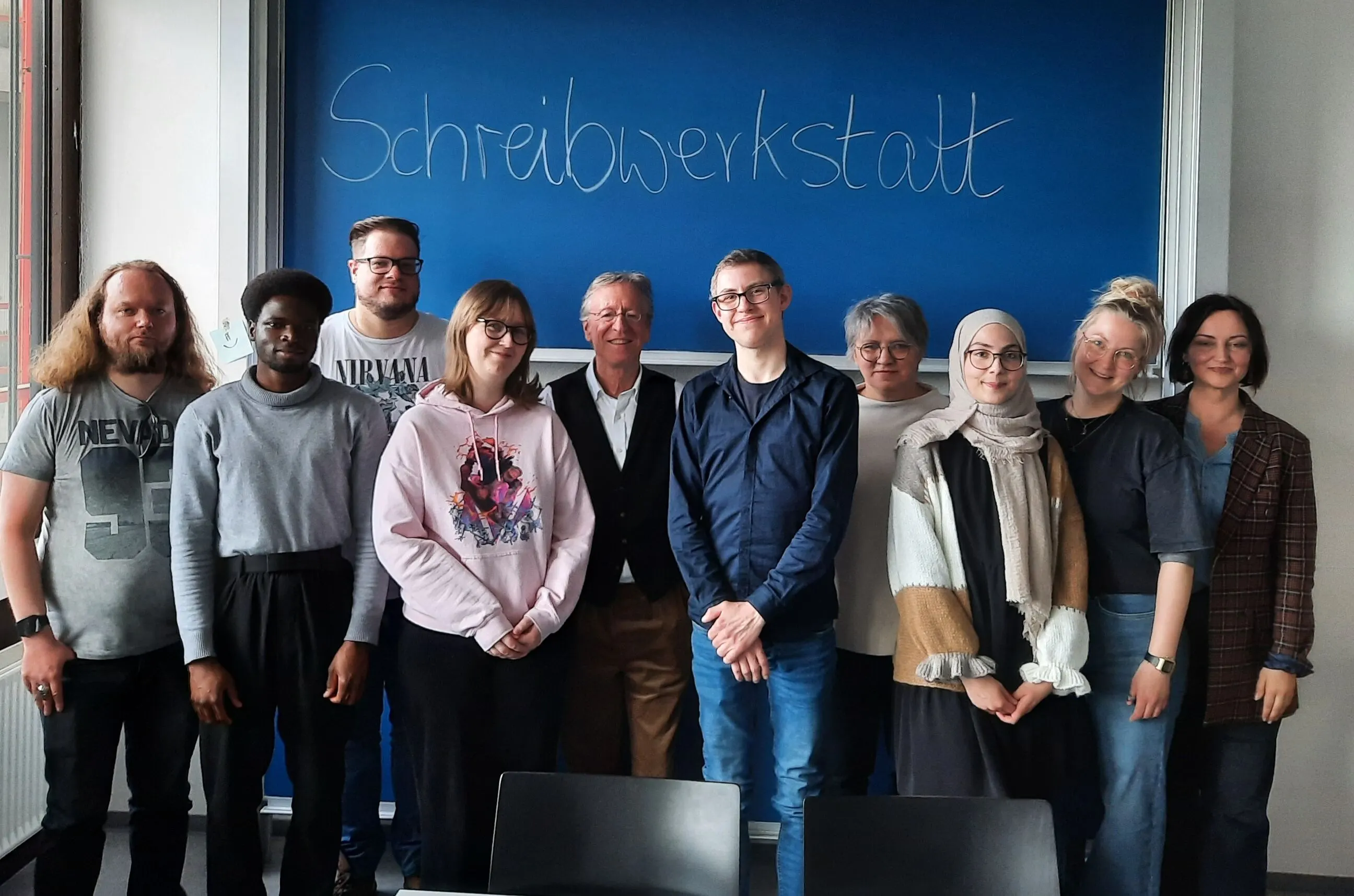
It’s the first meeting of the semester, and the seminar room is filling up. Many of the faces are familiar to Dr. Roland E. Koch. The instructor walks through the rows, chatting with students. He greets someone here, asks how someone else is doing there, and cracks a few jokes. Naturally, the conversation turns to books and authors—after all, he’s one himself. A writer and lecturer who teaches various seminars on writing, staged readings, and debating at the University of Siegen.
You quickly get the sense that students keep coming back here. Not out of obligation, but out of conviction. Even though they’re earning academic credit, a space has emerged amid prose, poetry, and wordplay that some simply call their “island” in the daily grind of college life. Because they’ve found a place where they can experiment with literature and learn to handle criticism without losing their own voice.
This summer, the writing workshop is now going public with a book: an anthology featuring texts by 24 students is being published by universi Verlag. It is a collection that shows what emerges when young authors dare to write personally and when they encounter a group that provides exactly the right space for their texts to resonate. Roland E. Koch has led the writing workshop since 2011. His stance is clear: “‘Well written’ and that’s good enough—that doesn’t get anyone anywhere.” The writing workshop isn’t about polished texts, but about those that take risks. About stories that are tangibly connected to the writers themselves.
You’ll search in vain here for fantasy epics or “new Harry Potter universes.” Instead, short stories dominate—no more than three pages long, often autofictional, and closely tied to the writers’ own lives. Themes such as family, grief, relationships, and the struggle with oneself as well as with political and social developments run throughout.
The seminar is clearly structured. One or two students read their texts aloud. The others read along—on paper—take notes, and then offer their assessment of the text. The author is then met with a wave of praise or critical comments. First, the discussion focuses on the “central theme,” the characters, the structure, and whether—and how—the text captivated the readers. Later, the group examines linguistic details with a keen eye. Whoever has read aloud must then remain silent. Which is difficult. “But they shouldn’t explain anything or defend anything; instead, they should take in what’s being said,” says Koch. The immediate feedback and the collective reflection on language, structure, and impact allow texts to grow. “We work together to make the text better.”
Sometimes tears flow, too. Not because of the criticism. That’s always constructive and appreciative. “We always talk about the text, never about the person,” the instructor emphasizes. “But writing is very emotional, and what’s read can be deeply moving.”
Since 2019, the writing workshop has regularly made its way out of the seminar room and into the public sphere, to a special location: the Museum of Contemporary Art in Siegen. Amid installations and exhibitions, students read their texts aloud, interspersed with live music.
The audience is growing steadily. It includes not only students but also people from the city—anyone with a passion for literature. The atmosphere is unique, says Koch. Perhaps because different art forms come together in the museum. Perhaps also because the texts take on a different quality in this setting.
The anthology currently in the works builds on these readings. It brings together texts by 24 authors who have already read their work at the museum. Some are represented by one piece, others by two. The cover was designed by writing workshop member Dana Kopsan. This, too, is a sign of how much the writing workshop functions as a community. The range is broad: from quiet snapshots to more experimental forms such as sound poetry. “What matters isn’t the genre, but the quality of the texts,” emphasize Ole Kemper and Sevinç Ebru Kesdiren-Aksoy, both of whom have been involved with the writing workshop for a long time and whose texts can be found in the book, along with those by: Agnes de Lucca, Alexander Mosig, Annelie Seibold, Christine Eck, Dana Kopsan, Daniel Blokesch, Johanna Brauner, Johannes Herbst, Kateryna Boiko, Kathy Subat, Lutz Dehenn, Mark Remisch, Melek Curuk, Michael Fassel, Nora Hille, Ole Kemper, Olivia Jabbour, Phillip Ahrberg, Séverin Yisharh, Badolo, Sevinç, Ebru Kesdiren-Aksoy, Susanna Mengel, Valentin Ramachandran, Victoria Neuser, and Viviane Börner.
The next reading and book presentation will take place on Thursday, July 23, at 6 p.m., at the Museum of Contemporary Art. Admission is free.


