Eugenics in Europe and North America: Definitions of the Ideal Human Being Between Fiction and Reality
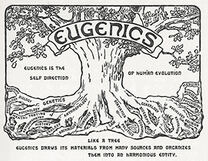
Through eugenics, Francis Galton extended the theory of evolution to another social sphere. In doing so, he drew directly on the ideas of his cousin Charles Darwin and used, above all, Darwin’s magnum opus as the basis for his own reflections. Unlike social Darwinism, which tended to focus on the “struggle” among larger human societies, eugenics focused more on the individual and his or her role within a group of people. According to the ideas of Galton and his successors, a person’s desirable and undesirable traits could be easily identified, traced back to elements of their genetic makeup, and either promoted or eliminated with the group as a whole in mind.
To achieve this, eugenics drew on certain aspects that had already characterized the somewhat earlier social Darwinism, such as the categorization of human groups, the biologization of society, and the application of eugenic findings to political and state action. Combined with the notion—which persists to some extent even today—that in every society, in every nation, or in every population group, there is something like a clearly definable gene pool that could be just as clearly developed in any desired direction, eugenics made it possible—especially at the state level—to carry out interventions that infringed upon the personal civil liberties of citizens. Among these measures, which were implemented in many countries of the Western world in the name of eugenics, was above all forced sterilization, intended to prevent the reproduction of individuals deemed genetically “defective.”
The global exchange among leading eugenicists, combined with similar fears of degeneration in many countries in Europe and North America, led to eugenics developing into a politically and socially influential discipline across nearly the entire Western Hemisphere. Whether in the United States, Canada, or social-democratically governed Sweden, laws on population policy issues shaped by eugenic ideas existed everywhere. Nazi Germany built upon very similar ideas, but in the measures it actually implemented—which included the murder of hundreds of thousands of people—it went far beyond what was carried out in other countries.
Contents of this section in the book:
- Francis Galton and the Origins of Eugenics
Nicholas Wright Gillham - Eugenics and Racial Hygiene in Europe: Definitions
of the ideal human being and attempts to implement them
Uwe Hoßfeld and Michal Šimůnek - The Eugenics Movement in the United States in the 20th Century
Aaron Gillette - Immigration and the Eugenics Debate in Canada
Łukasz Albański - “Master Race”:
Plan and Reality in the Third Reich
Amy Carney - Frankenstein Under the Swastika?
Human Breeding and Human Experimentation in the Third Reich
Richard Weikart - A Welfare State Policy?
Eugenics and Sterilization in Scandinavia in the 20th Century
Nils Roll-Hansen - A Continuation of the Eugenics Debate by Other Means?
Discourses on Population in the 20th and Early 21st Centuries
Alexander Pinwinkler
Image source: Harry H. Laughlin (ed.): The Second International Exhibition of Eugenics. Held September 22 to October 22, in Connection with the Second International Congress of Eugenics at the American Museum of Natural History, New York. An account of the organization of the exhibition, the classification of the exhibits, the list of exhibitors, and a catalog and description of the exhibits, Baltimore, MD 1923, p. 15.