(Natural) Scientists in the Public Eye
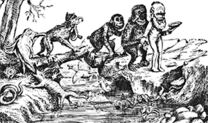
The theory of evolution is a scientific one. Its creator, Charles Darwin, gained such fame through its publication that he would go on to have a lasting impact on the public image of the scientist—who, at first, was exclusively male. Throughout the 19th century, it was initially mostly men and only a few women in science who evolved from amateur researchers into professional scientists and gradually gained social influence.
Charles Darwin was one of the few among them who quickly became truly visible to large segments of the public. People not only heard about his theory but could actually see the researcher in numerous photographs, paintings, and caricatures in various media even during his lifetime. He was the talk of the town. Thus, as early as the 19th century, Darwin became the prototype of the modern natural scientist, often visualized as an icon. The physicist Albert Einstein assumed a similar—and even greater—role in the 20th century. As with Darwin, his research touched on fundamental questions of humanity. Even more so than the biologist, Einstein deliberately sought media attention and rose to become a “superstar” of the scientific community.
Alongside such icons of research, visible to everyone, clear stereotypes of scientists—and, much less frequently, female scientists—have developed since the 19th century. These stereotypes were and are based less on personal knowledge than on attributions. Archetypes such as the absent-minded professor, the heroic researcher, or the menacing mad scientist emerged from already established images of alchemists or magicians from the premodern world. The media filled in the remaining gaps in these images with supposedly typical characteristics.
Even today, most people still picture the “scientist” as a man. Women in scientific research continue to face entrenched role stereotypes—most of which are perpetuated uncritically—and gender-based prejudices. Even in popular culture, many of these older notions persist: Who can immediately think of a well-known movie or novel featuring a successful and respected—or a mad—female scientist?
Contents of this section in the book:
- On the Creation of the Prototypical Scientist:
Portraits of Charles Darwin in the 19th century
Janet Browne - Einstein Superstar: The Scientist as a Pop Icon
Ernst Peter Fischer - Absent-Minded Scholars and Heroic Researchers:
Two Conceptions of Scientists in the 19th Century
Noyan Dinçkal - Soldering Iron and Pearl Necklace:
The Natural Sciences in the Media Then and Now
Martina Erlemann - The Rise and Fall of the Mad Scientist in Film
Roslynn Haynes - Female Scientists in Feature Films: Between Gender Stereotypes and Scientific Clichés
Eva Flicker
Image source: David Lack, *Evolution Theory and Christian Belief: The Unresolved Conflict* (London, 1957), half-title page.