Aren't I a human being, too?
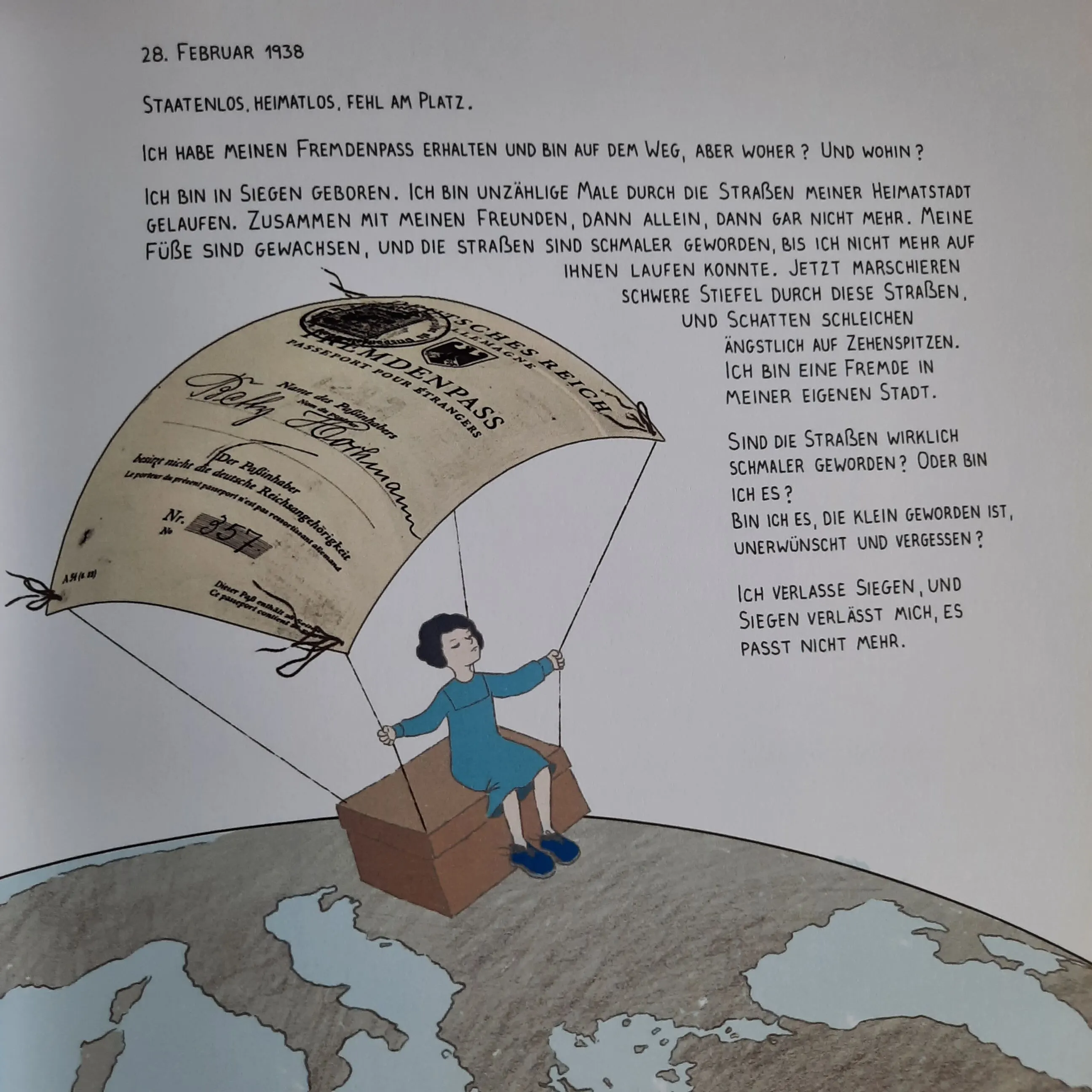
The era of eyewitnesses is coming to an end. New forms of remembrance are becoming more important. The graphic novel anthology “Am I Not Human, Too? Remembering, Telling, Experiencing,” created at the University of Siegen in cooperation with the Aktives Museum Südwestfalen, brings local stories from the Nazi era to life through comics.
“Am I Not a Human Being, Too?” recounts specific, local stories from the Nazi era. Is this regional focus key to making memory tangible for young people?
STEIN: That was, at least, the basic idea behind the anthology. We wanted to translate some of the life stories that the Active Museum of South Westphalia had researched and documented into a medium that would offer young readers—as well as anyone open to graphic storytelling—a new perspective on the history of the city and the region. The fact that many of the places featured in the book still exist today underscores that history is not a closed chapter but continues to have an impact. But it must be remembered; otherwise, it will fade into oblivion. In the cityscape, Stolpersteine and the buildings in front of which they lie, as well as museums and memorials, fulfill this function. But the life stories and the people behind them—and this was important to us—can be experienced in an entirely new way through the graphic narratives.
ASPELMEIER: The fact that these people and their journeys are relatable within the familiar everyday world of young people is the key to bridging the sometimes vast distance to the general history of National Socialism —only when a person with a name has walked the very same streets that I walk every day does it become interesting and also provocative to grapple with the perpetrators and victims. Historical sites, remnants, and ruins only function as memorials through such a heightened awareness of the issues.
What age group is the book suitable for?
MIKOTA: Due to the difficult and complex subject matter and the fact that some of the people profiled did not survive the Holocaust, the book is intended for readers ages 12 and up. However, it is not conceived solely as a book for young people, but is intended to appeal to anyone interested—adults and teenagers alike. We place particular importance on the dialogue between generations, each of which represents different phases of remembrance culture and has different perspectives on the Nazi era. The book is intended to foster this dialogue. Two of the stories—Inbal Leitner’s “Mein Weg, meine Schritte” (“My Path, My Steps”) about the Jewish girl Betty Hochmann, who manages to flee to what was then Palestine and survives, and Stephanie Lunkewitz’s story about the Siegen synagogue—are also suitable for younger readers in the 3rd or 4th grade and up.
Has there been any feedback yet?
STEIN: Yes, we’ve received initial feedback from teachers, though not yet from actual classroom use, since the book has only just been published. Some teachers have looked at the proof copy we prepared for the book launch at the Aktives Museum Südwestfalen and have responded extremely positively.
ASPELMEIER: We believe that, through its local focus, the book brings regional history to life against the backdrop of major historical developments, making it very well-suited for use in schools and other learning contexts. Its format as an anthology of illustrated short stories with accompanying historical, biographical, and educational texts was also considered particularly valuable by the teachers who have seen it.
MIKOTA: We’re hearing the same thing from students. They see it as an opportunity to engage with the region’s history and thereby gain a better understanding of the Holocaust in their local area. And student teachers, in particular, recognize that the anthology offers many opportunities to spark conversations with their future students. The fact that renowned artists such as Inbal Leitner, Marion Goedelt, Stephanie Lunkewitz, Lisa Rock, and Bianca Schaalburg illustrate the stories is something very special for many readers (and for us as well).
ASPELMEIER: We’ve also received encouragement from the residents of Siegen and, above all, from the dedicated members of the Active Museum of South Westphalia (Traute Fries, Hans-Georg Fries, Peer Ball, Dieter Pfau), who supported us as historical experts.
Was there a response beyond Siegen?
MIKOTA: There has already been a response beyond the region. For example, the anthology was presented at the Leipzig Book Fair in collaboration with Ariella Verlag, led by Myriam Halberstam, and a reading is planned at the Berlin State Library. Several colleagues from Germany and abroad to whom we’ve presented the book also view it as an important contribution to the culture of remembrance. We will expand these activities in the coming months, including through lectures at universities and readings, as well as research articles related to the book and the creation of supplementary materials for schools. We want the stories to reach all students in the region and many more beyond the Siegerland.
Will the book be discussed in university seminars?
MIKOTA: Definitely. We’ve already incorporated it into our work; for example, Marion Goedelt participated in a master’s seminar on Shoah comics and spoke with the students there about her work; Inbal Leitner led a creative workshop with students; Stephanie Lunkewitz and Bianca Schaalburg read from their earlier publications. Our anthology will become an integral part of teacher-training programs and will also be used in courses.
The University of Siegen, the Active Museum, people from Siegen, and international artists were brought together by the book. What was special about this collaboration, and will there be further projects?
STEIN: From our perspective, what made it special was precisely this collaborative project, in which different groups of people with their respective areas of expertise came together: research and teaching from the university, historical and personal commitment from the Aktives Museum, and the illustrators’ artistic and creative perspective on the city and region. It was highly complex and not always without conflict, especially since it was a major priority for everyone involved to meet the many demands placed on such a publication.
ASPELMEIER: Another unique aspect is that the life stories of the people portrayed—Betty Hochmann, Inge Frank, Otto Päulgen, Zina, Simon, and Johanna Grünewald—appear in graphic form for the first time in this publication and take on entirely new dimensions through the various drawing styles and image arrangements. Incidentally, the book’s diverse content effectively reflects the project’s multi-perspective nature.
MIKOTA: There will certainly be further projects. We want to develop additional educational materials for using the anthology in schools. And we have just founded the Center for Pictorial Holocaust Narratives together with Tatia Gruenbaum and Carmen Becker from the Technical University of Braunschweig, which will provide further opportunities for projects, publications, and events.
(This interview appeared in the university newspaper *Querschnitt* 2/2026)
---------


