Elinor Ostrom Prize Awarded to Dr. Steffen Lange
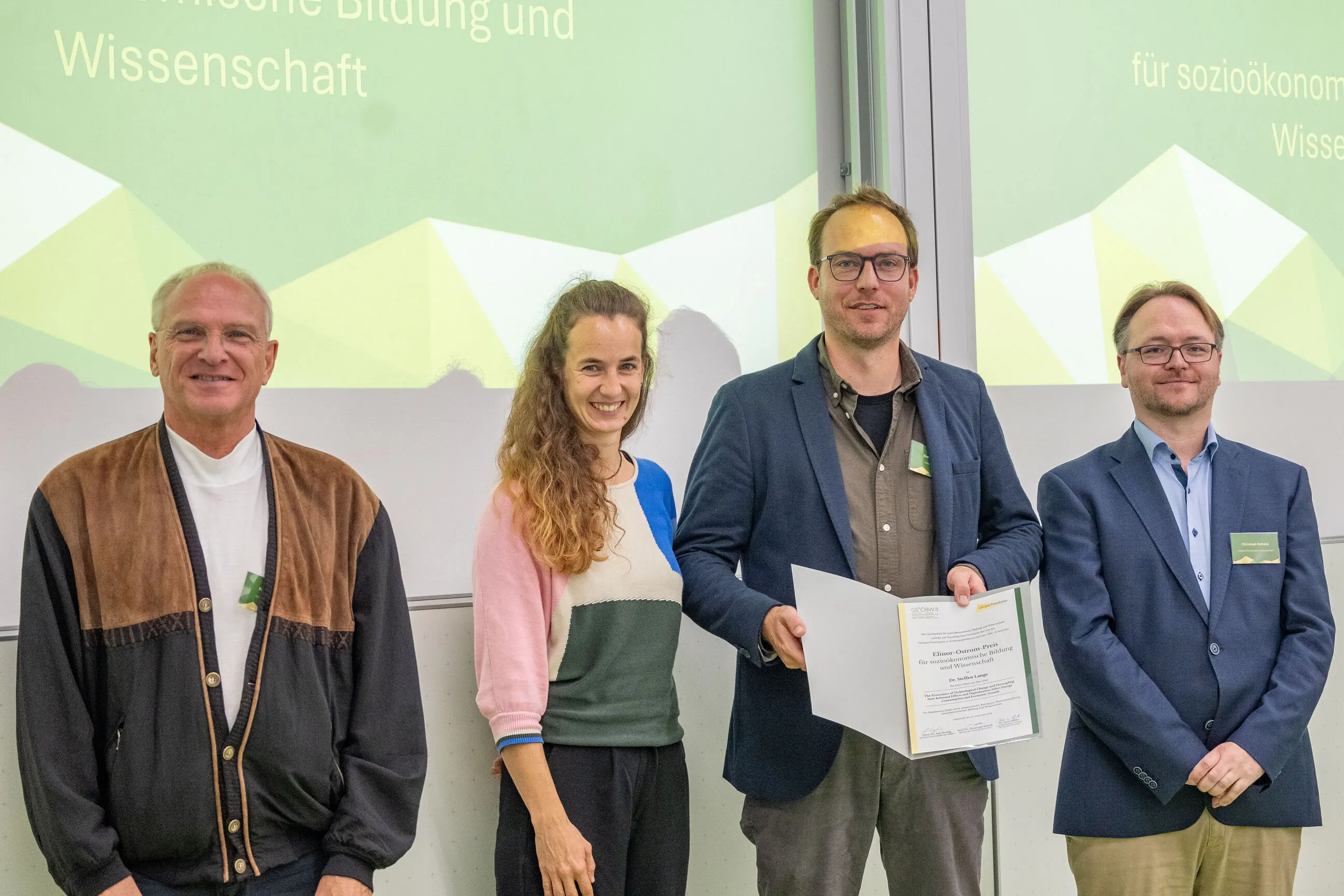
Dr. Steffen Lange has been awarded the Elinor Ostrom Prize for his habilitation thesis, “The Economics of Technological Change and Decoupling: How Rebound Effects and Digitalization Affect Energy Consumption and Economic Growth.” With this award, the Society for Socioeconomic Education and Science (GSÖBW) recognizes his scholarly work on technological change, digitalization, energy consumption, and economic growth.
In his habilitation thesis, Lange examines whether technological progress and digitalization can actually help decouple economic growth from energy consumption and environmental impacts.
It has long been known that so-called rebound effects negate some of the hoped-for energy savings achieved through more efficient technologies. This also applies to digital technologies.
Therefore, digitalization is not automatically “green.” While it can make processes more efficient, it simultaneously creates new devices, applications, business models, and consumption opportunities—and thus also new energy and resource consumption.
Steffen Lange devotes particular attention to these “induction effects” in his research. New technologies not only trigger rebound effects but also open up new consumption options that drive energy consumption skyward. Consequently, the efficiency gains of new technologies are always linked to economically growth that is ecologically harmful. This makes it more difficult to decouple growth from energy consumption and ultimately suggests the need for a non-growing economy.
“Technology is an important part of the transformation, but it doesn’t operate in a vacuum,” Lange emphasizes. What matters is how it is shaped economically, politically, and socially. “For me, the best thing about the award is that it sparks discussions about whether digitalization and artificial intelligence truly advance climate protection,” says the scholar. In the “Plural and Transformative Economics” program at the University of Siegen, he teaches plural economic theories and concepts for a digital and sustainable transformation of the economy.
The Elinor Ostrom Prize is awarded by the GSÖBW for outstanding undergraduate theses and dissertations dedicated to interdisciplinary and intradisciplinary approaches in socio-economic education and scholarship. Consideration is given to works that make a groundbreaking contribution to the thematic, methodological, paradigmatic, or didactic development of socio-economic education and scholarship.
The Canopus Foundation, based in Freiburg, has been the sponsor of the award since 2018.


