Patented Hydrogel: New Approach to Safe Dressing of Wounds

The skin is the largest human organ. When it is damaged, bacteria can penetrate into the body through wounds, potentially leading to life-threatening infections. To improve the healing of wounds and avoid bacterial infections, chemists at the University of Siegen and Amsterdam University Medical Center have developed an innovative, therapeutic hydrogel for dressing wounds. It protects the injury site, supports healing, and effectively fights infections — including those caused by multidrug-resistant bacteria. The researchers have already patented their invention, although additional research and development work is needed before it can be launched onto the market.
The project work was conducted by Muhammad Atif, who studied chemistry in Pakistan and China and who came to the University of Siegen through the EU’s “STIMULUS” program. “STIMULUS” is a Marie Skłodowska-Curie Action for early-career researchers, aimed at the development of intelligent wound dressings to fight infections. “I’m very happy that I was accepted into the program and had the opportunity to develop the hydrogel together with colleagues. The fact that this has resulted in a patent is, of course, also a wonderful success,” says Atif, who has just completed his doctoral thesis on the innovation.
In the lab of the Macromolecular Chemistry department at the University of Siegen, the Pakistani-born chemist developed a method of producing polymers — macromolecules consisting of repeating units — and subsequently linking them by irradiation with light: first into chains and then into three-dimensional networks. When they are swollen with water, a hydrogel is created. “A hydrogel is a solid body that nevertheless contains a great deal of water — its consistency can be compared to gelatin,” says Prof. Dr. Ulrich Jonas, who is supervising Atif's doctoral thesis. The key innovation was to embed a special antimicrobial protein into the hydrogel, thus preventing wounds from getting infected.
The expertise regarding the protein came courtesy of the research group under Prof. Dr. Sebastian Zaat at Amsterdam University Medical Center, where Muhammad Atif spent several months researching as part of the program. “The biggest benefit of this protein is that no resistance to it has been reported to date, unlike with many of the antibiotics used until now to prevent and treat infections,” Atif explains. The protein is firmly anchored in the hydrogel and does not enter patients’ bodies. It acts directly on the surface of the gel like a “contact poison,” rendering harmless any bacteria that come into contact with it.

Another plus for the novel hydrogel in Prof. Jonas’ view is its tissue-like structure: “In appropriately designed wound dressings, the hydrogel can swell in the aqueous wound environment without sticking to the skin. That allows the wound to heal better.” The hydrogel is also breathable and wicks away wound fluid. This eliminates the need for frequent bandage changes, a major cause of wounds re-opening. The developers also point to the option to integrate a color indicator into the hydrogel to provide an early warning if dangerous bacteria are present in the wound.
More research is required before the hydrogel can be used in medical applications, including identifying ways to incorporate the hydrogel into dressings, which will require technical development together with industry partners. In addition, processes must be identified for large-scale production of the hydrogel and embedded protein, explains Prof. Jonas. And, of course, its compatibility with the human body must be scientifically proven.
Muhammad Atif and Prof. Jonas see major potential in their development: “Antibiotic resistance is growing around the world, yet at the same time, a growing number of people are suffering from chronic wounds, for example as a result of diabetes. According to forecasts, infections caused by antibiotic-resistant microorganisms could overtake cancer as the leading cause of death as early as 2050. Innovations such as the newly developed hydrogel are thus urgently required.”
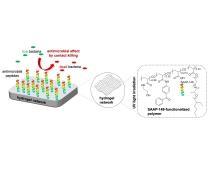
Schematic depiction of an antimicrobial hydrogel with covalently embedded peptides (such as SAAP-148), which kill bacteria immediately upon contact. The UV-crosslinked, water-rich hydrogel is suitable as a wound dressing for effective infection prevention.
This research has been published in the following sources:
1. Atif, Muhammad, et al. "Antimicrobial peptide SAAP‐148‐functionalized hydrogels from photocrosslinkable polymers with broad antibacterial activity." Macromolecular Rapid Communications 45.24 (2024): 2400785; https://doi.org/10.1002/marc.202400785
2. Atif, Muhammad, et al. "Dye-integrated photocrosslinkable polymers and networks for the visual chromogenic detection of a bacterial enzyme." Materials Advances 6.17 (2025): 6109-6121; https://doi.org/10.1039/d5ma00580a
3. Atif, Muhammad, et al. "Chromogenic and Antimicrobial Peptide-Functionalized Polyacrylamide Systems for Proof-of-Concept Detection and Treatment of Bacteria”. (published) Mater. Adv. 7.17 (2026): 8749-8759; https://doi.org/10.1039/d6ma00487c
4. Atif, Muhammad, et al. “Modified polymer-based hydrogels for autonomous detection and treatment of Escherichia Coli.” EP Patent (2024) (Application number: EP 24 210 082.4)
STIMULUS is a European training network established within the framework of the Marie Skłodowska-Curie Actions, itself part of the EU's “Horizon 2020“ program. It allowed the participating early-career researchers to engage in unique training in various disciplines — including stays at partner universities and research institutions. For more information, please visit: https://www.stimulus-etn.eu/
The researchers are supported during the patent application process and in their search for industrial partners for follow-on development by PROvendis GmbH — a central service provider for science and technology transfer in NRW.