Safety begins before anything happens

Threats, physical assaults, or other critical situations are among the challenges that public service employees may face. This happens wherever people work, learn, or seek help: in city halls, schools, colleges, hospitals, or simply in broad daylight in a pedestrian zone. At the#sicherimDienst#sicherinSiegen symposium, therefore, the discussion focused not only on safety concepts but also on how such experiences affect those involved and how institutions can address them. Over 40 participants gathered at the Unteres Schloss campus to exchange ideas on the topic.
The University of Siegen recently joined the NRW-wide network “#sicher im Dienst.” The campaign by the state of North Rhine-Westphalia is part of the initiative “Greater Protection and Safety for Public Service Employees.” More than 850 organizations are now part of the network. They share experiences and continue to develop preventive measures.
The symposium opened with a welcome address by Iris Litty, Chancellor of the University of Siegen. Together with the organizing team from the University of Siegen’s Executive Department for Occupational Safety, Health Protection, and Campus Security, she expressed her delight at the positive response to the event.
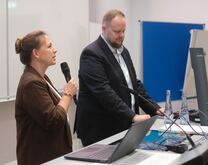
The symposium’s program demonstrated just how varied the requirements can be. Topics included the work of the Social Psychiatric Service in crisis situations, emergency and crisis management, de-escalation techniques, and the question of what structures are needed for an effective violence prevention strategy.
“Incidents of violence occur in all service sectors: in government offices, schools, universities, and hospitals. We must adapt safety concepts and procedures, which is why networking is so important,” said Anne Herr from the prevention network“#sicherimDienst.”
New forms of violence were also discussed. Digital violence is already a problem in some institutions, while others have little experience with it yet. “But it will certainly be an issue for some of you in the future,” said Anne Herr. She added that networking can be particularly helpful in preparing for situations that may become more prevalent in everyday work in the future.
For Maximilian Faßbender, team leader in the Campus Security Department at the University of Siegen, it is important that those affected know where to turn for help. “We see ourselves as a service center and want to reduce stress and anxiety.” The topics of safety and protection against violence must therefore be addressed more visibly and openly. “We want no one to be afraid to come forward if they feel unsafe or threatened in a situation.” When it comes to safety, it’s not just about technical equipment, structural requirements, or campus regulations. The people who come to the university and their respective life situations must be taken into account.
In the workshops on emergency and crisis management, protection against violence, and de-escalation techniques, the participants worked through specific issues themselves. Boglarka Beyer-Rickes, the contact person for protection against violence at the University of Siegen and, together with Maximilian Faßbender, an organizer of the conference, viewed this as a major benefit: “The first Regional Symposium was a complete success. The workshop format gave participants the direct opportunity to reflect on their own needs and incorporate valuable new insights.” The discussions have already led to requests for further training and collaborations.
The “Seek and Find” exchange ultimately demonstrated just how great the need for such interaction is. Contacts and services were shared on the bulletin board, including police counseling, victim protection, prevention, dealing with mental health issues, and conflict resolution. The issue of violence against teachers was also addressed.
For the University of Siegen, the symposium marks the start of stronger networking in the region. Beyond concrete measures, the focus was on a shared stance: Unsafe or threatening situations must be taken seriously, and employees should know that they will not be left to deal with them alone.


