The Early Evolution of Humans: Scientific Debate and Popular Accounts (1859–1900)
The question of the origin of all life on Earth is probably as old as humanity itself. While mythical and religious concepts once offered simple answers, increasingly complex scientific explanations—based on observation and analysis rather than mere faith—began to gain acceptance starting in the late 18th century. Among the most important of these scientific theories in the modern sense is the theory of evolution by natural selection, presented by Charles Darwin in 1859, which was soon discussed as the “evolution controversy” not only in scientific circles but also among an increasingly broad public.
Darwin’s theory by no means emerged in a vacuum. Important foundational concepts, such as the great age of the Earth, had already been established in the decades leading up to Darwin’s most significant publication. Furthermore, Darwin spent about two decades afterward gathering as much clear evidence as possible to support his theory—whether out of scientific rigor alone or to better counter public criticism of his theses. For Darwin was well aware that his theory would provoke questions and criticism from many quarters. This resistance came not only from the church but also from the scientific community, as various theories existed in the mid-19th century regarding the fascinating question of how life on Earth might have evolved.
Outside the realm of pure science, the pros and cons of Darwin’s theory of evolution were debated primarily in the media. Above all, the then-still-relatively-new technology of photography played a crucial role as a means of supposedly incorruptible documentation, helping to support the theory with visual evidence—a tool Darwin himself made particular use of, especially in his work on the emotions of humans and animals.
In addition to photography, all other forms of visualization were also an essential pillar in the widespread dissemination of Darwin’s theory. Physical reenactments were also used, such as in depictions of early humans. These were presented to an astonished public in the form of remains—such as bone fossils—or tools, as well as reconstructions based on the findings. Some images of the “wild man” persist to this day. In the 19th century, such views—as well as information about evolution—were further reinforced by the exhibition of people from overseas in zoological gardens across Europe and North America and their portrayal as the missing link in human evolutionary history.
Contents of this section in the book:
- Changing Concepts of Evolution: Debates in the Pre-Darwinian Era
Marianne Klemun - Darwin’s “Journey to Insight” and the Origin of a Debate
Matthias Glaubrecht - Evolution: A Public Controversy Since 1859
Peter J. Bowler - Darwin and Photography: Influences on Visual Culture
Monika Pietrzak-Franger - Darwinism as a Battle of All Against All?
The Origin and Consequences of a Misunderstanding
Dirk Solies - Evolution at the Zoo: Illustrating a Theory Through Living Organisms
Rebecca Bishop - The Early Evolution of Humans: Scientific Debate and
Popular Representations (1859–1900)
Chris Manias - Of Wild Men and Women: Reconstructions of
prehistoric humans in museums
Bärbel Auffermann and Gerd-Christian Weniger
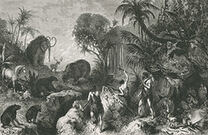
Image source: Louis Figuier: *La Terre avant le Déluge*, 5th edition, Paris 1866, p. 427.