53 Years at the University of Siegen

With one hand, Bernd Dreseler traces a coordinate system in the air, explaining points and curves. “Isn’t that wonderful?” he asks with a smile. For a moment, it seems as though the mathematics professor is back in the lecture hall once more. His enthusiasm for his field remains even now, as he finally bids farewell to teaching after more than fifty years at the University of Siegen.
He’s clearing out his office in the tower on the Emmy Noether Campus and admits that he’s feeling a bit melancholy right now. Such a long time, so many people, so many stories.
When Dreseler arrived in Siegen in 1973, the mathematics program was still in its infancy. “The first course was Analysis I in the winter semester of 1973,” Dreseler recalls. “Our study group was housed in a former classroom on the Paul-Bonatz Campus.”
Dreseler witnessed the establishment of the department and the transformation of what was then a comprehensive university into a research university, with which he remains connected to this day. Even after his official retirement in 2008, he continued to teach as an adjunct professor. His areas of expertise are applied analysis and harmonic analysis.
It was by no means a given that he would one day become a researcher. Having grown up in Wuppertal, his original goal was to become a teacher. After studying mathematics and physics, he transferred to the Diplom program at Ruhr University Bochum, where he got his first taste of academic life as a student assistant. This was followed by stints in Mannheim, where he earned his doctorate in 1972, and Bochum, before his path finally led him to Siegen, where he completed his habilitation in 1977. “A career in academia was long beyond my wildest imagination,” he says. “I come from a down-to-earth family, so that wasn’t a foregone conclusion.”
However, his professional path didn’t just evolve in his field of expertise. In the early 1980s, Dreseler completed training as a telephone counselor. “That awakened a whole different side of me,” Dreseler says thoughtfully. Later, he completed training in Theme-Centered Interaction (TZI), earning his diploma in 1992. Together with the alumni association, he developed the “Get Fit for Leadership” workshop series on personal development and leadership skills. For him, mathematics, communication, and social skills were never separate worlds. “If I want to connect well with others, I have to be in touch with myself,” he says.
This attitude has also shaped his lectures over the decades. Technically speaking, a lot has changed. “But I’ve never had a problem with that,” says the professor. Laptops and digital materials are second nature to him. Yet, time and again, taking the chalk in hand remains indispensable to him. “Mathematics that flows through a living person is different from the kind you just read about.” A little entertainment is part of it. Dreseler smiles and recounts that, while erasing the board during his lectures, he would occasionally play music by Eric Clapton and others. And sometimes he’s also used chess as a gateway to the world of mathematical structures. His goal has always been to strike a good balance between the topic at hand, group interaction, and the development of each individual student.
Dreseler views the influence of artificial intelligence on learning with concern. It’s not the technology itself that gives him pause, but the danger that students will outsource their own thinking. “Sell your product,” he would sometimes call out to students who were working through problems without paying attention to the group. After all, it’s not just about copying down a solution, but about communicating it in a way that others can understand.
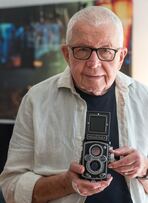
For the future, Dreseler hopes for one thing above all: that mathematics at the University of Siegen remains a vibrant and strong discipline. And his own future? It looks like he’ll have a full schedule. He’s looking forward to spending more time on his second passion: photography. His goal: “I want to continue to stay in close contact with people of all ages.”


