Dementia Advisory Boards Receive an Award
Award for Human Rights and Ethics in Medicine for Older Adults
Date: July 17, 2026
On July 17, 2026, Celina Sander and Stefanie Kremer were awarded the Josef and Luise Kraft Foundation’s Prize for Human Rights and Ethics in Geriatric Medicine in recognition of their work with dementia advisory boards. The award recognizes projects in practice and applied research that strengthen the human rights of older adults.
During a formal ceremony at the Catholic Foundation University of Munich, Celina Sander, a research associate at the Chair of Psychological Aging Research at the University of Siegen, accepted the award on behalf of the recipients.
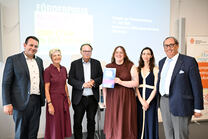
The Josef and Luise Kraft Foundation is committed to promoting the human rights, social participation, and quality of life of older adults. With its annual award, the foundation honors individuals, organizations, and initiatives that advocate, for example, for social inclusion and participation, access to health care, or the elimination of age discrimination. The award committee consists of representatives from the foundation, the German Institute for Human Rights in Berlin, the research group “Human Rights and Ethics in Medicine for Older Adults” at Friedrich-Alexander University Erlangen-Nuremberg, and the Catholic University of Applied Sciences in Munich.
The Dementia Advisory Boards and Their Work
The award was presented to the dementia advisory boards of the Chair of Psychological Research on Aging at the University of Siegen and the Alzheimer’s Association of Siegen-Wittgenstein. They provide people with dementia, as well as their caregivers and loved ones, with a framework to actively contribute their experiences and perspectives to research and care. A central idea lies at the heart of this approach: research should not merely discuss people with dementia and their family members and caregivers, but should be shaped in collaboration with them.
The Dementia Advisory Boards emerged from the PsychPart and PsychPart 2 projects, which investigated how the participation of people with dementia and their family members and caregivers in research projects can be facilitated and made sustainable. Research was also conducted on the impact of this participatory research format on psychological variables such as self-efficacy and life satisfaction. Through the Dementia Advisory Boards, this participatory approach is being continued and firmly anchored as a permanent structure within the research work of the Center for Psychological Research on Aging.
By recognizing people with dementia and their caregivers and loved ones as active contributors to research and care, the Dementia Advisory Boards make an important contribution to the promotion of human rights. In particular, they strengthen the right to participation and self-determination: Their experiences and perspectives are incorporated into the development and implementation of scientific projects and help ensure that research questions and care services are more closely aligned with the actual needs of the target group.
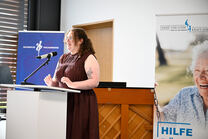
The work of the dementia advisory boards also highlights the valuable perspectives that people with dementia can bring to society and science. At the award ceremony, Celina Sander reported: “In the new edition of the guide *Communication with Dementia* [ 1], an advisory board member wrote: ‘Dementia is not a flaw to be ashamed of. Rather, dementia is a different perspective.’ We want to not only incorporate this perspective into our work but also highlight it in public discourse. We are therefore all the more delighted to receive this award. It serves as a tribute to all members of our dementia advisory boards, who make an important contribution to research and care through their experiences.”
[1] Haberstroh, J., Pantel, J., & Neumeyer, K. (2026). Communication in Dementia: A Guide for Family Members and Caregivers. Springer. https://doi.org/10.1007/978-3-662-72305-0
