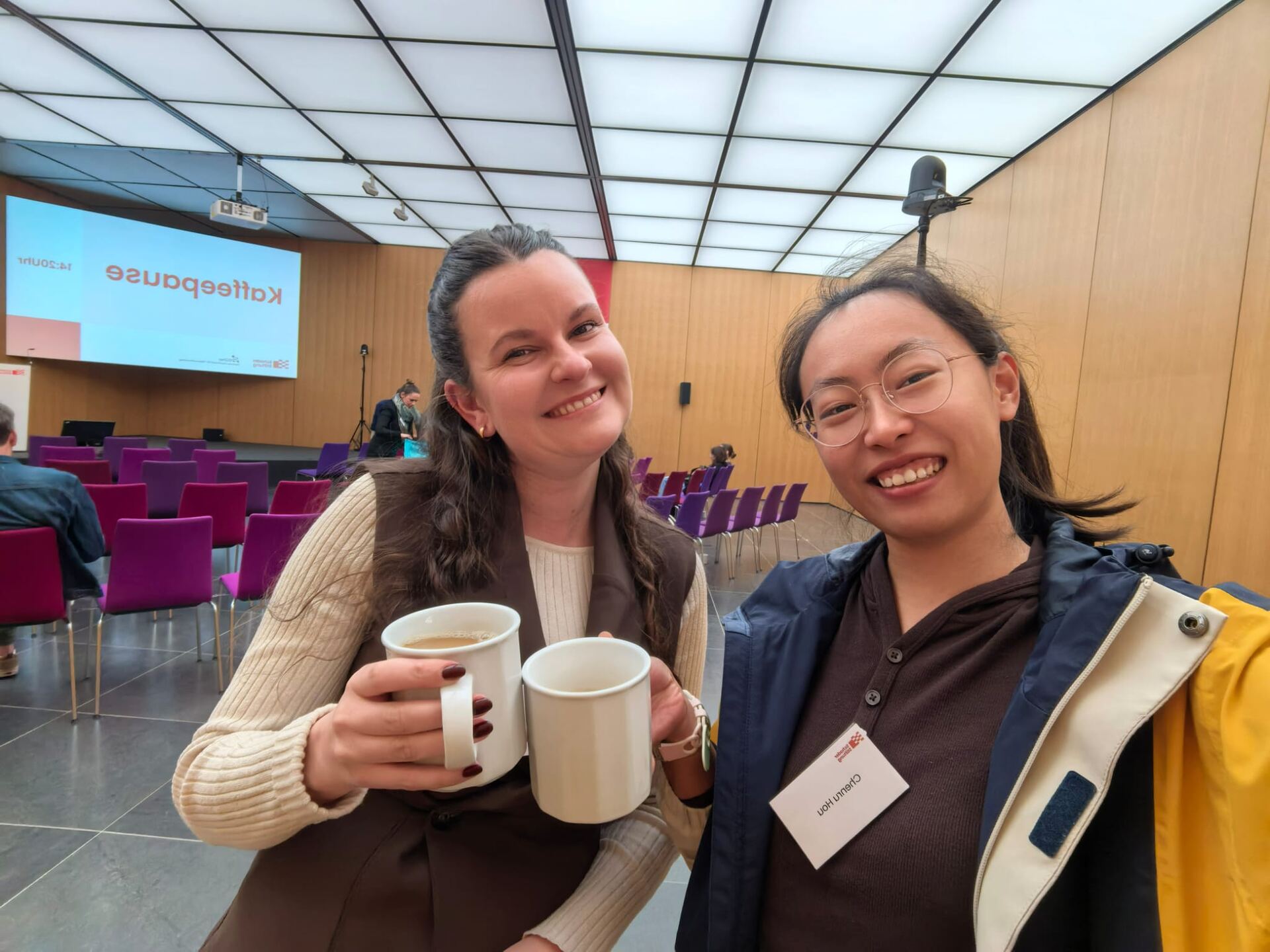
On October 22 and 23, 2026, the 11th Congress of the German Society for Network Research (DGNet) took place on the Schader Campus in Darmstadt in cooperation with the Schader Foundation. Under the title “Connected Worlds: How Networks Shape Research, Society, and Democracy,” researchers and practitioners from various disciplines discussed the significance of networks for social developments, democratic processes, and institutional cooperation.
Chenru Hou from Friedrich-Alexander University Erlangen-Nuremberg (Nina Bremm’s Chair) and Marion Schwehr from the University of Siegen (Kathrin Racheräumer’s team) presented a joint paper. In their presentation “Who Really Coordinates Decentralized Governance? Multiplex Relationships, Influence, and Brokerage in German Education Governance Networks,” they examined how coordination and influence are distributed within decentralized education governance networks.
The results illustrate that decentralization cannot be assessed solely on the basis of network structure; rather, the functional distribution of coordination tasks must also be taken into account. Even in broadly structured networks, coordination work is often concentrated in the relationships of central actors. The analysis of multiplex relationships reveals the extent to which different governance functions are bundled within individual relationships. At the same time, the respective functional shares indicate whether this bundling is attributable to specific areas of responsibility or to a cross-cutting portfolio of tasks.
In addition to the academic presentations, the conference offered a wide range of opportunities for interdisciplinary exchange. Particularly enriching was the opportunity for students to present their own research, including bachelor’s and master’s theses in the field of network research. This underscored the conference’s importance as a forum that brings together established researchers and emerging scholars and opens up new perspectives on the analysis and shaping of networked societies.