Recap of the "20 Years of the Master's Program in Urban Planning in North Rhine-Westphalia" Conference
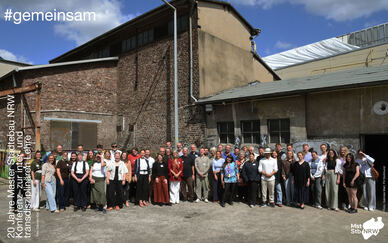
For two days, people from the fields of teaching, academia, and urban planning practice gathered at the Osthof in Cologne-Kalk to discuss the future of urban planning education. The inspiring venue provided the setting for an open and respectful dialogue in which different perspectives were brought into relation with one another and shared understandings were developed.
The first day of the conference was shaped by four key themes: the common good (Johanna Debik), urban practice (Ivana Rohr), the Anthropocene (Laura Veronese), and co-creation (Verena Schmidt). Through these discussions, several central ideas emerged:
From Object to Process.
From hierarchy to co-creation.
From building to making an impact.
From the illusion of control to a culture of learning from mistakes.
Urban planning is thus expanding its self-conception: in addition to design, it now encompasses initiating, facilitating, and supporting processes of transformation. Spatial quality emerges from the interplay of design, cooperation, and shared responsibility.
Kaye Geipel summed up this discussion: The different perspectives can serve as the foundation for a socio-ecological theory of urban planning.
A particularly enriching addition was the impromptu visit by Anaclaudia Rossbach, Executive Director of UN-Habitat and Under-Secretary-General of the United Nations. With her global perspective on urban planning, urban transformation, and sustainable housing, she added an important international dimension to the discussion.
On the second day, four perspectives enriched the debate: the students (Simon Hoffmann, Lea Hecker, and Greta Gaßner), graduate Montana Schulze, the pedagogical perspective of Maren Harnack (Frankfurt University of Applied Sciences), and the practical perspective of Stefan Hartlock. Together, they articulated the vision for education that is open, global, context-specific, participatory, critical, process-oriented, and continues to be formative.
Perhaps this was the most important insight from the conference: If our greatest crisis is indeed a crisis of imagination, then overcoming it requires, above all, relationship-building. For imagination arises where people design together, discuss, learn from one another, and take responsibility. This is precisely where the future of urban planning lies.
We would like to extend our heartfelt thanks to the entire team of the Master’s program in Urban Planning NRW—especially Andreas Fritzen (Bochum University of Applied Sciences), Martin Hölscher (THOWL Detmold), Sarah Jarosch (Cologne University of Applied Sciences), Christian Moczala (Dortmund University of Applied Sciences), Sabine Tastel, Yasemin Utku (both from the Technical University of Cologne), and Hilde Schröteler-von Brandt for their outstanding organization and the many inspiring conversations.
#LearningFromNRW #MasterUrbanPlanningNRW #UrbanPlanning #UrbanDesign #Teaching #Transformation #CommonGood #CoCreation #Anthropocene


