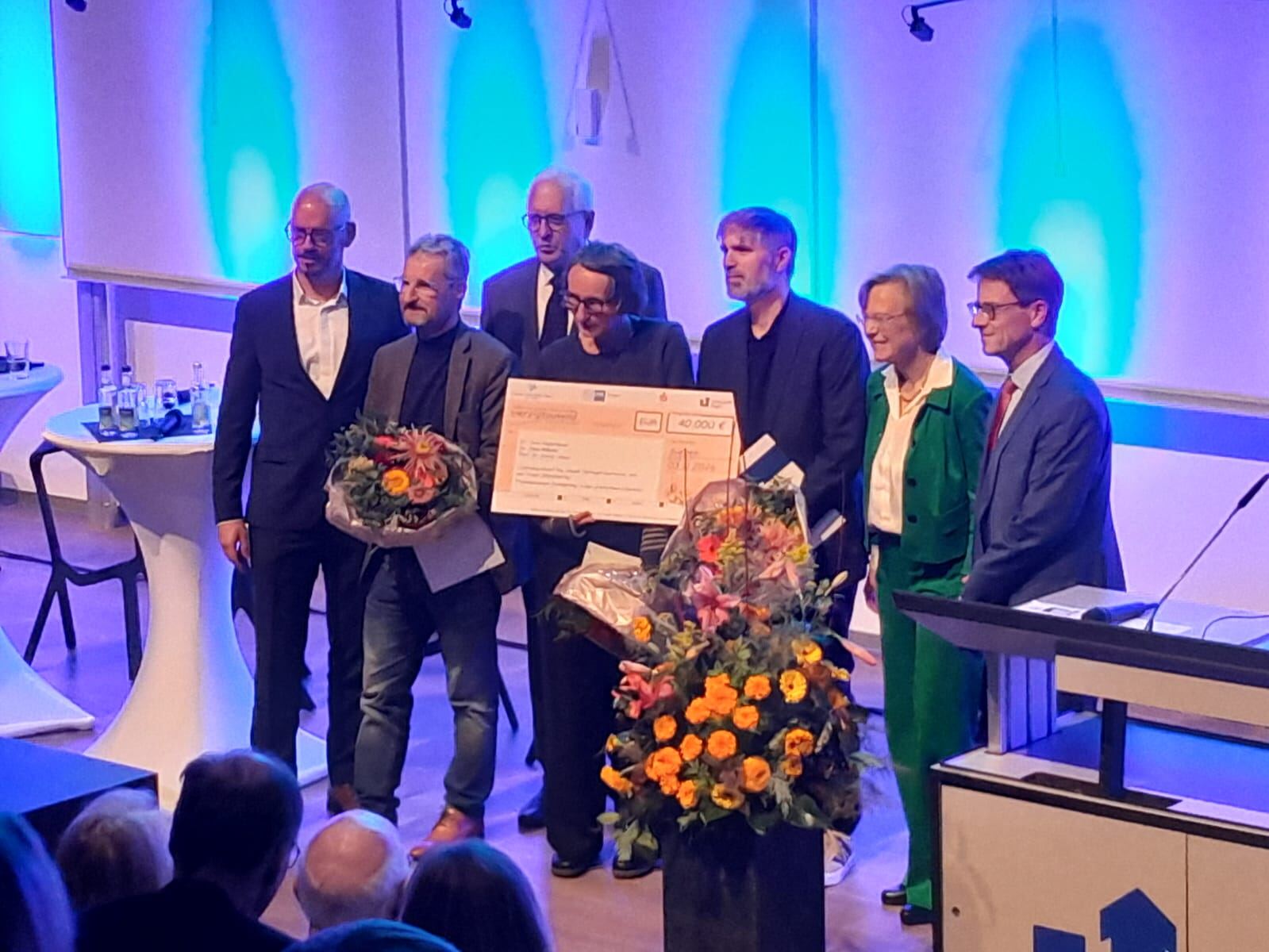
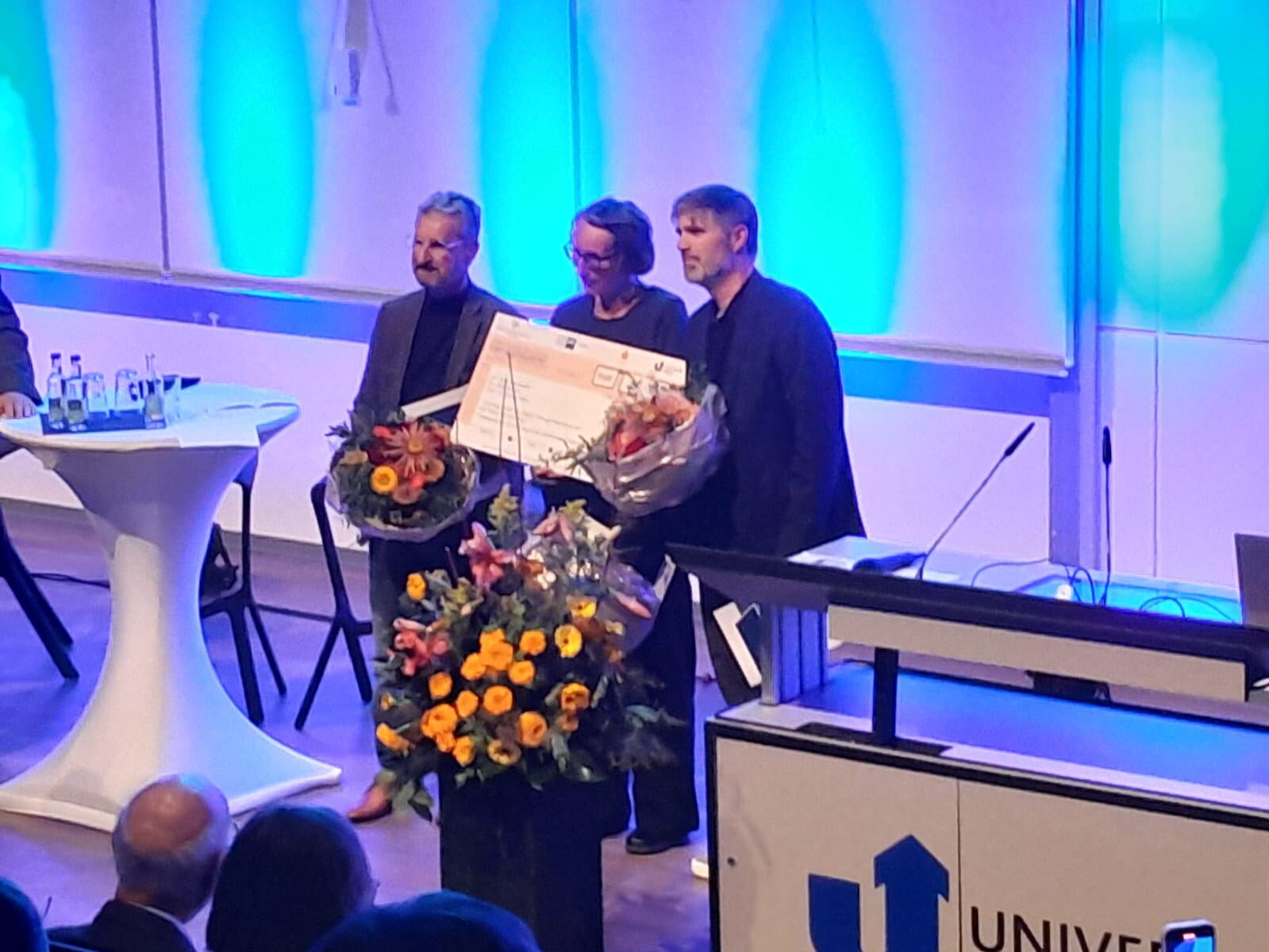
The project “Learning about the Shoah Through Narrative Art and Visual Storytelling” was awarded the “Siegen Science and Innovation Prize”!

The “Siegen Science and Innovation Award” was presented for the first time this year. This award recognizes outstanding scientific achievements and innovative developments in the business sector that are closely tied to the city of Siegen and the surrounding region and have a lasting impact there. The focus is on projects and research that address regional issues and develop solutions to current societal challenges.
The prize, endowed with 40,000 euros, was established by the Christa and Dieter Lange Foundation, Sparkasse Siegen, the Siegen Chamber of Industry and Commerce, and the University of Siegen. Representatives from these four institutions jointly form the jury. In selecting the award recipients, special emphasis is placed on interdisciplinary collaboration and innovative approaches that provide new impetus and create forward-looking perspectives for the region.
(Siegen Science and Innovation Award 2026)
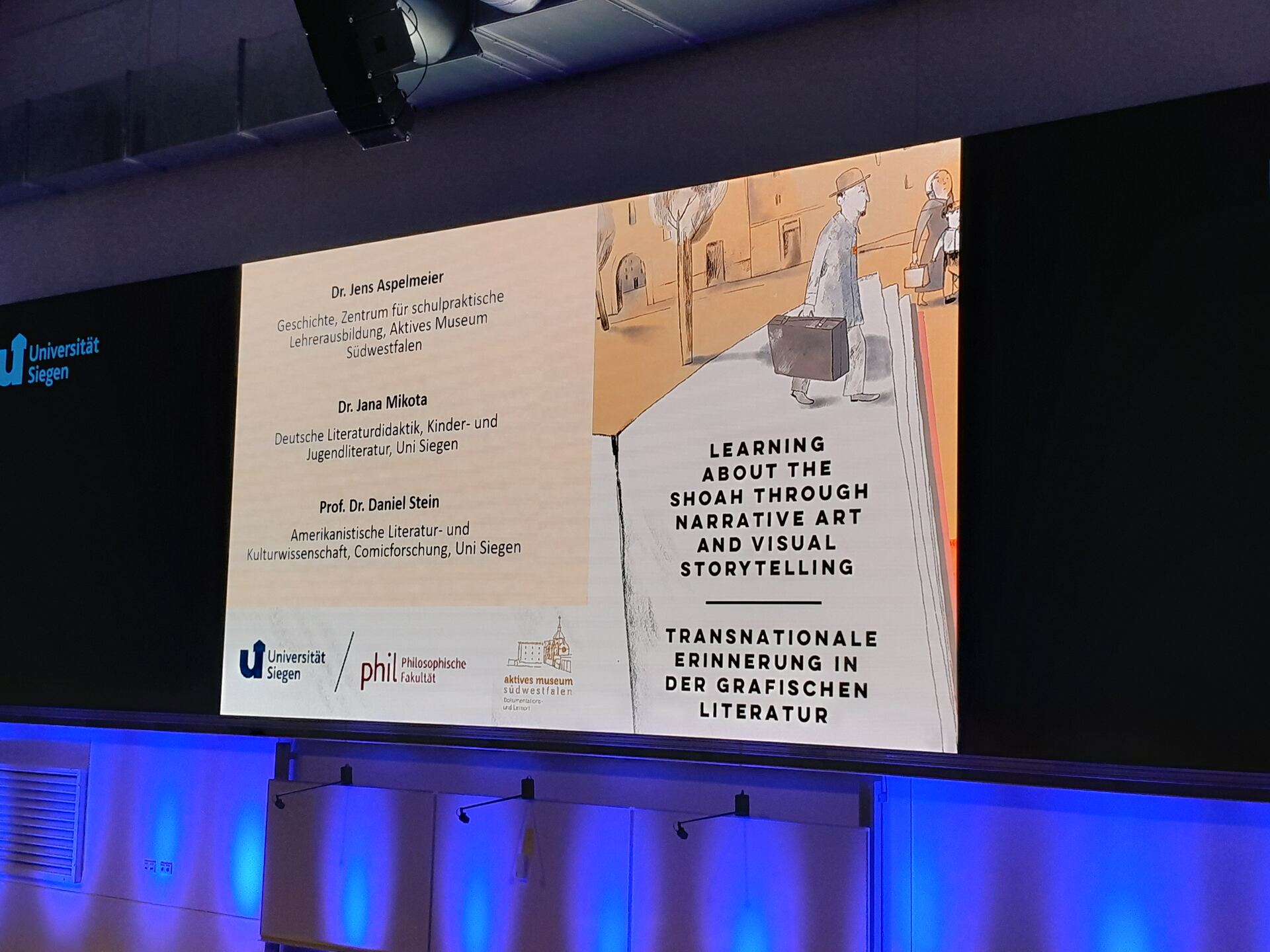
The award-winning project “Learning about the Shoah Through Narrative Art and Visual Storytelling,” – Transnational Memory in Graphic Literature,” which has been underway since September 2024, is closely linked to our Center for Pictorial Holocaust Narratives (CPHN) and has already produced numerous exciting and impressive results. In addition to a special exhibition curated by the three project leaders at the Aktives Museum Südwestfalen, an international conference, and several lecture series, the anthology “Am I Not Also Human?” is a particular highlight.
During the award ceremony, the project’s founders—Jens Aspelmeier (History, Center for Practical Teacher Training, Aktives Museum Südwestfalen), Jana Mikota (German Literature Didactics, Children’s and Youth Literature, University of Siegen), and Daniel Stein (American Literature and Cultural Studies, Comic Studies, University of Siegen) briefly presented the project and its work.
Throughout all components of the project, the participants demonstrate that the Holocaust did not begin only at Auschwitz, but that issues such as exclusion and the denial of rights were already part of everyday life much earlier—even in Siegen. The anthology presents the life experiences of five residents of Siegen whose biographies are part of Siegen’s history. These were to be adapted into graphic stories by five different artists in order to document the diversity of graphic storytelling. When selecting the artists, it was important that their respective artistic styles align with the story. Betty Hochmann survived the Holocaust by emigrating to Israel—or what was then Palestine—at the age of 15, against her parents’ wishes. Through Betty’s memories and Inbal Leitner—who is Jewish herself and grew up in Israel—Betty’s story can be told. Inge Frank was a Jewish girl with her own dreams and hopes, which could not be fulfilled due to her deportation and murder. We have Traute Fries and her family to thank for allowing us to get to know Inge Frank, at least through their stories. Through her artistic approach, Marion Goedelt has succeeded in depicting the disappearance of Jewish life and illustrating Inge Frank’s life. Zina came to Siegen as a twelve-year-old forced laborer and worked there under inhumane conditions. Zina managed to survive and returned to Belarus, where she was barely allowed to speak about her experiences. As a result, her silence and her fear of further persecution are part of her story, which was told and illustrated by Bianca Schaalburg. Otto Päulgen was a young man with a disability and epileptic seizures. With the onset of Nazi rule, a happy man became a victim of persecution. Lisa Rock was able to depict Otto’s joy through her colors, but his story also shows that the Nazis disenfranchised and persecuted people for a wide variety of reasons. The synagogue was meant to symbolize Jewish life in Siegen—a sense of belonging and hope—which was brutally destroyed. Through Stephanie Lunkewitz’s photorealistic illustrations, the synagogue and the Jewish life surrounding it can come alive once more. All the stories about Jewish lives show that Jewish people were part of the city’s society before 1933 and helped shape it. The synagogue—as the stories by Leitner, Goedelt, and Lunkewitz also show—was part of the cityscape.
Secondary witnesses also played an important role by contributing their memories, documents, and personal perspectives. The collaboration spanned from Cambridge to Los Angeles and Berlin to Siegen. Gradually, an international network of remembrance emerged—and with it, the foundation for this anthology.
A magnificent honor for a project that is as important as it is inspiring—congratulations to everyone involved!
Authors: Lea Starsetzki and Britta Hönes