
About Our Working Group
Brief Introduction

In the Physical Chemistry I research group, we work on current research questions in the fields of surfaces and interfaces, polymers, and nanoscale systems, which we analyze using modern physicochemical characterization techniques. We are particularly interested in new materials and self-organized systems for the production of defined responsive interfaces and nanomaterials for future biomedical applications.
In inherently interdisciplinary research projects, our highly international team addresses experimental questions that relate to both fundamental research and (future) applications. International collaborations play a particularly important role in this work.
Current Projects: INJECTHEAL (MULTIFUNCTIONAL SELF-HEALING INJECTABLE HYDROGEL FOR CHRONIC WOUND HEALING AND TISSUE REGENERATION, https://cordis.europa.eu/project/id/101177924); Project in SPP 2171 (DFG) Priority Program titled “Dynamic Wetting of Flexible, Adaptive, and Switchable Surfaces”: Depth-Resolved Analyses of Water Penetration During Dynamic Wetting in Solvatochromic Dye-Gradient Polymer Brushes by Time-Resolved Fluorescence (SCHO 1124/8-1).
Our Research Profile
Key Areas and Topics in Physical Chemistry I
The goal of our research activities is to produce suitable (bio)chemically functionalized and micro- and nanoscale-structured model systems—primarily using wet chemical methods—and to study their properties and interactions with biological molecules and systems (e.g., cells) using high-resolution microscopy techniques. The insights gained in this way are used to develop improved sensor and surface treatment methods—for example, to control cell-surface interactions—as well as for the controlled release of active substances.
The central overarching question is how chemical and physical processes—such as reactions and intermolecular interactions—at surfaces and in confined spaces are influenced by the local chemical composition and structuring of the environment at the micro- and nanoscale.
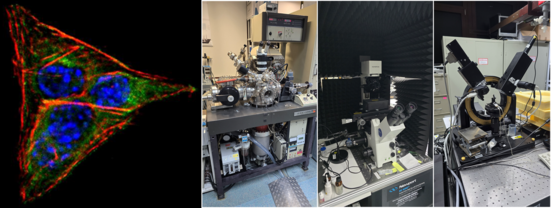
In conducting this research, it is important, on the one hand, to control the (surface) structure and properties of synthetic systems through appropriate synthesis or modification. On the other hand, high-resolution analysis of the physicochemical aspects of these systems’ functionality is of central importance. Quantitative atomic force microscopy (AFM), time-resolved fluorescence microscopy (lifetime imaging), and their combination with various complementary characterization methods play a very important role in this context. Custom-designed probe molecules are used for nanoscale analyses.
Latest publications:
Ernest Gachui Maina, Nicola Cusick, Holger Schönherr, Structure–Antibacterial Activity Relationships in Quaternized Cellulose-grafted-PDMAEMA: Influence of Graft Length, Degree of Quaternization, and Alkyl Chain Length. ACS Appl. Eng. Mater. 2026, in press.
Joshua Schumacher, Yu Yoshimura, Renée Sophie Hoffmann, Andreas Jagic, Kenichi Morigaki, Holger Schönherr, “Polymer brushes on polymerized and patterned lipid bilayers via UV-initiated RAFT polymerization,” ACS Applied Mater. Interf. 2026, in press.
Jonah L. Decker, Sören Steup, Sergey I. Druzhinin, Heiko Ihmels, Holger Schönherr, Unveiling the fluorescence lifetime changes of a solvatochromic aurone probe dye upon wetting in an emissive polymer brush matrix by deconvolution of TCSPC data. European Physical Journal E 2026, 49, 60.
Kawaljit Kaur, Kinyanjui Stephanie, Nthiga Esther, Douglas Onyancha, Holger Schönherr. Morphology-Dependent Sensitivity of Chitosan-Based Sensing Materials for the Colorimetric Detection of β-Glucuronidase from Pathogenic E. coli. Macromol. Biosci. 2026, 26, e70212.
Joshua Schumacher, Nicola Cusick, Désirée Anna-Maria Schütz, Carsten Engelhard, Holger Schönherr. A polymer brush prodrug for antibiotic delivery from implant surfaces. Polymer 2026, 349, 129750.
Nicola Cusick, Holger Schönherr. Phloxine B-chitosan films as light-activated antibacterial coatings for wound applications. International Journal of Pharmaceutics. 2026, 697, 126857.
Aswathi Syam, Nicola Cusick, Alexander Zilles, Holger Schönherr. pH-responsive carborhodol-coupled chitosan-based hydrogels for the detection of wound infections. RSC Mater. Adv. 2026, 7, 4710.
Research Focus Areas
- Nanocapsule-, nanoparticle-, and hydrogel-based controlled-release systems
- Sensory materials for the detection of bacterial infections
- Antimicrobial photodynamic therapy (3rd generation)
- Polymer brushes: responsive biointerfaces
- Cell-surface interactions
- Method development for atomic force microscopy and fluorescence lifetime microscopy
- Nanotemplate fabrication and replication
- Surface Nanobubbles


Contact the Working Group
Postal address
University of Siegen
Department of Chemistry and Biology
Physical Chemistry 1
2 Adolf-Reichwein Street
57076 Siegen
Visitor address
University of Siegen
Department of Chemistry and Biology
AR-F/G Level 01
2 Adolf-Reichwein Street
57076 Siegen
Secretariat
Please contact Professor Holger Schönherr.