A Look at Real-World Applications
The 70-page brochure for Global Digital Health Week reads like a “Who’s Who” of the international research landscape in the field of digitalization and healthcare. Twenty-four participating research alumni from 22 countries and nearly every continent contributed their research projects and engaged in intensive discussions with experts from the participating German universities and institutions. A brief research profile is provided here for each of the six project partners:
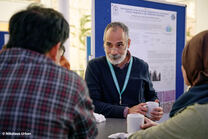
Mark Sujan (55) from the United Kingdom was a doctoral candidate at the Karlsruhe Institute of Technology from 1999 to 2002; after holding various positions in Siena, Rome, Oxford, and York, he is currently a professor at the University of York. For about 25 years, he has been working in the field of patient safety and other safety-critical areas, as well as on ensuring the safety of systems using artificial intelligence. His focus is on “human-centered AI,” human factors in healthcare, and questions regarding how AI should be designed and applied to ensure safe and ethical care. One example is AI-assisted skin cancer detection systems, which work better on lighter skin than on darker skin—a situation that could contribute to inequality.
The renowned scientist is a trustee of the Chartered Institute of Ergonomics and Human Factors and a member of the AI and Digital Health Interest Group. The introduction of AI in healthcare is increasingly viewed as indispensable by policymakers; however, in his opinion, many current initiatives run the risk of being “dominated by a technology-centered mindset.” He places great importance on personal exchanges with colleagues during the project week. He noted, “Many of us work in relatively related fields, and we can now build on these connections.” In addition, participants gain a deeper understanding of the international scientific landscape and can (re)strengthen connections that have, in some cases, suffered as a result of Brexit.
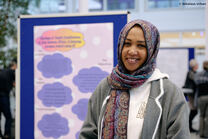
Lamees Elhassan, (41), currently in Morocco, was a researcher at Heidelberg University from 2019 to 2023; she is currently the representative for public-private partnerships at the Federal Ministry of Health in Sudan (suspended for the time being due to the conflict in Sudan). A native of Sudan, she is a dentist and specialist in global health; she has also worked extensively on public health systems and digital innovations in this field, developing frameworks for universal health care and strategies for reform. “The week has been truly impressive. Amazing! These interdisciplinary fields, this international group!” she enthuses.
She focuses particularly on the use of e-learning and blended learning methods to better address the shortage of medical professionals in sub-Saharan Africa and to improve access to medical training opportunities. However, implementing such digital tools there poses significant challenges, particularly given the infrastructure limitations in rural regions of Africa. Access to technologies such as the internet, smartphones, computers, and electricity is sometimes limited. The severe shortage of skilled professionals goes hand in hand with these resource-constrained countries bearing nearly a quarter of the global disease burden. She also traveled to Germany with the aim of establishing contacts with stakeholders to foster collaboration.
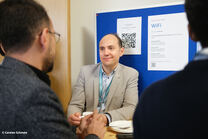
Aparecido Fabiano Pinatti de Carvalho (43), a native of Brazil, was a researcher at the University of Siegen from 2016 to 2022 and is a professor at the Department of Computer Science at the University of Oslo. He also heads the “Design of Information Systems” research group in the field of digitalization and is a member of the European Society for Socially Embedded Systems and the Association for Computing Machinery. Pinatti de Carvalho is particularly interested in human-computer interactions and an interdisciplinary approach that does not focus solely on data but also incorporates sociological questions and methods from the social sciences. “We must develop technologies that make the world a better place.” To do so, he says, one must have a deep understanding of real-world practice. Based on a study involving radiologists and prostate cancer diagnostics, for example, it has become clear that medical professionals need transparent AI systems that provide diagnostic recommendations with clear justifications and are aligned with clinical thought processes in order to build trust, increase acceptance, and ensure high-quality patient care.
He hopes to raise his colleagues’ awareness of this complex topic during the project week. The event is “a great opportunity to meet researchers from a wide variety of disciplines and develop new ideas. We already have a few! Maybe this will even lead to a new project proposal for the network!”
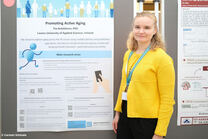
Tiia Kekäläinen (34) from Finland received a Women in Research Fellowship (WiRe) in 2024 as a postdoctoral fellow at the University of Münster and is a researcher at Laurea University of Applied Sciences, Department of Social Services and Health Care. “My background is in gerontology and health sciences,” says the young researcher, who traveled to the conference in Cologne and Heidelberg with her six-month-old baby and her husband. She enjoyed the opportunity to meet other researchers and gain insight into current research projects. “I get new ideas from every conversation, and the lab tours were also very interesting,” said Kekäläinen.
Among other things, she conducted research on mental well-being in assisted living settings. She provided a more detailed presentation of the “novel, smartphone-based ecological momentary assessments” (EMA), in which behavior, experiences, or performance are typically assessed several times a day over a specific period. The data could be combined with other methods to investigate real-time correlations between physical activity and cognitive functions or mental health.
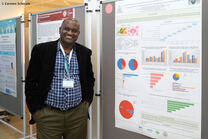
Aliyu Muhammad (43) from Nigeria spent six months as a postdoctoral fellow at the German Cancer Research Center in Heidelberg from 2015 to 2016; he is currently an associate professor at Ahmadu Bello University. He has been conducting research and teaching in the field of medical biochemistry for over 14 years, covering topics ranging from cancer biochemistry, nutrition, and health to AI and machine learning. Among other things, he focuses on public perception of climate change and its serious impacts on health, particularly breast cancer risk factors. From UV radiation to pesticide use to air pollution—the 43-year-old emphasizes that public awareness of the links between climate and breast cancer, as well as ways to protect against environment-related risk factors, must be given greater attention. Digital tools and AI-supported strategies are of great importance, for example, in information campaigns.
During the project week, he “gained a great many ideas and insights,” for example regarding data science and artificial intelligence, and the question of how applications could and should be adapted in his home country. Information about starting a business, funding opportunities, and sustainable collaborations is also of great interest. He had many interesting conversations with colleagues from Brazil to Norway: “It’s very exciting, and I can see that there’s a lot that could be done with AI. I hope to return to Germany soon after the project week—together, we could accomplish so much more!”
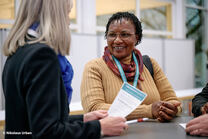
Lily Makalanga (53) from Tanzania was a postdoctoral fellow at the University of Cologne in 2024 and is currently a lecturer and researcher at the University of Dodoma in Tanzania, where she earned her Ph.D. in development studies. Her work focuses on gender-specific issues and gender equity in the global digital health sector, as well as women’s leadership roles in politics and gender-sensitive health issues. She has participated in various projects aimed at improving healthcare through innovative digital platforms.
She is very interested in the overarching theme of the alumni project week and its international composition, noting that the opportunities and challenges vary greatly from country to country. In Tanzania, many women have little or no access to smartphones and other digital technologies. “I received many ideas during the week, for example regarding the use of artificial intelligence.” It offers opportunities—provided AI is applied in an ethical and gender-equitable manner.
The project week was funded by the DAAD with support from the Federal Foreign Office (AA) and the Federal Ministry for Economic Cooperation and Development (BMZ).
The interviews were conducted by Martina Windrath, a freelance journalist based in Cologne.
More articles on the project week: