Syntik
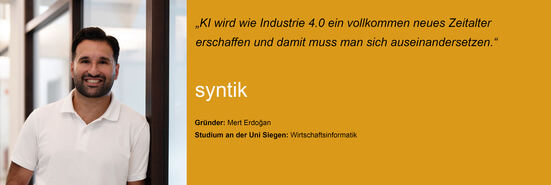
Mert Erdoğan, a native of the Siegerland region, is the founder of the startup “syntik gmbH.” In his AI workshops, he not only teaches the fundamentals of AI but also shows small and medium-sized businesses how they can benefit from the responsible use of artificial intelligence.
What is syntik?
With syntik, I offer traditional IT services. Among other things, the goal is to help clients understand AI through workshops. We explore what possibilities are available, what added value it offers for business operations, and how we can use it to transform small and medium-sized enterprises. I use existing tools or develop custom solutions, depending on the scale of the problem.
Ultimately, AI is about analyzing data, recognizing patterns, and making decisions based on that analysis. Whether it’s automated quote generation, a company that frequently participates in bids, or one that wants to cross-check something against an internal checklist. The goal is to automate all repetitive processes—that is, processes that occur over and over again and require no creativity. That’s the approach we take at syntik.
Can you give an example of how you help companies become more efficient through automated processes?
For example, if we have a chatbot for a service that handles certain incoming inquiries on its own. Sometimes you’re talking to an assistant, and at some point, when a limit is reached, the person behind the scenes steps in to handle the case completely. We can’t always automate and digitize everything 100 percent—sometimes only to a certain extent. And all these use cases—whether it’s a chatbot in customer service, automated quote generation, or bid matching when a company participates in tenders— Automating this process—which takes three hours—so that it only takes 15 minutes. That’s the approach: saving time so that the capacity freed up can be used for other areas.
What makes your startup special?
What makes syntik special—its unique selling point—is that we focus on small and medium-sized businesses while also bringing the experience of large corporations to the table.
We have the experience and understand how processes work at large companies. Because we know these approaches and possess this know-how, we can apply them to small and medium-sized businesses and then accurately assess just how much real added value they provide.
If we create solutions that are far too expensive and overhyped, they’ll ultimately be of little use; or do we have solutions that deliver immediate value—especially given all the hype surrounding ChatGPT? For the past two or three years, everyone’s been talking about ChatGPT, but many are asking themselves: How do I know exactly what I can do with it in my company? What complies with data protection regulations, what’s redundant, and what isn’t; should I even invest money in it at all? These are the approaches we’re taking, and in my opinion, no one else in Siegen-Wittgenstein is doing this.
We stay away from manufacturing and the hardware and sensor sectors—that requires a high level of investment, as I’ve already seen in other projects. That’s why we decided to focus on what we’re good at and what we know—namely, the purely commercial aspects—and that’s where we see our USP, especially in this region.
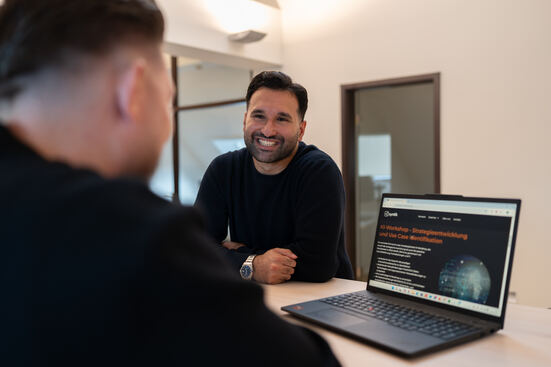
What defines a medium-sized company?
Generally speaking, there are three categories: the classic SME, the lower-tier SME, and the upper-tier SME. When we talk about SMEs in our context, we’re always referring to companies with 50 or more employees; in other words, as soon as a company has fewer than 50 employees, it’s generally considered a smaller business. These are less interesting to us because the problem is that custom AI solutions are expensive and more cost-intensive, and we can’t expect companies for which off-the-shelf solutions are more relevant to bear that cost. That doesn’t mean we don’t also recommend off-the-shelf AI solutions for small and medium-sized enterprises. Sometimes that’s enough, because even off-the-shelf solutions have 80% accuracy. So it really depends on the use case, and the cutoff is up to 5,000 employees, because that’s where the upper mid-market ends. Beyond that, we’re moving into the realm of large enterprises, and we steer clear of that because we’re too small for it ourselves and would lose our focus.
When did you decide to go into business for yourself?
Basically, I’ve always been interested in digital solutions. I studied Business Information Systems because I’ve always wanted to use digital solutions to transform the economy and society—since these possibilities have a truly significant impact on people. I knew that at some point I’d want to develop or market something.
Here in the region, I keep hearing from people in my own circle that there’s very little knowledge about the use and potential of AI. So I figured, since I’m right here, I might as well take the risk. I’m interested in it anyway. So the drive was definitely there to do something in the future, but the timing was also due to the situation.
Were there any seminars at the University of Siegen that you’re now benefiting from in your company?
During my studies, I learned the basics—so, what is AI? What can AI do? What are machine learning and deep learning? All these elements naturally come from the theory I learned in school, as well as from the practical project at the university.
There are modules in Business Information Systems that focus on processes—understanding, designing, and optimizing them—just as we do today. But at the same time, there were also computer science courses. I remember the programming internship well—we developed our own solutions and games there. That’s where I gained my first knowledge of object-oriented development. Fortunately, my university studies already had a strong practical focus, both technically and economically—meaning investments, financing, and accounting.
How would you describe a typical workday for you?
Unfortunately, there’s no such thing as “normal” right now. At the moment, I’m heavily involved in sales. We don’t just offer AI solutions—we also run workshops. That means we have to make AI tangible. So first, I have to show the region what’s available. Accordingly, I also do classic cold calling. I reach out to the Chamber of Commerce and Industry and my network. I do a lot of marketing. When I get here in the morning, I start with sales and then work through my emails. I handle marketing once or twice a week and also prepare for my appointments.
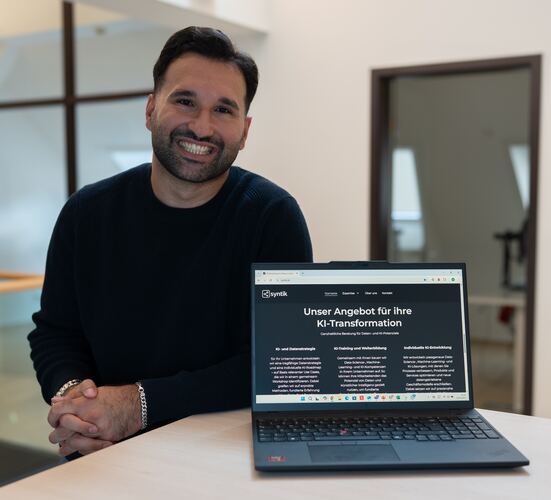
What do companies learn from the AI workshops you offer?
In the workshops, companies first learn what AI is, exactly what it can do, and what the best practices are in their respective industries—whether in retail, manufacturing, or the chemical industry. I focus on all industries except finance and healthcare, because those are highly regulated sectors. But aside from that, we look at best practices, existing AI solutions, the current state of AI legislation, the legal role of the EU AI Act, and how to build your own AI assistants. You’ll also learn how to create your own GPT and use it in compliance with the GDPR.
At the end of the workshop, we’ll work together with the functional departments—such as purchasing and sales—to identify which processes are repetitive. From there, we’ll try to identify use cases—that is, real-world applications—such as generating a quote or implementing a chatbot in customer service. We’ll then prioritize these use cases based on technical feasibility and, based on that, begin implementing an AI solution. So the AI workshop really needs to be viewed holistically—from “what is AI” to “what can we implement for the company.”
You’ve just launched your startup. What challenges are you currently facing?
Making AI accessible to people. Many hear about AI, many see AI, but they struggle to understand exactly where the added value lies. Clarifying this added value—that’s what I see as my most important task right now. I don’t see the problem as a lack of meetings. I’m fortunate that many people are open to the topic. Especially since we’re from the region ourselves, I really feel the local support.
The real challenge is convincing people during these meetings of the value AI offers them, because they’re often afraid to invest in something when they aren’t 100% sure they’ll see a direct return on that investment. That’s still a bit of a challenge in this region. My goal there is to make AI accessible and, in doing so, instill a sense of confidence.
What do you like most about this job or about this industry in general?
I’m passionate about IT and AI topics. What interests me is automating processes that aren’t necessary—ones that robots will be able to take over in 10 or 20 years. That gives us more freedom and capacity for other tasks that interest us much more and don’t bore us in our day-to-day work. For example, when I first started my consulting work, I spent three weeks filling out a simple Excel spreadsheet—a completely mindless, manual task. I don’t think that kind of thing is necessary anymore these days.
What advice would you give to young entrepreneurs who want to start their own business?
I struggled a bit at the beginning. I was on my way to becoming a manager and had a great position. Taking that leap of faith—without clear clients, without security—is the biggest leap that many people don’t dare to take.
My advice is this: if you have a certain level of financial security and can accept the risk of spending half a year doing something you believe in—something you actually enjoy—you should always take that step. A very good friend of mine, who runs a startup himself, always said, “Just get started—you’ll figure out the rest.” So have confidence in yourself and just get started.
What is your goal with syntik?
I want to make AI more accessible in the region—to businesses and people alike. With syntik, I want to support companies so they’re on equal footing with those in other countries and on other continents. I know how it works in America, the U.S., and China.
In Germany, there’s little investment in AI because people are afraid. I want to make AI approachable and create added value so that we can continue to develop both culturally and economically. We use AI in production, but in business processes like controlling, accounting, sales, and procurement, we’re still very manual and repetitive, and LLMs—or Large Language Models—are hardly used at all. We need to evolve in this area; otherwise, even more companies will struggle to generate the necessary revenue and establish themselves in this new era.
Like Industry 4.0, AI will usher in a completely new era, and we need to grapple with that.
This profile is based on an interview with Mert Erdoğan and was written by Duygu Cicek.