MEBCarbon
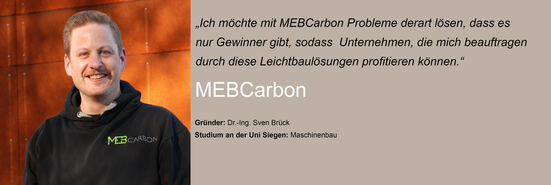
After earning a degree in mechanical engineering, Sven Brück completed his doctorate at the University of Siegen in the field of materials science, researching how cracks in stainless steel propagate under the influence of hydrogen. Today, the 40-year-old works as deputy head of design at Heinrich Georg. Since 2021, Brück has been pursuing his passion part-time at MEBCarbon (Manufacturing, Development, and Brück), where he offers development and manufacturing services using carbon fiber. In 2022, the carbon-fiber sleds he designed for the German national skeleton team will be used at the Winter Olympics in Beijing.
What is MEBCarbon?
MEBCarbon stands for Manufacturing, Engineering, and Brück and is an engineering firm with an integrated manufacturing division. Using carbon fiber, we develop solutions that can create components in many fields that could not be built in the same way using metal, aluminum, or steel. These must first be developed “engineer-style” on a computer and then manufactured using specialized production methods. We specialize in prototypes and small production runs, so domestic manufacturers or specialty firms that need only a few components turn to us.
What makes MEBCarbon special?
The combination of development and manufacturing, as well as our scientific background, is what makes MEBCarbon special. As a company, we always strive to get the best results for our customers. This has worked very well for MEBCarbon so far because we develop many solutions in close collaboration with our customers. For example, I’ve worked with our customers’ development departments to create a solution that helps their business move forward. Customers know their own problems best, and with MEBCarbon, we can offer a different perspective on their challenges.
Many sports equipment items are now made of carbon, such as tennis rackets, skis, and bicycles. Formula 1 cars are made entirely of carbon. The aerospace industry also uses this material. These applications also reflect the material’s high cost. What I do is never cheaper than what companies can achieve with metal. Because the material is too expensive, it’s only used when it can solve a specific problem. To give a striking example: if a robot always has to move something from A to B, but its tool is too heavy for the task, then it makes only a few movements from A to B, which hinders productivity. If this tool becomes lighter, the robot can work faster. So when things reach productivity limits or strength limits, that’s when we step in. That’s also when people are willing to pay the premium, which results from both complex mold making and higher material costs. Customers who have me repair carbon fiber parts previously had nothing but plastic scrap, and after the repair, they have a piece of sports equipment with which they can resume their hobby without having to invest in a new one.
So MEBCarbon comes into play when problems need to be solved. The great thing about MEB is that when I succeed in solving the problems, the customer is satisfied. That, in turn, is palpable and immediately tangible. For example, after I built the sled for skeleton pilot Jacqueline Lölling, we were able to immediately incorporate her feedback into the design and compete with it in the World Cup.
How did you come up with the idea to found MEBCarbon?
The idea had been suggested to me since I was 17, because back then I was already laminating and building carbon parts for motorcycles and other equipment as a hobby. The reason I founded the company is also the coolest thing I’ve ever had the chance to do: I designed a sled for the Olympic athlete “Jacka.” That’s not something mechanical engineers often get to work on. Having something like that as my first project was absolutely amazing.
What’s your typical workday like? For which products do you use carbon fiber, for example?
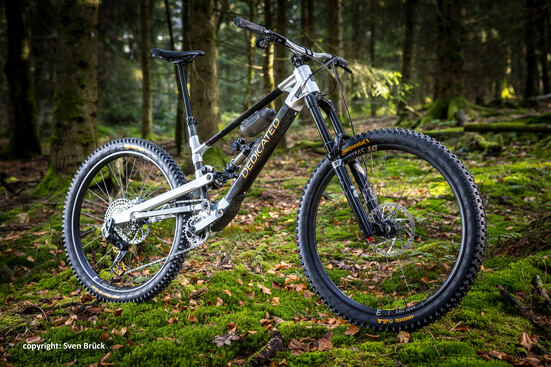
At Georg, I work as the assistant design manager and am responsible for development projects—when I take off my Georg polo shirt, I continue working on technology and development projects in our workshop or at the computer. Right now, for example, we’re designing bicycles from the ground up. I’m also doing a lot of repairs right now, since carbon is a material that’s easy to repair. If carbon breaks, I can fix it. I learned how to do that back in college during my racing days, thanks to Formula 1 engineers who mentored me. I repair bicycles, sports equipment, and components for customers that have lost their functionality due to damage—specifically, carbon that has broken. The development work involved in designing new bikes begins around 4:00 p.m., when I get home or arrive at the workshop after my day job.
You’ve equipped the skeleton pilots on the German national team with carbon parts. How did that come about?
In skeleton, the sled and the rider together may weigh up to 102 kilograms. That means that if the rider has a healthy weight of 70 kilograms, the sled itself must weigh very little. Carbon helped us design the components to be specifically lighter, stiffer, or more shock-absorbing in order to save weight in the right places. After Jacka achieved good times in the winter of 2021 with the sled I built using carbon parts, the German national team took notice of me. We then conducted joint test runs and developed the parts together.
What was your reaction when you found out that you were going to manufacture the plastic parts for the skeleton sleds for the Winter Olympics?
Pure pride. I thought it was absolutely fantastic, because at the time I was still working in a 12-square-meter workshop. Back then, I was competing against other sled builders—specifically the FES (Research and Development Institute for Sports Equipment). After all, that’s a government-funded institute in Berlin that works around the clock on developing Olympic equipment.
What was your biggest challenge? And how did you handle it?
As a mechanical engineer, if you stay solely within your field of expertise, you initially have no exposure to economic considerations. So it’s still difficult for me to think in economic terms and adopt an entrepreneurial perspective. For example, in the beginning, I miscalculated some things and had to learn the hard way. But that’s how you learn. Now I have a colleague by my side who, as a business administration major, is much more knowledgeable about economic issues than I am.
What advice would you give to founders?
Start early enough, before you’re fully settled in life. Because once you’ve “made it” in life, you create a comfort zone that’s hard to leave. Networking is also very important. There are platforms for this, such as the Entrepreneurship Center or Startpunkt57. MEBCarbon received support through their incubator program. Getting in touch with these initiatives and not starting out alone can be extremely important. Plus, certain challenges are much easier to solve as a team.
What do you hope to achieve with MEBCarbon?
I’d like to achieve with MEBCarbon what I accomplished with Skeleton—namely, solving problems in a way that ensures everyone wins. So that companies here in the Siegerland region that hire me can benefit from these lightweight construction solutions.
This profile is based on an interview with Sven Brück and was written by Duygu Cicek.