
About the chair
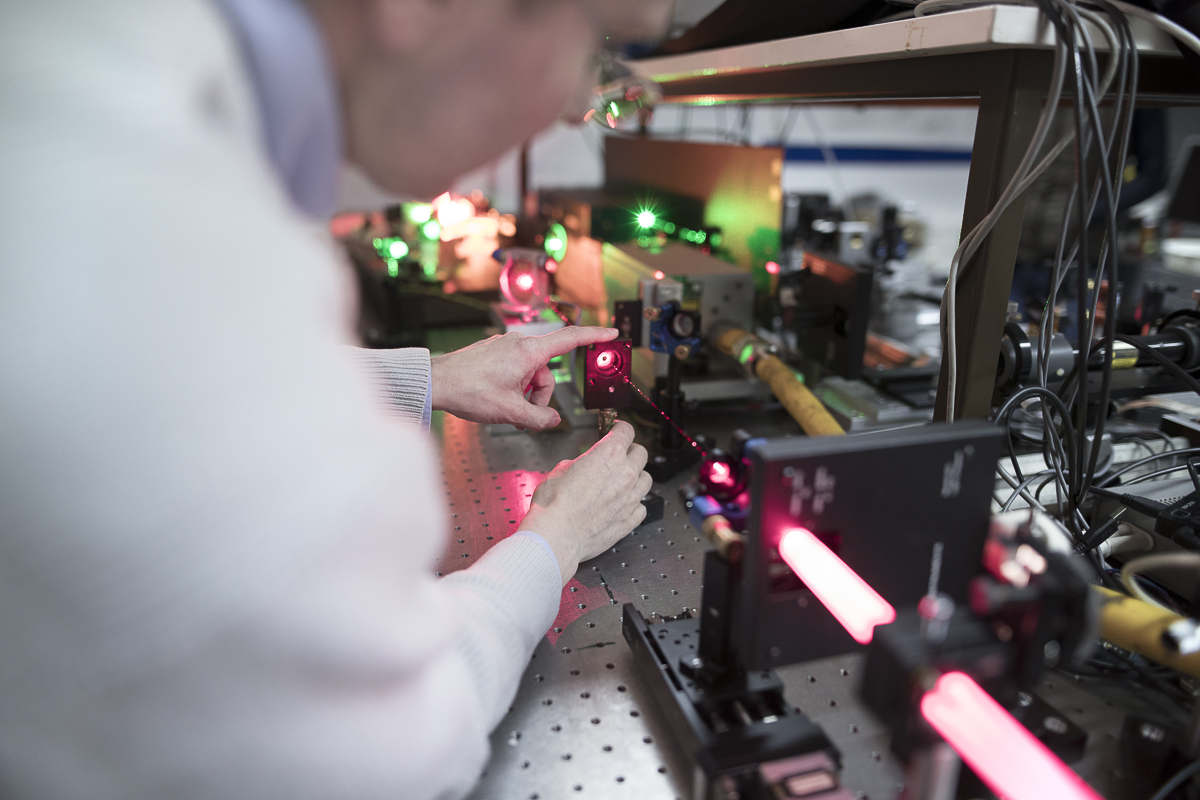
The Chair of High Frequency Technology and Quantum Electronics (HQE) conducts research and teaching on photonic and quantum electronic components for information technology, security technology and the life sciences.
The focus is on research into innovative terahertz technologies. The terahertz frequency range (1 THz = 1012 Hz) is located in the electromagnetic spectrum between microwave and infrared radiation and has great potential in a wide range of applications. Intensive research in recent years has made it possible to identify a large number of interdisciplinary fields of application and to develop technological possibilities for diversely applicable THz systems.
The research work at the Chair of High Frequency Technology and Quantum Electronics includes the simulation, modeling and development of THz systems and the exploration of new areas of application in close cooperation with national and international working groups. The close interdisciplinary cooperation as a member of the Center for Sensor Systems
and the Center for Micro- and Nanochemistry
within the University of Siegen.
The terahertz frequency range
Description of the research focus areas and list of focus areas
The terahertz or sub-millimeter wave frequency range, roughly defined as the range between 300 GHz and 10 THz, is one of the longest existing unused regions in the electromagnetic spectrum. Technological advances in recent decades have enabled the development of very sophisticated and complex systems that operate in this frequency range as standard. This has led to major advances in areas such as astronomy or the study of the atmosphere.
Nevertheless, it has not yet been possible to make this spectral range with its diverse potential usable for everyday applications. Thus, the term THz gap was created due to the lack of suitable technologies to effectively bridge this transition region from electronics to optics.
Intensive research in recent years has opened up technological possibilities for broadly applicable THz systems and identified a large number of interdisciplinary application areas. Currently, THz research is in a key phase and will radically expand our analytical capabilities in the near future due to its intrinsic advantages:
- Many optically dense materials are transparent in the THz range. This results in novel analysis and imaging applications for research and technology
- THz radiation is non-ionizing and therefore harmless for biomedical analyses and thus offers an alternative to conventional X-ray methods
- Specific THz molecular rotations and vibrations enable the selective label-free identification
of molecules and molecular groups
- THz radiation provides crucial insights into the electronic dynamics of semiconductors, metals and nanostructures, with the latter playing a particularly important role in photonic and electronic components and systems
- In contrast to optical wavelengths, THz radiation is less scattered, which favors its use in harsh environmental conditions, e.g. for robotic vision and process control
under industrial production conditions.
Research work at the university includes the simulation, modeling and development of THz systems and research into new areas of application in close interdisciplinary collaboration with national and international working groups.




Contact the chair
Postal address
University of Siegen
Faculty of Natural Sciences
Chair of High Frequency Technology and Quantum Electronics
Hölderlinstr. 3
57076 Siegen
North Rhine-Westphalia
Germany
Visitor address
University of Siegen
Faculty of Natural Sciences
Chair of High Frequency Technology and Quantum Electronics
Building E - Level 3 (soon INCYTE)
Hölderlinstr. 3
57076 Siegen
North Rhine-Westphalia
Germany
Secretariat
Chair holder: Univ.-Prof. Dr.-Ing. Peter Haring Bolívar