IZBR "Learning location of the future" competition decided
The University of Siegen donated cash prizes worth €2,000 and the publishers Birkhäuser and Jovis each donated five book prizes. The jury, which was made up of academics and students of architecture and education, was able to select the winners from more than 70 entries. They awarded the first prize of €1,000 to Martin Appel's presentation. The second prize of €500 went to Veronika Mihalji (both University of Siegen) and the third prize of €300 to Luis Blum, Mainz University of Applied Sciences. The other cash prizes went to: Dominik Aberle, University of Siegen, €100, Diego Rodewald, Potsdam University of Applied Sciences, €100. Book prizes were awarded to (in alphabetical order) Daniel Afriyie Owusu (University of Hanover), Annalisa Biehl (University of Münster), Nik Bürk (Biberach University of Applied Sciences), Nefelo Panagota Drongiti, Simone Gallo (Polytechnic University of Milan), Nele-Isabeau Giesen (Technical University of Cologne), Jan-Niklas Kellermann (University of Siegen), Léo Rodriguez Afonso (Polytechnic University of Madrid) and Gizem Sarak (University of Siegen). Prizes for remarkably independent solutions were awarded to Vivien Centelles-Schlegel (University of Siegen) and Michel Tuttas (University of Hanover), also as book prizes.
All competition results were exhibited at the 1st Network Meeting of the Interdisciplinary Center for Educational Spaces on 29.10.2025 in Siegen and could be viewed by the almost one hundred participants.

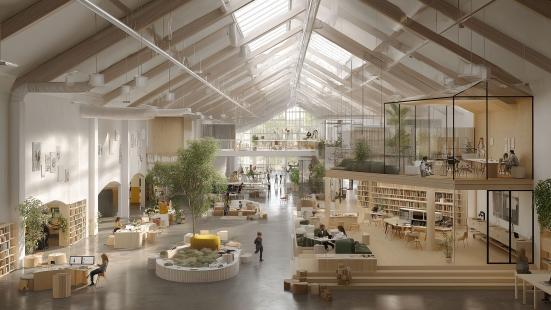
Brief description:
SOCIETY OF PRACTICE
The Society of Practice arises from a combination of situated learning and communities of practice: Situated learning means that knowledge is not created in isolation in the mind, but through action, social interaction and concrete problem solving with real contexts. Communities of practice extend this to the social dimension, in that people learn from and with each other by working on specific problems. In view of the rapid changes in society, technology and the environment, lifelong, flexible and context-related learning is necessary. The Society of Practice enables collective social learning in which everyone can participate. It is a place of dialog, discussion and perspective. The learning space of the future should therefore not be institutional, but social and must therefore not only be authentic, experimental, heterogeneous, participatory and inclusive, but also have the resources and infrastructure to enable a society of practice to emerge.
Jury appreciation:
In the jury's view, the entry submitted by Martin Appel stands out due to two different aspects: on the one hand, the brief description shows a profound understanding of the social challenges and need for change in the field of education. On the other hand, the creative result demonstrates a high aesthetic quality and a well thought-out variety of learning locations. The prompts used dovetail these requirements and create a coherent and well-founded end result. Martin Appel was therefore awarded 1st prize in the student competition.
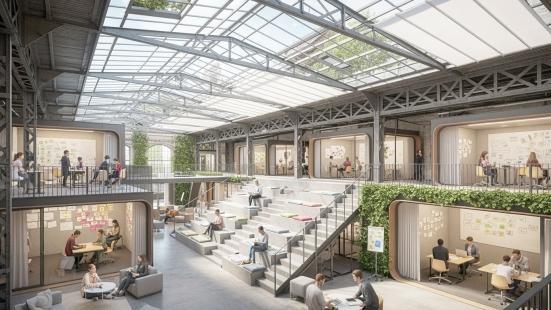
Brief description:
A modern learning space in converted industrial halls with visible steel girders, flexible, modular and removable elements, split-level platforms with seating steps for group work, individual work and creative projects, a transparent roof that can be opened or closed depending on the weather and vertical greenery, which creates an open, collaborative learning atmosphere and can also be used flexibly and sustainably.
Jury's appraisal:
The entry submitted by Veronika Mihalji takes up the theme of seeing learning spaces outside the school context and using transformation sites such as industrial vacancies. In the jury's view, this has created an exciting place with high spatial qualities. The flexibility of the roof connects the exterior and interior, which can lead to a significant increase in the quality of the space. Veronika Mihalji was therefore awarded 2nd prize in the student competition.
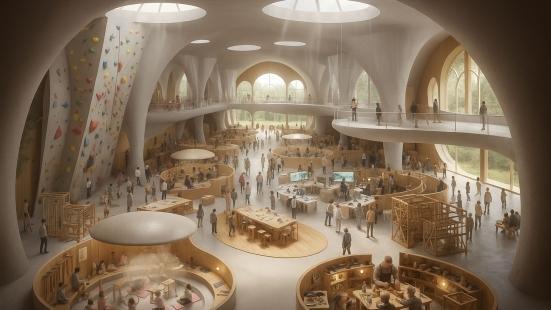
Brief description:
"A place of learning for all generations, subject areas and learning styles - simple in its space, modern in its aspirations."
Jury appraisal:
The entry submitted by Luis Blum generates an organic-looking place of learning that incorporates many different settings and meets different requirements. In the jury's view, this has created a flexible and diverse learning space with a high quality of stay. The design requirements can be derived from the dialog between Mr. Blum and Gemini and ChatGPT. Luis Blum was therefore awarded 3rd prize in the student competition.
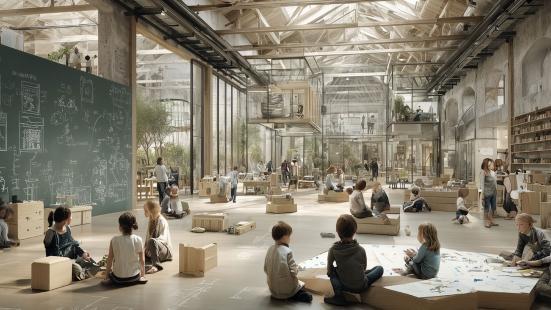
Brief description:
Concept: The learning place of the future is an open "space of possibilities" in which people of all generations learn from each other through joint experimentation, real-life tasks and shared practice, thus combining technology, culture, nature and social participation.
Jury appraisal:
The entry submitted by Dominik Aberle shows a place of learning with a great deal of creative potential. Located in an old industrial hall, it offers various settings ranging from communicative and experimental areas to places for reflection and concentrated work. In the jury's view, this has created a diverse and creatively appealing learning space that encourages curiosity and participation. Dominik Aberle was therefore awarded 4th prize in the student competition.
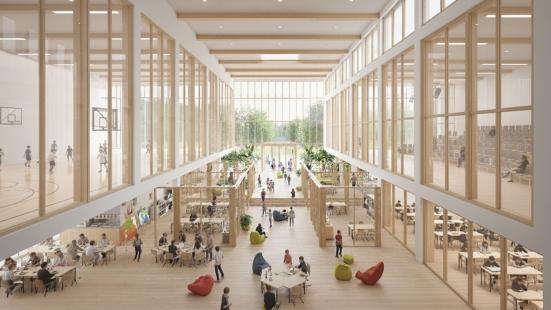
Brief description:
Open, bright communal spaces with short access routes should create a balance between frontal and independent teaching alongside small places of retreat, so that learners decide for themselves how they learn what and when they take a break.
Appreciation of the jury:
The entry submitted by Diego Rodewald shows a structured and clearly organized learning space with various offerings. Areas for sports, lectures, communication and concentrated work are arranged around a central hub. From the jury's point of view, the entry shows a restrained and clear architectural language that offers the necessary potential to the areas of use as a platform. Diego Rodewald was therefore awarded 5th prize in the student competition.
University of Siegen, School of Education, Architecture and the Arts
Department of Architecture:
- Prof. Dr.-Ing. Bert Bielefeld, Chair of Building Economics and Construction Management, Spokesperson IZBR, Head of Master Architecture program
- Dipl.-Ing. Björn Vierhaus, research assistant
- Edda Voitz, research assistant Bachelor
Department of Educational Sciences:
- Dr. Annika Gruhn, AG spokesperson for primary school pedagogy, IZBR spokesperson, scientific director OASE Lernwerkstatt,
- Dr. Jörg Siewert, Head of the Siegen School Network (SiNet)
- Phillip Ahrberg, Bachelor's research assistant
All participants
| Germany | 55 |
| Greece | 3 |
| Italy | 1 |
| Sweden 1 | 1 |
| Spain 1 | 10 |
| Total number of participants | 70 |
Participants from German colleges/universities
| Baden-Württemberg Cooperative State University | 2 |
| Potsdam University of Applied Sciences | 1 |
| Heinrich Heine University Düsseldorf | 1 |
| Anhalt University of Applied Sciences | 2 |
| Biberach University of Applied Sciences | 3 |
| RheinMain University of Applied Sciences | 1 |
| Mainz University of Applied Sciences | 1 |
| Rhenish-Westphalian Technical University Aachen | 1 |
| Braunschweig University of Technology | 1 |
| Cologne University of Technology | 1 |
| Lübeck University of Technology | 11 |
| Rosenheim University of Technology | 1 |
| University of Hanover | 2 |
| University of Münster | 1 |
| University of Siegen | 14 |
| University of Weimar | 3 |
| without indication of college/university | 9 |
| Participants from German colleges/universities | 55 |
Participants from European colleges/universities
| University of Patras, Greece | 1 |
| Polytechnic University of Milan, Italy | 1 |
| Polytechnic University of Madrid, Spain | 5 |
| without indication of college/university | |
| Athens, Greece | 2 |
| Lund, Sweden | 1 |
| Madrid, Spain | 5 |
| Participating European colleges/universities | 15 |
Cash prizes
1,000 € Martin Appel University of Siegen
500 € Veronika Mihalji University of Siegen
300 € Luis Blum Mainz University of Applied Sciences
100 € Dominik Aberle University of Siegen
100 € Diego Rodewald Potsdam University of Applied Sciences
Book prizes
Daniel Afriyie Owusu, University of Hanover
Annalisa Biehl, University of Münster
Nik Bürk, Biberach University of Applied Sciences
Nefelo Panagota Drongiti, NN
Simone Gallo, Polytechnic University of Milan
Nele-Isabeau Giesen, Technische Hochschule Köln
Jan-Niklas Kellermann, University of Siegen
Léo Rodriguez Afonso, Polytechnic University of Madrid
Gizem Sarak, University of Siegen
Special Prizes Book
Vivien Centelles-Schlegel University of Siegen
Michel Tuttas University of Hanover
