On Good Health and Social Inequality—An Interview with Prof. Christoph Strünck
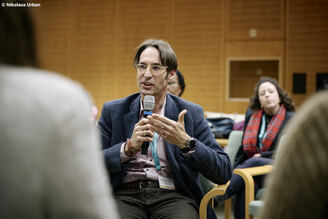
Question: For several days in Siegen, research alumni from 22 countries and numerous scientists from the participating universities and research institutions exchanged ideas on the topic of digital health. What was the purpose of the program?
Strünck: At the heart of our mission is to strengthen the connections among international researchers and to further expand and deepen our joint alumni network of researchers from the four participating universities, as well as KIT and DKFZ. Together, we took an interdisciplinary approach to think outside the box and gained a deeper understanding of the diverse approaches taken in the projects.
Question: And you were also able to learn from one another...
Strünck: We, as so-called industrialized nations, were able to learn at least as much from others as they did from us, and we, as local scientists, learned from the alumni—and vice versa. In some cases, for example, digitalization in healthcare is significantly more advanced in countries like those in Africa—if only because of the vast distances that must be covered and a less dense healthcare infrastructure.
Question: The projects are diverse. What were the overarching focal points?
Strünck: One major topic that is developing rapidly on a global scale is artificial intelligence. What’s interesting about this is that people aren’t really talking about the technology itself, but rather about which problems AI can actually solve. The questions are: Where are the areas of application? What data is needed for this?
Question: There are certainly significant national differences when it comes to data protection, ethical issues, or access to excellent medical centers.
Strünck: That’s right. Another key topic was inequality. Almost everyone participating in this project week knows that people have varying levels of health and that this is linked to social inequality. Poorer people, in particular, tend to have especially poor health. One hope is that digitalization can be used to reduce such inequality.
Question: Where do you see particular challenges in this regard?
Strünck: We can actually already use AI on a global scale, but it has to fit into each national healthcare system. That’s the biggest challenge, because every country has different forms of regulation. And the question arises: Who pays for the use of digital technologies?
Question: Is there a common ground?
Strünck: The overarching goal is generally for all of us to stay as healthy as possible and receive good care. But every country has its own conditions; health care systems are organized differently, and funding options vary widely. We may have the most amazing technology, but political systems don’t always have the goal of keeping people healthy and making them healthy. It’s also a matter of interests and the question of funding. Incidentally, while Germany has the second-most-expensive healthcare system in the world, the population isn’t as healthy as it could be... We all have room for improvement. Digitalization could help make some things more transparent and accessible, allow us to test new methods, and expand our knowledge of health-related topics. This is a process with an open-ended outcome.
Question: Are any new plans emerging from the project week?
Strünck: The connections we’ve made are also giving rise to smaller networks, new groups, and topics—and we want to continue fostering that. This can also happen digitally. But the face-to-face dialogue here over the course of a week in Cologne and Heidelberg was incredibly important. It unleashes a lot of energy and sparks new ideas. Very exciting!
Interview with Prof. Strünck. Martina Windrath, freelance journalist, Cologne
The project week was funded by the DAAD with support from the Federal Foreign Office (AA) and the Federal Ministry for Economic Cooperation and Development (BMZ).
The interviews were conducted by Martina Windrath, a freelance journalist based in Cologne
More articles about the project week: