Strong cooperation on sensitive issues
Prof. Dr. Anna Pandolfi - Prof. Dr.-Ing. Kerstin Weinberg
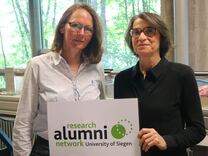
Prof. Dr. Anna Pandolfi and Prof. Dr.-Ing. Kerstin Weinberg are currently investigating a special type of concrete. Concrete is a construction material particularly well-suited to withstanding compressive loads, but it performs less well when exposed to impact or long-term vibrations that induce a tensile state. Tensile stresses are dangerous because they can cause cracks, which shorten the material’s service life. Similarly, repetitive vibrations can reduce the material’s mechanical properties. The scientists and their team have been working to develop a material consisting of concrete with inclusions that can absorb some of the mechanical energy. In this way, part of the vibration energy can be dissipated from the concrete, which is then no longer as strongly exposed to this energy. This material could then be used, for example, under train tracks or under rotating machinery in oil drilling.
In recent years, concrete failure has been studied using various calculation methods and through experiments conducted at the Politecnico di Milano and the University of Siegen. For example, the fracture patterns of approximately 160 plates struck by a sphere were analyzed both experimentally and numerically. Spheres of different weights produced a wide variety of patterns. The experimental findings have been examined and compared to the results of numerical simulations designed to mimic the plate failure. A major challenge is that the numerical results appear very symmetrical and unnatural. “A fracture is never perfect or symmetrical.” Everyone is familiar with the appearance of a crack pattern when a soccer ball breaks a pane of glass. Many crack patterns resemble a spider’s web. Representing and understanding this fracture behavior is truly not easy; there are many mathematical challenges,” explains Prof. Weinberg.
Prof. Pandolfi adds that a fracture should be understood as a modification of the body’s boundaries. When an intact body is subjected to a fracture, new boundaries form within the body. This leads to many computational problems. For example, the shape of the body changes, and the mechanical response must be modeled differently. It is also important that the modeled fracture corresponds to the one that occurs in reality. Simulations must produce a specific crack pattern, not a generic one. Therefore, one must account for the physical laws of reality, according to which the final state of a fractured body is characterized by minimum energy.
As they tackle these challenging steps in their research, the two scientists can rely on a strong scientific partnership that has proven its worth many times in the past. Prof. Pandolfi is a civil engineer with interests in computational mechanics and the biomechanics of soft tissues, while Prof. Weinberg is a mechanical engineer focused on solid mechanics. Both bring different skills to the team that complement each other perfectly. The strong foundation for their collaboration was laid back in 2001, when the two scientists were working on different topics at Caltech in California and shared the same office. They quickly realized that they had many common professional interests, and thus the ongoing German-Italian collaboration began.
But even today, their research continues to benefit from this collaboration. For example, they benefit from the Politecnico di Milano’s access to a large number of online articles that the University of Siegen does not have access to. Prof. Pandolfi also emphasizes that the collaboration opens many doors for her and her team: “In Italy, we don’t receive any funding for our research. Our research depends on funding from industry. This complicates many things. For example, we can’t build machines as easily in Italy.” At the University of Siegen, they have machines that can be used for experiments. In general, there is a lot of support. If you want to use the laboratory in Italy, a lot of red tape is involved, which is not the case in Germany. The importance of being able to work together in the lab became clear once again during the COVID-19 pandemic. While coding can also be done online, it is beneficial to work together in the lab. It is much faster and more accurate to respond to others’ findings, and ideas that arise on site can be implemented more quickly in practice. A visit to Siegen, which was originally supposed to be funded by the research alumni program (Return for Research Grant) with financial support from the alumni association “AMS-Alumni Maschinenbau Siegen” in 2020, also had to be postponed due to the pandemic. Fortunately, this visit could now take place and was supported by these funds.
Moving forward, they have several joint experiments planned in the lab on the new concrete. In future experiments, stronger concrete samples will be tested. As Prof. Pandolfi explains, the reason for this is as follows: “If the material is too weak, it is difficult to measure its fracture properties. We need something that can withstand the impact so that we can better evaluate the force acting on the sample. If the object is too weak, it will break under a very small load.” Subsequently, they will also model the fracture in the new concrete using numerical codes. The physical problem can be simulated using different mathematical methods. It is necessary to determine which mathematical approach is the best and also the fastest, because computational time is very important. It doesn’t make sense to wait days for the results of a simulation when fracture lasts only a fraction of a second in reality. In this specific case, numerical calculations will address the question of how the new material will behave compared to traditional concrete. How much less resistant will the new material be?
But this collaboration has also led to further progress across projects. For example, Prof. Pandolfi was looking for a way to model the behavior of the cornea of the eye. Prof. Weinberg had already worked on a small structure made of assembled triangles. Coincidentally, this 3D model closely resembled the supporting structure of the cornea. So this model could be used in the future to support research on the structure of the cornea. This could be helpful, for example, in preventing injury to the cornea during surgical procedures. Prof. Pandolfi looks forward to further collaborations: “It’s always very interesting when I come here and see what other things Prof. Weinberg is researching. New ideas are constantly emerging, which may in turn serve as a starting point for further collaboration.”
This article is based on an interview conducted and written by Antonia Blumberg.