Digital Engineering - Mechatronics
Bachelor of Science (B.Sc.)
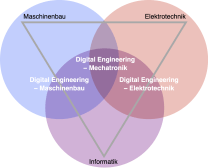
The Faculty of Science and Technology (Faculty IV) at the University of Siegen offers three digital engineering degree programs in cooperation:
- Digital Engineering - Mechanical Engineering
- Digital Engineering - Electrical Engineering
- Digital Engineering - Mechatronics
These degree courses combine the content of a traditional engineering degree course with the content of computer science in equal parts. In order to provide a solid education in both fields, the courses have a standard duration of 7 semesters, one semester longer than typical engineering courses.

Your future begins in Siegen
The aim of the degree courses is to integrate engineering and computer science. They combine the essential elements of an engineering degree program with practice-relevant components of computer science, in particular software engineering and machine learning.
Digital Engineering offers demanding degree courses that address the key challenge of future industrial value creation: The integration of classical engineering tasks and software.
The challenge of "software competence" for engineers has now arrived in the press and in everyday life. From electric cars and smart meters to Industry 4.0, a lack of software expertise among engineers is currently the bottleneck to more innovative products and better quality. The share of software in value creation is increasing steadily and rapidly, meaning that this challenge will gradually affect all areas of our lives.
A second dominant driver of innovation is "artificial intelligence", in particular machine learning. In the engineering environment, data-driven models are increasingly being used alongside classic white-box models(first principles models) based on the laws of mechanics, electrical engineering, thermodynamics and fluid dynamics, etc. These so-called black box models are, for example, neural networks and are trained using measurement data (or simulation data). This allows many very complex processes to be described relatively quickly and cheaply. This gives rise to many new important issues in research and practice in terms of robustness, reliability and interpretability, which require both computer science and engineering expertise.
Other important areas of application of machine learning in the modern industrial environment include the automated evaluation of large amounts of data(big data), so-called data mining, image processing and expert systems based on large language models (ChatGPT) and intelligent search (Google, Bing).
The mathematics component is almost identical in the three degree courses:
- Advanced Mathematics I and II
- Discrete mathematics
- Numerical Methods and Advanced Mathematics III
and the computer science component is identical in the 3 degree programs:
- Digital Technology
- Algorithms and data structures
- Object-oriented and functional programming
- Programming internship
- Introduction to machine learning
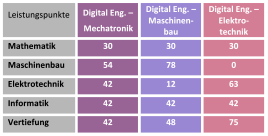
The different weighting of the contents of the three degree courses can be seen in the following table based on the credit points:
For more detailed information on the Digital Engineering degree programs, click here.