Shape Your Own Future, Starting Here in Siegen
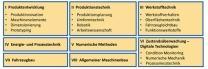
You can tailor your studies by choosing a technical track that fit your career goals. Along the way, you will build professional skills such as communication, teamwork, and presentation, and learn to work confidently with modern digital tools.
After graduating, you will be ready to work as an engineer in the mechanical engineering industry or in many other fields. You can also continue with graduate study in a master's program. Once you successfully complete the program, you will earn a Bachelor of Science (B.S.).
Quick Facts
-

Start of Studies
Winter semester -

Standard Duration of Study
6 semesters -

Separate Application Required
No -

Language of instruction
German

Preparing for Your Studies
Faculty IV offers various preparatory courses to prepare students for their studies. These follow on from the school curriculum and provide optimal preparation for the start of studies. Participation is voluntary, but makes the transition between school and university much easier. The preparatory courses are suitable for all degree programs of Faculty IV: School of Science and Technology.
Student Voices: Insights into the Mechanical Engineering Program
I was impressed by the outstanding academic program!
While studying mechanical engineering at the University of Siegen, I was impressed from the start by the versatility of the program and the outstanding academic offerings on the Siegen campus. Seven institutes with more than twenty chairs offered a wide range of courses, which allowed me to deepen my interests and knowledge. My earlier vocational training at a large regional mechanical engineering company gave me a head start in the field. The hands-on training, with real-world projects completed in close collaboration with industry partners, helped me gain not only theoretical knowledge but also practical skills and interests that I now put to excellent use as a laboratory engineer. The program was demanding, but I completed my mechanical engineering degree at the University of Siegen, not least thanks to the excellent, individualized support I received. Working closely with my professors, along with the help of tutors and mentors on exam preparation, term papers, and theses, often made a real difference. I would choose to study at the University of Siegen again in a heartbeat.
Course Content and Areas of Focus
Here's What to Expect in the Mechanical Engineering Program
Course Section: Mathematical Foundations
1st–4th semester
Compulsory modules: Advanced Mathematics I + II, Advanced Mathematics III for Mechanical Engineering, Numerical Methods, Computer Science
Fundamentals and Applications of Engineering / Advanced Studies
1st–6th semesters
Compulsory modules: Engineering Mechanics I–III, Engineering Thermodynamics, Electrical Engineering, Control Systems, Materials Science, Design I–III, Manufacturing Technology, Specialization in Mechanical Engineering or Automotive Engineering
Elective Modules / Project Work / Internships
2nd–6th semesters
Core elective modules: Core electives for specific track in mechanical engineering or core electives for specific track in automotive engineering; core elective module “Supplementary Technical Fundamentals”
Project Work: Planning and Development Project (PEP)
Internship: Technical Internship (6 weeks)
Bachelor’s Thesis
At least an 8-week introductory internship before the start of studies: to become familiar with materials and their machinability, gain an overview of manufacturing facilities and processes, and experience the social aspects of the work environment. Approval is granted by the Internship Office; the internship must be completed before beginning the bachelor’s program and proof of completion must be provided by the end of the third semester.
During the degree program, a specialized internship of at least 6 weeks: to supplement and deepen the knowledge acquired during the program through work in various company departments and an initial introduction to engineering practice.
Also offered as a practice-integrated dual study program (academic study + practical work at a company).
Candidates who do not hold a general university entrance qualification such as the German Abitur, but who do possess an entrance qualification for technology colleges such as the Fachhochschule, or who are in the middle of their careers, should review the information provided here.
Why Choose Mechanical Engineering at the University of Siegen?
- Wide range of courses
- Excellent support: Close contact with faculty means you get personal, individualized help whenever you run into challenges
- Modern facilities: The University of Siegen offers state-of-the-art teaching and research facilities, along with well-equipped libraries and labs, so you have ideal conditions for learning. The new INCYTE Research Center will add a building with about 5,200 m² (roughly 56,000 sq ft) of usable floor space for state-of-the-art laboratories
- Affordable cost of living: Living costs in Siegen are generally lower than in larger cities, which makes it easier to manage your finances while you study
-
Attractive location: Siegen-Wittgenstein is Germany's most heavily forested district, with a beautiful setting and plenty of recreational opportunities. The University is also well integrated into city life, so everyday student life is enjoyable