Prof. Dr. Volkmar Pipek
Univ.-Prof. Dr. Volkmar Pipek passed away on 06.01.2024. The University of Siegen and the Faculty of Economic Disciplines, Business Information Systems and Business Law mourn with his family. An obituary can be found here, an obituary for his services to the establishment of the FabLab at the University of Siegen can be found here on Instagram.

A memorial page has been set up here
has been set up for him. You will also find a list of his publications and an overview of the research projects he led and in which he was involved.

Obituaries
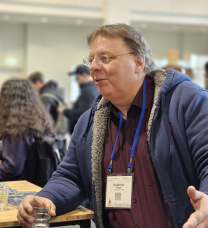
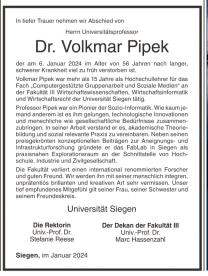
In deep mourning, we bid farewell to Dr. Volkmar Pipek. He passed away on 6 January 2024 at the age of 56 years after a long serious illness, much too early.
For more than 15 years, Volkmar Pipek was a faculty member at Siegen University in the field of "Computer-Supported Cooperative Work and Social Media".
Pipek was a pioneer in Socio-Informatics. Like hardly anyone else, he succeeded in bringing together technological innovation and societal demands. In his work, he had a great capability in aligning academic theory building with societally relevant practices. In his theoretical contributions he lined out the concepts of appropriation, appropriation support, and infrastructuring. He also founded the FabLab in Siegen, a design-oriented space for exploration at the intersection of university, industry, and civil society.
In recognition of his academic achievement, Volkmar Pipek received the EUSSET-IISI Lifetime Achievement Award in 2023.
Our faculty has lost an internationally renowned researcher and a good friend. We will deeply miss his honesty, his unpretentious brilliancy and his creative mindset. Our heartfelt compassion is with his wife, his sister and his close friends.
Pictures
Obituaries:
I met Volkmar in 2000 in Cambridge, Massachusetts. Back then we were working on the book "Sharing Expertise". I was always touched by how generous and kind he was, how agile and approachable, and of course I liked him for his sense of humor.
Later, he showed me around Cologne and I sensed that he was proud to be from Cologne. Much later, we talked about his illness. He was optimistic, perhaps also fatalistic. I thought I sensed his sadness, but he brushed that thought aside.
It's really tragic that he had to go so soon. He was very important to my research, and to many others in all the research communities. His work was a reflection of himself - generous, thoughtful and profound.
I will miss him very much.
--------english--------
I first got to know Volkmar in 2000, when we worked on the Sharing Expertise book while we were all in Cambridge, Mass. I was always struck with how gracious and friendly he was, how quick and thoughtful, and by his gentle humor.
Later he showed me around Cologne, always speaking with pride. Considerably later, we spoke of his illness. He was optimistic or perhaps fatalistic. I thought I detected sadness, but he waved it off.
It is a great tragedy that he passed so early. He was instrumental to my research, and instrumental to many others across several research communities. His work reflected himself - gracious, thoughtful, and deep.
I will miss him greatly.
Dear Volkmar, we met in Siegen in 2006. At the time, you were a junior professor for CSCW and I had just started as a doctoral student at Fraunhofer FIT. Our contacts were therefore sporadic, but very formative, especially for my early scientific development: you helped me to design my first research proposal to the DFG (German Research Foundation), which was the foundation of my scientific work and determined it for a long time. It was also your suggestion to examine my dissertation topic from the perspective of articulation work. At the time, this led to a breakthrough for me in developing my own research agenda. Last but not least, when we set up the Siegen HCI Lab, we came closer together scientifically through our joint work on your idea of "Sociable Technologies". Unfortunately, we lost sight of each other again when I left Siegen and you fell ill. I still benefit from your impulses today, which were and are very valuable and groundbreaking for my scientific work. You were a great teacher and inspiring colleague. Your death is a great loss, both personally and for research.
Thank you for everything.
--------english--------
Dear Volkmar, we got to know each other in 2006 in Siegen. At that time, you were junior professor for CSCW, and I had just started as a doctorand at Fraunhofer FIT. Our contacts were only a few, but very formative, and in the narrower sense for my early scientific development: For example, you were a great help to me in conceptualizing my first research application at DFG that represented the basis of my scientific work and defined it for a long period of time. It was you who made the proposal to investigate my dissertation theme from the perspective of articulation work. This represented the breakthrough for me when it came to the exploration of an own research agenda. Not only in this case we came to a closer scientific cooperation when establishing the Siegen HCI Lab and working jointly on your idea of the "Sociable Technologies". To my regret, we lost contact due to my leaving Siegen and due to your disease. I take profit until these days from your pulses that have been, and still are, valuable and groundbreaking for my scientific work. You were a brilliant teacher and an inspiring colleague. Your death is a great loss, for me personally and for the research. Thank you for everything!
Susan Leigh Star and I have always distinguished (with a certain vagueness) between "friends at heart" and "friends on the street". Although neither of us knew Volkmar as well as we would have liked, he was always a friend at heart to us: someone who bubbled over with enthusiasm and love; someone you could talk to about anything. Yes, we could talk about our ideas - his work with Volker on "infrastructuring" was brilliant. But there was more to it than that. You were always playing and interacting with the whole person, whose love for the world and for his fellow human beings was abundant. Intellectually and emotionally - he was a force of nature who covered my world with insight when I was lucky enough to meet him. He loved his work beyond measure, always looking beyond the edge of formality (which he mastered perfectly) to the life force behind it. His were not insights applicable to specialized fields - although he was quite capable of that - but they made you understand the world in a way that made a difference. To quote Hesiod: I honor his work and his days. I was fortunate to have known him and he will always play a role in my life.
--------english--------
Susan Leigh Star and I always made a (fuzzy) distinction between 'friends of the heart' and 'friends of the road'. Although neither of us knew Volkmar as well as we wished, he was always a friend of the heart: someone bubbling over with enthusiasm and love; someone you could talk with anything about. Yes we could talk ideas - his work with Volker on 'infrastructuring' was brilliant. But it was always more. You were always playing/interacting with the whole man, whose love for the world and for others was abounding. Intellectually and emotionally, he was a force of nature - suffusing my world with insight whenever I was lucky enough to be in his presence. He cared deeply about his work: always seeing beyond the technicalities (which he mastered brilliantly) to the life force behind. His were not insights tailored to specialties - though he could do this - they were ways of understanding the world so as to make a difference. I honor, to cite Hesiod, his works and days. I was fortunate to have known him; and he is a continuing presence in my life.
Ever since I first met Volkmar in Bonn at the ECSCW in 2001, I have admired his work and his lively intelligence. I have been fortunate to get to know him better over the years and also to experience his sense of humor, kindness and generosity. His research work is a rare example of technical innovation that draws on a deep understanding of people in a social world, while also contributing insights about theory and practice. His personal qualities made him a committed, generous, open-minded colleague and friend. I always enjoyed the time I spent with him and I will always remember so many funny incidents, especially the time at ECSCW 2013 in Paphos when we were preparing slides for a conference panel on the beach because there was a free and fast internet connection. All the vacationers who were amused watching these two fully dressed, foreign nerds sitting on deck chairs and mashing the keyboards of their laptops. Every few moments we would burst out laughing because we realized we were being watched, and honestly I don't remember how we got the job done. Throughout the years with his illness, we always spoke openly and empathetically about what he was going through and I felt privileged to have such open and honest conversations with him and I am grateful to have been able to speak and hug him again - for the last time - at CHI 2023 in Hamburg.
Our community has lost a true star. We will all miss Volkmar dearly and never forget him.
--------english--------
Ever since meeting Volkmar for the first time at ECSCW 2001 in Bonn, I have deeply admired his work and his vivid intelligence. Luckily, I got to know him better over the years and to share also in his sense of humor, kindness and generosity. His research is a rare example of technological innovation moved by deep understanding of humans in a social world, always providing insights on both theory and practice. His personal qualities made him an engaging, generous, open-minded colleague and friend. I always enjoyed spending time together, and I will always remember many fun occasions, especially the memorable time at ECSCW 2013 in Paphos when we ended up preparing slides for a conference panel on the actual beach because it had free and fast internet connection. All the holidaymakers enjoying themselves were ogling these two fully-dressed and nerdy strangers sitting on sun chairs and typing away on their laptops. Every minute or so we would burst out laughing at the looks we were getting and I honestly don't know how we got the job done. During his years of illness, he always talked openly and very insightfully about what he was experiencing, and I felt privileged to have those honest conversations with him, and grateful to have a had a chance to speak to him and hug him one last time at CHI 2023 in Hamburg.
Our community has lost a true star. Volkmar will be greatly missed by us all, and never forgotten.
Volkmar, when we were young, we spoke and philosophized with each other almost daily for several years. Your positive, profound and subtle manner made this something special. Even at a young age, you understood that life is something exciting and brings its own challenges. Your closeness was infinitely valuable. Now we can only draw on that. We miss you as an exemplary person and extraordinary personality!
LG Roman
--------english--------
Volkmar, when we were young, we were in contact almost every day over several years, doing philosophies. Your positive, profound, and subtle character made this very special for me. You had understood already as a young man that life with all its challenges is an inspiring thing. Your nearness was so precious to me! From now on, I will savour from the memories. I miss you as a commendable person and extraordinary personality!
Best, Roman
Dear Volkmar,
We knew each other for a long time, and unfortunately our friendship ended too soon.
You were a member of a small community of young computer scientists who went through a difficult phase many years ago (they were fighting against the veteran computer scientists in Germany at the time). You argued and provided the evidence that computer science needed not just technicians, but people who understood that the human side could not be neglected when it came to quality of life in the digital age. You and a few colleagues were an important team in the founding of socioinformatics, development for end users, HCI and CSCW in Germany and around the world.
I still vividly remember our last meeting at the Business Information Systems 2019 conference in Siegen, where you were the co-chair. You addressed the participants at a reception on the evening before the meeting and told them that you would unfortunately not be able to attend the next day because you had to go to hospital for treatment. I was shocked when I heard this, not realizing how far your illness had progressed.
I will miss you very much during my future visits to Siegen, at conferences and other meetings.
--------english--------
Dear Volkmar,
I have known you for a long time - unfortunately, our relationship ended too early.
You were a member of a small community of younger computer scientists who many years ago had a difficult time (fighting the establishment of senior computer scientists at the time in Germany) arguing and providing evidence that computer science did not only require technologists but people who understood that there is a human side to improve the quality of life in the digital age. You (together with a small number of allies) have been an important teammate in establishing socio-informatics, end-user development, HCI, and CSCW in Germany and around the world.
I vividly still remember our last personal encounter at the "Business Information Systems 2019" conference in Siegen for which you served as a co-chair. You addressed the attendees the night before the meeting started at a reception informing us that you unfortunately would not be able to attend the conference because you had to go to a hospital for treatment the next day. This information shocked me at the time but I did not understand how seriously ill you were already at that time.
I will greatly miss you in my future visits to Siegen, to conferences, and to other meetings.
Volkmar Pipek was blessed with a special gift. When talking to him, he would throw in a friendly and inviting intellectual remark. He had a keen sense of the intellectual interests and scientific needs of his interlocutors. Volkmar often surprised me - and many others - with this special communicative gift. While every grant proposal must include credible concepts for inter- and transdisciplinary work, Volkmar showed a deeper sense of interdisciplinarity. You could always talk to him about data, whether you came from biology or media studies. And you could be sure that whatever the topic, Volkmar would contribute a friendly comment paired with a pun. This mindset could be described as "a sense of computer-aided cooperative research". When Erhard Schüttpelz and I started to set up the CRC Media of Cooperation in Siegen, we came across Volkmar and Volker Wulf's seminal text on "Infrastructuring". I still have an extensively annotated print version of this article, which appeared online in 2009 and is now a frequently cited document in media studies. To honor Volkmar's legacy, we should all read this paper again - as a source of inspiration, which it still is. When I met Volkmar for the last time, he was already very calm, serene and composed. All his friendliness and cooperative spirit could still be felt, but there was already something new in his words, a relaxed wisdom. We will miss you, Volkmar!
--------english--------
Volkmar Pipek had the most marvelous gift. In any conversation he could just come a up with a friendly and welcoming intellectual remark. He had a keen sense for the other's intellectual interests and scientific needs. So Volkmar surprised me - and many others - with that specific communicative gift. While every grant proposal must come up with believable concepts for interdisciplinary and transdisciplinary work, Volkmar deeply embodied a spirit of interdisciplinarity. You could talk data with him all the time, no matter whether your background was in biology or media studies. And you could be sure that you'll get a friendly remark with a pun by Volkmar on pretty much any possible subject. We should call that spirit a sense for computer-supported co-operative research. When Erhard Schüttpelz and I set out to establish the Siegen-based CRC Media of Cooperation we turned to Volkmar's and Volker Wulf's seminal text on "Infrastructuring." I still have a heavily annotated paper print of that article, which appeared online in 2009. It has now become a well-cited paper in media studies, too. To honor Volkmar's legacy, we should all re-read it as the inspiration that it still is. When I last met Volkmar, he was already very calm and serene. All his friendliness and cooperative spirit was still there, but there was also a new, relaxed wisdom in his words. We will surely miss you, Volkmar!
Volkmar joined the Software Ergonomics and CSCW project area at the University of Bonn after graduating, and he was an immediate asset: a real computer scientist with a wide range of interests with whom you could talk about everything.
We were lucky with the acquisition of third-party funding and worked on different projects with many points of contact and one or two joint publications.
I had lost sight of Volkmar somewhat. Now it's too late and I'm sad.
--------english--------
After having received his diploma, Volkmar attended projects for software ergonomics at Bonn university, and right away he was a gain: a true computer scientist with a diverse portfolio of interests with whom one could discuss about everything and anything.
We were lucky with the acquisition of third-party funds, and we worked on various projects that offered many points of reference and we published the one or other paper together.
I lost sight of Volkmar. Now it's too late, which makes me sad.
Dear Volkmar, it was a great honor to know you and I always appreciated your openness, objectivity and kindness. I will never forget how you gave me support and explained the background in the context of the SFB "Media of Cooperation". It is a great pity that you left us so early, we could have made a lot of progress together.
--------english--------
Dear Volkmar, for me it was a great honor to know you, and I highly estimated your frankness, practicality, and your caring attitude. I will never forget when you supported me, in the context of CRC "Media of cooperation", and explained the backgrounds. It is a real pity that you are no longer with us, at a much too early stage of life. Together, we would have been able to promote so many more things.
I met Volkmar at the end of the 1990s, together with Volker and Markus. Although we never worked on a project together, we often met at program committee meetings, conference dinners and get-togethers during our COST Action Sharing&Caring (a program name that really suits Volkmar!) not only all over Europe, but all over the world. I have always admired his intellectual abilities. His publications have strongly influenced the CSCW communitywork, and I have often referred to his papers (and will continue to do so in the future) when discussing usage and end-user development with my students. But it wasn't just his papers. At meetings or even in private discussions, he constantly contributed to the conversation with his insightful remarks, and he drew attention to key points that some of us might have missed, because he had a strong knowledge beyond CSCW. How sad that he also became an expert on cancer and its treatment options. Nevertheless, I will always remember his intellect, his warm and friendly manner, his appearance when he showed up at early meetings with his long, still damp hair - very refreshing! I am deeply saddened by his untimely passing. We will miss him and the team in Siegen will not be the same without him.
--------english--------
I met Volkmar at the end of the 1990s, alongside Volker and Markus. Although we never collaborated on a project together, we shared numerous program committee meetings, conference dinners, and gatherings during our COST Action Sharing&Caring (a name that truly suited Volkmar!) across Europe and around the world. I always admired his intellectual capacity. His published work has been profoundly influential in the CSCW community, and I often referred (and will refer) to his papers when discussing appropriation and end-user development with my students. It wasn't just his papers. During meetings or casual discussions, he consistently offered the most insightful comments, highlighting crucial points that some of us may have overlooked, as he possessed extensive knowledge beyond CSCW. Sadly, he also became an expert in cancer and its treatments. Yet, I will always remember not only his intellect but also his warmth and friendliness, the way he would arrive at early meetings with his long, wet hair, so refreshing! I am deeply saddened by his premature departure; he will be profoundly missed, and the Siegen team will never be the same without him.
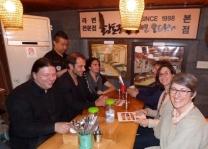
A dinner during CHI in Seoul
Volkmar was an extraordinary person, doctoral supervisor, mentor and friend over the years. Volkmar's influence on my life is immeasurable and will always hold a special place in my heart.
It was Volkmar who gave me my first student job and showed me that technology achieves its greatest significance when it is used for the good of society. After my thesis, it was Volkmar who convinced me to continue academically and take a position as a research assistant in his group. I come from a non-academic family, and it was Volkmar who not only supported me during my doctorate as my supervisor, but also actively encouraged me in almost all scientific areas. He not only opened the doors to the academic world for me, but also accompanied me on my way by always supporting me in my career.
Over the last 16 years, our relationship developed beyond the purely professional. Volkmar became a friend who always stood by my side with his wisdom. I will always cherish the memories of our conversations, the deep discussions and our joint research work. Just a week before he passed away, we were still talking shop about the content developments of our research groups, how to support the adoption of Artificial Intelligence and how to bring back more technological applications to CSCW research: a testament to his continued passion and dedication to science.
With Volkmar's loss, I lose a valued colleague, an inspiring PhD supervisor, a wise mentor and a friend. May we all find solace in the memory of a man who was not only an outstanding scientist, but also a fighter, teacher and friend. Volkmar's life's work will live on in our hearts and minds.
Thank you Volkmar, it was an honor to know you.
--------english--------
Volkmar was an extraordinary type of man, doctoral supervisor, mentor, and having become a friend over all those years. Volkmar's influence on my personal life is immeasurable and will always take pride of place in my heart.
It was Volkmar who employed me at the beginning of my student life and he showed me that technology achieves its greatest importance when it is used for the benefit of society. After my diploma thesis, it was again Volkmar who convinced me to continue my academic working and to commence a position as research assistant in his group.
Me being a child with a non-academic family background, Volkmar was not only my supporter during my doctoral phase, but also my doctoral supervisor and he promoted me in nearly all scientific topics. Not only he opened the doors to the academic world, but also he accompanied and supported me in my career.
During the last 16 years, our relationship developed beyond the merely professional aspect. Volkmar became a friend of mine who was, with this wisdom, always on my side. I will always cherish the memories of our conversations, the in-depth discussions and our joint scientific research projects. Only a week before he passed away, we had shoptalk on the content of the developments of our research groups, for example how the adaptation of AI can be supported and how we can position, in a stronger way, technological applications in CSCW research: evidence of his never-ending passion and commitment to science.
By Volkmar's passing away, I lose an estimated colleague, an inspiring doctoral supervisor, a wise mentor, and a friend. May we all find solace by remembering a person who was not only an extraordinary scientist, but also a fighter, a teacher, a friend. Volkmar's lifework will live on in our hearts and minds.
Thank you, Volkmar, it was a great honor for me to know you!
The pictures on the memorial page bring back memories of Volkmar for me. When we spoke about 15 to 25 years ago, he seemed like a friendly bear to me. He was warm, friendly, thoughtful - and of course quite clever. One of the many reasons I liked him was that he wasn't self-absorbed in his intelligence. He was interested in the people around him, serious and patiently inquiring. Volkmar was a human being with feelings and he was brave enough to name his vulnerability. He had a big heart. I miss him and will remember him in my heart.
--------english--------
The pictures on this memorial page bring back such memories of Volkmar. When we talked together, 15-25 years ago, he was somehow like a friendly bear. He was warm, kind, thoughtful, and of course very smart. One of the many reasons that I liked Volkmar was that he was not interested in his own intelligence. He was interested in the people around him, with a sincere and patient inquiry. Volkmar was also a person of feelings, and he was brave to discuss his vulnerabilities. He had a very big heart. I have been missing him, and I will hold him in my heart.
I got to know Volkmar Pipek in 1999 when he was leading the Politeam project and I was in the final phase of the OrgTech project (Volker Wulf, previously project leader, had moved to a professorship at short notice). Also, because I was working on the same project with Paul Fuchs-Frohnhofen in Aachen at the same time, it was quite a challenging and unusual situation for me as a sociologist. During this time, I shared the office with Volkmar - which was very fortunate because I was able to pepper him with questions. And so I learned from him how committed computer scientists work, how they access scientific sources, publish and position themselves. And how relaxed manners can be. Volkmar taught me a lot every day!
When Volkmar was born, I was already at school, when I met him I had a doctorate (he hadn't yet). Nevertheless, we immediately met as equals - we always teased each other a bit. For example, I was amused by one of Volkmar's diets, which involved him eating nothing at all during the day for two weeks - and becoming increasingly grumpy as the day wore on. I still think of this today when I see the Snickers advertisement: "You're not you when you're hungry": just like in the advertisement, Volkmar took a chocolate bar (in Volkmar's case a Toblerone) out of his drawer at the end (always around 5 p.m.), ate it - and was his old self again! If I wanted something from him: before noon or after 5 p.m.!
I remember this temporary nerdiness - because Volkmar actually represented the exact opposite for me! With his rationality, professionalism and experience, he would have had every reason to look down on others, e.g. me as a newbie. But that didn't happen! Instead, with Volkmar I experienced a great interest in people and an understanding of the interconnectedness of topics, a problem-oriented interdisciplinary approach to the world, for which respect for other perspectives and practices was also constitutive.
I have fond memories of Volkmar.
--------english--------
I made Volkmar's acquaintance in 1999 when he was the head of the Politeam project and I in the final phase of OrgTech project (Volker Wulf, the preceding head of project, had accepted a visiting professorship elsewhere). For me, as a sociologist, this was a highly demanding and unfamiliar situation, also because I worked simultaneously for and with Paul Fuchs-Frohnhofen, Aachen university, on the same project. At that time, I shared an office room with Volkmar - what a lucky guy I was! - so I could drill him with questions. Hence, I learnt from him how committed computer scientists do their work, how they render scientific sources accessible, how they publish and position themselves. And how casual business etiquette can be. I kept learning a lot from Volkmar every day!
When Volkmar was born, I enrolled in school. When I first met him, I had already graduated, in contrast to him. Despite this, we met on equal level - and teased each other in some case or other. For example, I found Volkmar's dieting funny. The routine was that he did not eat anything during daytime for two weeks, which resulted in him getting more and more grumpy the more the day flew by. Every time I now take a glimpse of a Snickers pub "You are not yourself as long as you are hungry", I remember that Volkmar, at the end of a working day, around 5 p.m., picked a chocolate bar from his drawer (he loved Toblerone), munched it - and was himself again. Whenever I wanted to obtain something from him: best time for this was before lunch or after his chocolate break!
I remember this occasional nerdiness - because Volkmar, in my opinion, represented exactly the opposite! With all his rationality, professionalism and experience he would have had enough reason to look down on others, for example on me as a newbie. But this he didn't! Volkmar showed a great interest in people and he had a great deal of understanding for issues intersecting, he approached the world in a problem-oriented, interdisciplinary way, and respect was a major thing for him in encountering other ways of thinking and other practices.
For my part, I will always think of him with pleasure.
I wondered when I actually met Volkmar for the first time. It must have been about 15 years ago, at a CSCW or CHI conference, and at that time I would not have expected him to play a more significant role in my academic career. I remember having dinner with him at a Chinese restaurant when I first came to Siegen. We had a very nice evening, with lemon chicken and beer. I was taken with him, he was always friendly, interested, enthusiastic, humorous and he liked to chat (in the best sense of the word). In short, I was in the best of company. In the years that followed, I got to know him better and slowly developed a kind of appreciation for his intellect. As soon as he started to shine when he talked about ideas he or someone else had, his eyes would sparkle and it was wonderful to see. It was a privilege to talk to him in the Socratic manner (it was difficult to find out who was actually playing Socrates), with his endless questioning of himself and others. Discussions were often very profound, but never in a bad mood. When I worked with him in areas such as crisis management, I noticed how many doctoral students were inspired by him. I saw how much his kindness fueled his work with them. I saw how he embodied the combination of precision and imagination that produces the best ideas. His students and direct collaborators will forever be in his debt, and his friends will sorely miss him. In the words of Nehru, "The light has gone out of our lives. Darkness has fallen. I don't know what to tell you or how. Our dear friend, the father of our group, is no longer with us. Perhaps I am wrong to say this. Nevertheless, we will never see him again as we have seen him over the years. We will no longer be able to ask him for advice or seek comfort from him, and that is a bitter blow..."
--------english--------
I was trying to remember when I first met Volkmar. It must have been some 15 years ago, at a CSCW or CHI conference and at the time I never thought or expected he would come to play a more significant role in my academic life. I do remember going for a chinese meal with him the first time I ever came to Siegen and enjoying a very pleasant evening over beers and lemon chicken. Even then, I was charmed. Volkmar was always kind, interested, enthusiastic, humorous and (in the nicest way) gossipy. In short he was great company. I got to know him better in the years which followed and slowly developed an appreciation for his intellect. When he became animated over the ideas that he or someone else had, the fizz and spark was something to see. To participate in a Socratic dialogue with him (occasionally difficult to work out who exactly was playing Socrates), with his endless questioning of self and others, was a privilege... Discussions could be profound but they were never bad tempered. Working with him in areas like crisis management, I came to see how much PhD students depended on him for inspiration. I came to see how much his kindness infused his work with them. I came to see how he embodied the combination of rigor and imagination that produces the best ideas. His students and close colleagues will always be indebted to him and his friends will miss him badly. To paraphrase Nehru:
"The light has gone out of our lives and there is darkness. I do not know what to tell you and how to say it. Our beloved friend, a Father of our group, is no more. Perhaps I am wrong to say that. Nevertheless, we will never see him again as we have seen him for these many years. We will not run to him for advice and seek solace from him, and that is a terrible blow ...
I owe my scientific orientation to my encounter with Volkmar. As a newly appointed junior professor, Volkmar Pipek was the person in whose new project on communication in the event of a power failure I started as a student assistant at the university in 2006 and thus got my first contact with security research - an area in which I am still active today and which became the basis for all my other activities. Later, Volkmar became the supervisor of my diploma thesis and, after my return to university, also of my doctoral thesis. I have very fond memories of the pleasant contact, the breakfast meetings, the great freedom and his trust! Even after my appointment to a professorship in Darmstadt, for which the results of our collaboration were also decisive, we remained in contact. I will always have fond memories of Volkmar.
--------english--------
I owe my scientific orientation to my encounter with Volkmar. As a newly appointed assistant professor, Volkmar Pipek was the person in whose new project on communication in the event of a power outages I started as a student assistant at the university in 2006 and thus got my first taste of security research - an area in which I am still active today and which became the basis for all my subsequent activities. Later, Volkmar became the supervisor of my diploma thesis and, after my return to university, also of my doctoral thesis. I have very fond memories of the pleasant contact, the breakfast meetings, the great freedom and his trust! Even after my appointment to a professorship in Darmstadt, for which the results of our collaboration were also decisive, we remained in contact. I will keep a good memory of Volkmar.
You seemed calm, composed, objective, realistic but confident.
In our last conversations, you were still carefully considering plans, ideas, projects for the future, writing another paper, maybe going away again, a little trip over the weekend as soon as you were feeling a bit better.
You've known for years where your journey was taking you, you had no illusions, but I've never seen you despondent, complaining or bitter. I admired you for your calm strength, for your courage and the medical expertise that you have acquired over the last few years, systematically, analytically, researching. I didn't realize that you were worried about yourself, but about your wife and your friends. You were concerned about your colleagues, concerned about your staff, about PhD students, about their supervision and support.
We have worked together in prosec since the early 1990s in bonn, founded the iisi together in 2000 and published the international reports, built up the siegen socio-informatics with colleagues, co-published, worked together on projects, organized events and gave lectures. But we also traveled together, ate, drank, laughed and partied.
When I defended my dissertation, you unexpectedly turned up unannounced, partly to support me and to celebrate with me afterwards. You made the extra trip to roskilde for it. After your own dissertation, you told me about your experiences in finland, about polar lights, eternal days and nights, Finnish tango and very strange parties. Maybe that's why your promotion took a little longer than originally planned - just like mine.
When you were awarded a prize for your scientific life's work last year, all the jury members emphasized how much your work had inspired them and influenced their own research and how often they had used your publications for their teaching. You have contributed to the education of young scientists not only directly through your teaching activities in siegen, but also in the international academic community through your insights and ideas, as set out in your texts. And you will continue to do so.
Moreover, you were one of the few people I know who could quote Lucy Suchman or Susan Leigh Star and Geoffrey Bowker as well as Chumbawamba or the Neubauten off the top of their head.
Volkmar, you left on a day when we remember three kings following a brightly shining star. For all of us, this star now shines a little less brightly. But it does not fade, does not disappear. You did not fade away! You remain. Here in our presence, with your inspiring ideas, your concepts and writings that will live on in us and in future generations of students and academics.
But you leave a gap - not only in our research group, but in the scientific community. And this gap will remain. As scientists, we always try to close gaps in our knowledge, but as human beings, we will have to learn to live with the emotional gap you leave behind.
It feels surreal to walk past your empty office with your name still on the door. Something tightens inside me, it hurts.
Volkmar, my friend, I miss you!
--------english--------
You seemed calm, composed, matter-of-fact, realistic but confident.
In our last conversations, you were still carefully considering plans, ideas, projects for the future, writing another paper, maybe traveling again, a little trip over the weekend as soon as you were feeling a bit better.
You've known for years where your journey was taking you, you had no illusions, but I've never seen you despondent, complaining or bitter. I admired you for your calm strength, for your courage and the medical expertise that you have acquired over the years, systematically, analytically and through research. I didn't notice that you were worried about yourself, but about your wife and your friends. You were concerned about your colleagues, concerned about your staff, about PhD students, about their supervision and support.
We have worked together in Prosec since the early 1990s in Bonn, founded the IISI together in 2000 and published the international reports, built up the Siegen socio-informatics with colleagues, co-published, worked together on projects, organized events and gave lectures. But we also traveled together, ate, drank, laughed and partied.
When I defended my dissertation, you unexpectedly turned up unannounced, partly to support me and to celebrate with me afterwards. You traveled all the way to Roskilde for this. After your own dissertation, you reported on your experiences and adventures in Finland, on polar lights, eternal days and nights, Finnish tango and very strange parties. Maybe that's why your promotion took a little longer than originally planned - just like mine.
When you were honoured with a lifetime achievement award last year, all the jury members emphasized how much your work had inspired them and influenced their own research and how often they had used your publications for their teaching.You have not only contributed directly to the education of young academics through your teaching activities in Siegen, but also in the international academic community through your insights and ideas, as set out in your texts. And you will continue to do so. You were also one of the few people I know who could quote Lucy Suchman or Susan Leigh Star and Geoffrey Bowker as well as Chumbawamba or the Neubauten off the top of their head.
Volkmar, you left on a day when we remember three kings following a brightly shining star. For all of us, this star now shines a little less brightly. But it does not fade, does not disappear. You did not fade away!
You remain. Here in our presence, with your inspiring ideas, your concepts and writings that will live on in us and in future generations of students and academics. But you leave a gap - not only in our research group, but in the scientific community. And this gap will remain. As scientists, we are always trying to close gaps in our knowledge, but as human beings, we will have to learn to live with the emotional gap you leave behind.
It feels surreal to walk past your empty office with your name still on the door. Something tightens inside me, it hurts.
Volkmar, my friend, I miss you!
I remember that Volkmar was the first person in Siegen to welcome me on my first day in Siegen. He was in a good mood and introduced me to the research group. During my first days in the research group, when I was exploring research ideas and case studies, he motivated me and told me I was on the right track. He was always very helpful to me, he cared and was easy to deal with. If I wasn't making progress with my work, all I had to do was speak to him and he would come up with a cornucopia of ideas to get my work moving again. He was always encouraging. During the presentation of my paper at CHI 2010, he saw me standing nervously in front of a large audience. He had no problem giving a 30 second crazy CHI presentation. That took the tension out of presenting my paper.
When I found out about his illness a few years ago, I was shocked at first and then relieved when I heard that he was getting better. The news of his death made me very sad. As a good researcher, mentor and person, he leaves a gap.
I miss you, Volkmar!
--------english--------
I still remember Volkmar was the first person to welcome me in Siegen on my first day in Siegen in October 2007. He was very positive and introduced me to the research group. During my early days in the research group when I was exploring research ideas and case setting, he always motivated me that I am on the right track. I have always found him very helpful and caring and easy to approach. Whenever I was stuck in my work I could reach out to him and he would come up with many ideas to take the work forward. He was always encouraging, during my paper presentation at CHI 2010, he saw me nervous in presenting Infront of a large gathering, so he volunteered to present a 30 second CHI madness presentation on my behalf so that I am a bit relaxed in my regular presentation of paper.
I was very shocked to hear about his illness a few years back and then was very happy that he started feeling better. However, the news of his death made me really sad as a good researcher, mentor and human being has left a void.
Miss you Volkmar!
I still remember when I received the first of Volkmar's papers to read. It led me straight into his views on several fascinating areas that later inspired my own research. With him, the University of Siegen loses a great colleague and the world loses a bright mind and a dedicated researcher in the field of socioinformatics. May Volkmar rest in peace.
--------english--------
I can still remember the first time I read one of Volkmar's papers. It immediately led to deep dive into his view on several fascinating topics, which later inspired my research. University of Siegen will miss a great colleague, and the world one truly bright mind and an engaged researcher in the domain of social informatics. Rest in peace Volkmar
Dear Volkmar, in your work in the academic world you showed yourself to be an exceptional scientist who possessed a unique combination of critical thinking, deep reflection and a capacity for clear, precise argumentation.
Your tireless dedication to examining issues from all sides was inspiring. Your scientific path was characterized by a constant urge to deepen understanding and not to accept surface explanations. This aspiration reminds us that true learning requires a dedication to delve into the depths of knowledge.
As someone who has had the privilege of engaging with your ideas, I can attest to the lasting impact of your contributions to science. Your work continues to influence my own intellectual journey and remind me of the power of rigorous research. In that sense, your legacy lives on not only in the academic world, but also in the minds and hearts of those who were fortunate enough to be touched by your work.
--
Dear Volkmar, in your work in the academic world, you showed yourself to be an exceptional scholar who possessed a unique combination of critical thinking, deep reflection, and a capacity for clear, precise argumentation.
Your tireless dedication to examining issues from all sides was inspiring. Your scientific path was characterized by a constant urge to deepen understanding and not to accept surface explanations. This aspiration reminds us that true learning requires a dedication to delve into the depths of knowledge.
As someone who has had the privilege of engaging with your ideas, I can attest to the lasting impact of your contributions to science. Your work continues to influence my own intellectual journey and remind me of the power of rigorous research. In this sense, your legacy lives on not only in the academic world but also in the minds and hearts of those who were fortunate enough to be touched by your work.
Dear Volkmar,
I was standing next to you at your bedside, we had arrived too late ... too late ... it was the end of a long, close, not always frictionless, but formative friendship between the two of us.
I remember how we became colleagues and very quickly also friends ... at the University of Bonn ... at Römerstraße 164 .... We spent long nights together in the office, discussing, brooding over essays - usually very close to the deadlines. Markus drove past this building in a cab - on the night you died.
You had studied computer science in Kaiserslautern with a focus on artificial intelligence (AI) - which was also an academic hype at the time. Our boss at the time hired you ... clearly against our will ... we didn't want - in our hasty eyes - an "AI-er" in our mainstream-critical working group. What followed is, in a way, history ...
We became fast friends and understood that you - technically much better educated than most of us - would pursue a decided vision of human-centered design of IT. We quickly agreed that IT should primarily serve the people (citizens, employees, etc.) and not primarily the institutions. You saw great potential in the use of IT to strengthen (grassroots) democratic participation, especially in political decision-making processes. One of the first activities in this field was the participation in the software ergonomic design of the Bundestag's petition portal.
Together with Mark Ackerman, we developed a concept of knowledge management that placed the actual working practices, the skills of employees and their personal exchange for learning from each other at the center of IT-technical support. Our jointly edited book "Expertise Sharing: Beyond Knowledge Management" was published by MIT Press and was well received in international discourse.
At the same time, you worked on your dissertation with your characteristic creativity. With a perspective oriented towards practical use, you designed how people collectively make an IT artifact their own and how these activities could be supported technically. In doing so, you formulated the concept of appropriation that is central to the Siegen style of socio-informatics, which was later developed further in the work of Gunnar Stevens. Through a generous invitation to Oulu/Finland, Kari Kuutti made it possible to complete this research - at a time when there was almost nobody in Germany who would have supervised such a doctoral topic. The profundity of your thinking and your own perfectionism drove this project forward and kept you intensively occupied and committed for years - right up to your physical limits!
After completing your dissertation, you, now a professor at the University of Siegen, took the concept of appropriation support a step further and generalized it from the world of software artefacts to physical artefacts. In the terminology you developed, a 3D printer with context-specific projected information and communication options with the user community and hotline is an example of a 'sociable technology'. You have also embedded the concept of appropriation in a broader understanding of socioinformatics theory formation. The concept of 'infrastructuring' describes the interrelated development of social practices and the IT artefacts that support them and are equipped with technical and interpretative flexibility. The moment of appropriation becomes a creative event that enriches the actors' repertoire of actions.
Concept formation is always nourished by a pool of design case studies. In this respect, you have been interested in a variety of areas of life and work - always with the perspective of exploring the emancipatory effect of suitably designed IT artifacts. In the field of civil security research, you have investigated how social media applications help people in emergency situations to organize themselves. During our last conversation on New Year's Eve - shortly before we finally said goodbye - you outlined this vision once again ... we had discussed empirical findings from my stay in Ukraine.
One of your key institutional legacies is the FabLab in Siegen. Like few others, you recognized the creative-emancipatory potential of an exploration space for high-tech design tools early on. Under Marios Mouratidis' moderation, your vision has become reality. In the FabLab, citizens, employees, students, entrepreneurs, pupils and pensioners come together, work on innovations and create community.
A few years ago, you were diagnosed with pancreatic cancer. An initially successful operation had given us all high hopes of beating the statistics. You engaged with your illness like hardly anyone else, penetrating it intellectually - in an effort to live. There was probably no scientific article on this type of cancer that you didn't read and weigh up in terms of its significance for your suffering. In dialog with a group of doctors, you ultimately decided on your treatment methods in a largely self-determined way. You were not allowed to die ... I always wished I had such a wise and well-read companion should I ever meet a similar fate!
In recent years, your life has been characterized by a succession of chemotherapies. They have massively affected your quality of life and structured your life in weeks with and without chemo. We saw less of you - also due to a rather unfortunate framing. In the end, you lost the battle after five and a half years ....
The last few weeks were intense, you came to our Christmas party and gave a short speech - about what socio-informal work means to you. Your speech and appearance - already in a wheelchair and with oxygen support - is deeply remembered by many of our colleagues.
The day after Christmas, you were admitted to a hospital in Cologne. You had problems with your oxygen supply at home, but otherwise felt you were still in good condition. Over the days, we spent several hours together at your bedside ..... You still wanted to live ... you still had plans for what you still had to do and wanted to do .... We were closer ..... than we had been for a long time.
Mika and I then went to Paris for a few days in the New Year ... when we were on the train on the way back, the news came that you were dying ... we were too late when we arrived at the hospital!
Thank you for more than 25 years of work, life and friendship together ... still with tears in my eyes...
Volker
--------english--------
Dear Volkmar,
I stood aside your bed, we had arrived too late... too late... it was the end of a long, tight, not always smooth, but formative friendship for both our sides.
I remember of how we got colleagues and, very soon, friends... at the Bonn university... Römerstraße 164... We discussed essays, long nights spent together in the office, the deadline like a pendulum in our inner eyes. In the night when you died, Markus, in a cab car, rode along this building...
You had studied computer science at Kaiserslautern university, setting a focus on Artificial Intelligence (AI) - this was an academic hype at that time. Our then Superior employed you... clearly against our will. We had not envisaged - in our overhasty eyesight - to have an AI nerd in our working group that was critical about the mainstream. The following development is in a certain way history...
Soon we became friends and understood that you - you had a much better technical qualification than most of the others in our group - were following a firm vision of human-oriented interpretation of IT. We soon came to a mutual conclusion that IT should in the first instance serve the people (citizens, employees, etc.) and not the institutions. You recognized a great potential in the usage of IT to strengthen (grassroots)-democratic participation, especially when it comes to political decision processes. One of the first activities in this field of topics was the involvement in the software-ergonomic design of the petition site of the German Bundestag.
In cooperation with Mark Ackerman, we developed a concept of knowledge management putting the actual work practices, the competences of the employees and their personal interchanging for learning of each other into the focus of IT support. Our jointly edited book "Expertise Sharing: Beyond Knowledge Management" was published by MIT Press and evoked a considerable echo in the international discourse.
In parallel with this, you elaborated on your dissertation with your intrinsic creativity. You built a concept based on a perspective oriented by the usage practice how human beings can appropriate an IT artefact collectively and how such activities could be supported from the technical side. In this context, you invented the central appropriation term that was, at a later stage, enhanced by Gunnar Stevens. The generous invitation to Oulu/Finland, Kari Kuutti has enabled to finalize this research project - at a time when in Germany there was almost nobody who was capable of supervising such a doctoral theme. The profoundness of your thinking and your intrinsic perfectionism promoted this plan. It kept you busy over years - and kept you bound - up to your physical limits!
After having terminated your dissertation and while you had been appointed professor at the Siegen university, you kept looking ahead on the concept of appropriation supporting, and you also generalized the software artefacts to the physical artefacts. A 3D printer with context-specific projected pieces of information and communication opportunities with the user community and hotline represents a sample for a "sociable technology" within the terminology that you developed. You embedded the appropriation term in a broader understanding of socio-informatics theory forming. The concept of "infrastructuring" describes the development of social practices related to each other with the IT artefacts that they support and that are equipped with technical and interpretative flexibility. The moment of appropriation mutates to the creative event that will enrich the repertoire of activities of the stakeholders.
Building a concept always takes nourishment from a stock of design case studies. In this context, you showed interest for a multitude of areas of living and working - always with the perspective to explore the emancipatory effect of suitably designed IT artefacts. In the domain of research on civil safety you investigated how "Social Media" applications can help people to organize themselves in an emergency case. When we had our very last conversation on New Year's Eve - just a moment before our final farewell - you laid out your vision ... we had discussed empirical findings after my stay in the Ukraine.
One of your major institutional legacies is the Siegen FabLab. As early as only a few others, you had recognized the creative-emancipatory potential of an exploration lab for high-tech design tools. Under the moderation of Marios Mouratidis, your vision has become vivid practice. Citizens, employees, students, entrepreneurs, pupils, and retirees meet in the FabLab for crafting innovative things, having fun in their community.
Some years ago, you fell sick with pancreas cancer. It was after a successful operation that all of us thought that the statistics could be played a trick on. As almost no one else, you let yourself in for the disease. You dipped into the disease intellectually, always having in mind your deep wish to survive. You must have read and studied each and every scientific essay describing this kind of cancer. You balanced the pros and cons in the context of your ailment. In the dialog with a group of medical specialists how to proceed with the medication and treatments, you took your decisions on your own. You were not to die... I have always begged to have such a knowledgeable and deep-read companion, should I one day be in a similar cruel fate!
Your life has been stricken by a sequence of chemotherapies during the recent years. They had a massive impact on your quality of life, they structured your life in "weeks with / without chemo". We failed to meet you more and more often - also owing to a rather unhappy framing. Eventually, you lost the battle after five and a half years...
The last weeks passed with intensity. You even managed to join our Christmas get-together, held a short speech on what means socio-informatics working to you. Your speech and appearance - already in wheelchair and with an oxygen supply device - will remain in the minds of the present colleagues.
One day after Christmas you had to go to a Cologne hospital. At home, you had to suffer from problems with the oxygen supply, but felt quite fit in other respects. During the next days, we spent some hours together... I sat at your bedside. You wanted to live on... had plans what to organize, what to do... We felt so close to each other, close like seldom before.
In the first week of 2024, Mika and I went to Paris for a short holiday. When we sat in the train back home, we received word that your end was near... we arrived too late in the hospital!
Thank you for more than 25 years of working and living side by side, for your friendship... still with tears in my eyes...
Volker
It is with deep sadness that we bid farewell to our long-time friend and professor Dr. Volkmar Pipek, who passed away far too early on January 6, 2024 at the age of 56 after a long illness.
Volkmar founded our Fab Lab in Siegen in 2015 as an interface between university, industry, art and culture.
With the Fab Lab, the broad civil society in the Siegen-Wittgenstein district was able to experience research in a low-threshold way for the first time at the University of Siegen, from which our lively community has developed over the last 9 years. Open, low-threshold and free access to technology and knowledge about it has always been a matter close to his heart.
With Volkmar, the Fab Lab has been able to make a major contribution to strengthening regional innovation, with numerous companies and start-ups working and learning with the Fab Lab in the field of digital technologies.
As an extracurricular place of learning, the Fab Lab has been able to inspire many young people and get them excited about technology.
The Fab Lab has also been involved in the fields of culture and urban history during this time, which has led to friendly collaborations with regional institutions.
We are losing a valued colleague and friend. We will greatly miss him and his human, visionary and creative nature. Our deepest sympathy goes out to his wife, his sister and his circle of friends.
Team Fab Lab
--------english--------
In deep mourning, we bid farewell to our long-time friend and professor Dr. Volkmar Pipek who passed away, much too early, on 6 January 2024 at the age of 56 years after a long period of illness.
Volkmar was the founder of the Siegen Fab Lab in 2015. This lab serves as hub between university, industry, arts, and culture. With the Fab Lab, the broad civil society of the local district of Siegen-Wittgenstein was offered a low-threshold possibility to get a glimpse into scientific research. During the recent nine years, this lab developed to a vivid community. The easy-access lab is open to the public free of charge for technology, and Volkmar was always interested in knowing about the ongoing activities.
Under the aegis of Volkmar, the Fab Lab rendered an important contribution to strengthen the regional innovation. A large number of companies and start-ups work and learn with the Fab Lab things around digital technologies.
The Fab Lab, as an extra-mural learning environment, was able to inspire young people, to make them enthusiastic for technics.
Another division of engagement is the culture and the local history of the town of Siegen. This enabled cooperations with regional institutions on a friendship basis.
We have lost an estimated colleague and friend. We will miss him and his human, visionary, and creative mindset. Our deepest condolences are submitted to his wife, his sister, and his circle of friends.
Team Fab Lab