YoungPoetry
Thanks to the Christa and Dieter Lange Foundation, it is possible to offer school readings from year 7 onwards in the YoungPoetry format and to use literature to engage in conversation with young people about current social issues. In 2025, authors of books for young people were invited to speak on the topic of "80 years since the end of the Second World War". In 2026, the topic will be "Mental health as reflected in current youth literature".

Nina Weger
"When my brother became a whale" (12. 12. 2025, Bertha-von-Suttner-Gesamtschule)
"The content has to be right"

Author Nina Weger read at the Bertha von Suttner Comprehensive School to kick off the new YoungPoetry series "Mental Health in the mirror of current youth literature"
The theme of the Science Year 2026 is "Medicine of the Future". In line with this, the House of Science at the University of Siegen is offering school readings on the topic of "Mental health as reflected in current youth literature" in 2026. The Siegen-based children's and young adult literature expert Dr. Jana Mikota is in charge of selecting the authors. The project is once again sponsored by the Christa-und-Dieter-Lange-Stiftung. Jana Mikota: "Mental health, mental health or resilience - these terms have played an important role in social discourse since the pandemic at the latest. It's about the question of how to overcome the problems of the present. On the one hand, children and young people experience social crises and are confronted with complex problems such as the war in Ukraine or right-wing radicalism on an almost daily basis; on the other hand, they also experience pressure and conflict within their peer group: staging on social media, bullying in the school playground, judgment of their body or clothing. But what else can children's and young adult literature do? Childhood/childhood patterns are told in many different ways and readers encounter different heroic figures in the literary world who can be role models, but who can also strengthen them and give them courage."
To kick off the new series, author Nina Weger was a guest in Siegen and at Bertha-von-Suttner-Gesamtschule in December 2025. She read from her young adult novel "When my brother became a whale" to Year 7 pupils. In her book, the author tackles the difficult and complex subject of dealing with coma patients. The story: Bela's older brother falls into a vegetative state after a traffic accident. He is discharged home "out of therapy". There, the pediatrician asks the family what should happen if Julius were to contract a serious infection, for example. Bela and Julius' parents are at odds over the answer. The mother is inclined to say goodbye to her son. The father does not want to stop fighting for his life. Bela sets out in search of a clear answer to this question, which is so fundamental for his brother.
Nina Weger: "The content of my books should be true." That's why the author researches content very meticulously. For her, every story needs an introduction, main section and conclusion. With this structure, it is not too difficult to write a story. What's more, she plans and describes her protagonists down to the smallest detail. This ensures that the plot and the characters are stringent. "Writing and reading are different things," says the Hanoverian. She takes speech and acting lessons for her readings. This enables her to captivate her mostly young audience over a fairly long period of time.
Dr. Martin Schäuble
"The story of the Israelis and Palestinians - The Middle East conflict from the perspective of those who experience it" (June 3, 2025, FJM-Gymnasium Siegen-Weidenau)
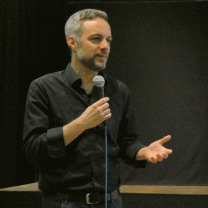
Points of view, also known as perspectives, stand for the way in which or from which someone views or evaluates something. In the plural, it means that several people have different perspectives on something. Different perspectives form the focus of Martin Schäuble's non-fiction book for young people "The story of the Israelis and Palestinians - The Middle East conflict from the perspective of those who experience it".
Dr. Martin Schäuble is a journalist and author. He studied and lived in Palestine. His book is based on conversations with Palestinians and Israelis. Schäuble was a guest at the Fürst-Johann-Moritz-Gymnasium in Weidenau at the invitation of the House of Science at the University of Siegen. He read to around 80 Year 11 pupils, alternating between the Palestinian and Israeli perspectives.
As an introduction, he chose the account of an eyewitness to the Hamas attack on the Kfar Aza kibbutz on October 7, 2023. Every house in the kibbutz had a "safe" room. The witness also fled to this room. 18 people crowded into the small room, the air to breathe became scarce, a window was tilted. The neighboring room was burnt out. Bodies lay in it. The people in the "safe" room were eventually rescued by a special unit of the Israeli army.
On the same day, a Palestinian father in the Gaza Strip reported an Israeli attack in which his young daughter was seriously injured by bullet fragments. The girl did not speak for seven months after the attack.
Two voices from 20 years ago. Abraham Bar-Am (Israeli): "I saw wars from an early age. I myself fought in the War of Independence, the Suez War, the Six-Day War, the Yom Kippur War and many other missions. My son fought. My grandson fought. He lies wounded in hospital. And I think my grandson's grandson will fight too.
Amelie Jaqaman (Palestinian): "My mother was born during the Ottoman occupation. I was born during the British occupation, my children during the Jordanian occupation, their children during the Israeli occupation. There is always someone who wants this country, but never someone who wants us. Isn't that a tragedy?"
Martin Schäuble showed the pupils a poster from the 1930s entitled "Visit Palestine". The poster was designed by the Jewish Austrian Franz Kraus, who fled from the Nazis. It shows the view of Jerusalem from the Mount of Olives. 50 years later, Palestinians used this template for a protest poster against the Israeli occupation.
The plan for two states drawn up by the United Nations after the Second World War never became reality. After the First Arab-Israeli War, around 500,000 Palestinians were expelled; refugee camps were set up. After 1948, many Jews were also expelled from Arab countries. According to the author, the current political situation between Hamas, Fatah and the right-wing religious Israeli government gives no indication of a solution to the complicated situation. It looks as if the Israeli government wants to expel the Palestinians completely from the Gaza Strip.
The reading was followed by a multi-layered discussion. YoungPoetry is funded by the Christa-und-Dieter-Lange-Stiftung.
Reiner Engelmann
"The Photographer of Auschwitz" (17. 03. 2025, Bertha-von-Suttner-Gesamtschule Siegen)
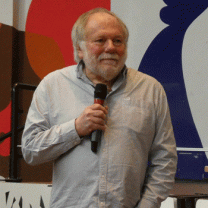
Who remembers the atrocities of the National Socialists when there are fewer and fewer contemporary witnesses? It is the records of the life stories and memories of the victims and sometimes also those of the perpetrators. These include Reiner Engelmann's book for young people, "The Photographer of Auschwitz". The author from the Hunsrück region traveled to the Siegerland region to present the life of Polish photographer Wilhelm Brasse, who became known as the "Photographer of Auschwitz", at the Bertha von Suttner Comprehensive School and to talk to around 250 pupils in years 10 and 11. Engelmann had been invited by the House of Science at the University of Siegen. The reading was funded by the Dieter and Christa Lange Foundation as part of the YoungPoetry format. Literary scholar Dr. Jana Mikota introduced the author: "With what he does, he is a role model for us all."
Wilhelm Brasse was born in December 1917 in what was then Saybusch, now Zywiec, in Silesia. He worked as a professional photographer from 1935, taking portraits and passport photos in his uncle's remote photo studio. As a young man, according to Engelmann, Brasse could certainly be described as a "bon vivant" who liked to party, dance and also liked girls. After the German invasion of Poland, Brasse wanted to enlist in the Polish army in his home town. However, Zywiec was already occupied when he arrived. Despite being bilingual - he spoke Polish and German - he refused to be recognized as a German. Together with friends, he set off in March 1940 to join the Polish resistance in France. The group was arrested shortly before the border.
Brasse was locked in a tiny cell with 25 other people. Many of the prisoners did not survive this first station as prisoners. Engelmann: "It was pure luck to survive those four months." Brasse was transported to Auschwitz via Tarnow in the summer of 1940. The extermination camp was under construction. Brasse was tattooed with the prisoner number 3444, which replaced his personal name in his salutation until the liberation of the Mauthausen concentration camp - his last prisoner station - by the US Army in 1945.
In Auschwitz, Brasse was first employed in road construction, then as a corpse carrier, in the potato peeling plant and finally as a camp photographer. As a photographer, he was a so-called prisoner functionary. This status was associated with better living conditions and better chances of survival. Engelmann's book, which is based on conversations with Wilhelm Brasse, describes the endless suffering and often agonizing deaths of countless fellow prisoners. Brasse photographed thousands of prisoners. He made sure that these photographs were not destroyed by the Nazis, but are still used today as testimonies and as a reminder of those who were murdered.
The auditorium of the Bertha von Suttner Comprehensive School was silent for two school hours. The pupils listened spellbound - if not speechless - to what the author had to say. The second 90 minutes were available for questions and discussion. The young people wanted to know a lot. They never ran out of questions: How do you deal with Holocaust deniers? Did the camp staff enjoy torturing, abusing and murdering people? Were those responsible held accountable and punished? Did they show an awareness of injustice? Can something like the Nazi dictatorship happen again? How can it be prevented?
Three hours passed quickly. The pupils had prepared for the reading and discussion in class. Reiner Engelmann's story about the murderous and inhumane events in Auschwitz and other extermination camps during the Nazi terror in Europe was deeply moving, regardless of prior knowledge.
Readings since 2020
Nina Weger: "When my brother became a whale" (12. 12. 2025, Bertha-von-Suttner-Gesamtschule Siegen)
Rüdiger Bertram: "Der Pfad" (10. 09. 2025, two readings at the Gymnasium am Löhrtor in Siegen)
Moritz Seibert: "Das letzte Aufgebot" (08. 07. 2025, Rivius-Gymnasium Attendorn)
Moritz Seibert: "Das letzte Aufgebot" (24. 06. 2025, St.-Ursula-Gymnasium Attendorn)
Reiner Engelmann: "The Photographer of Auschwitz" (17. 03. 2025, Bertha-von-Suttner-Gesamtschule in Siegen).
Dr. Martin Schäuble: "The history of the Israelis and Palestinians. The Middle East conflict from the perspective of those who experience it", (03. 06. 2025, Fürst-Johann-Moritz-Gymnasium in Siegen-Weidenau)
Johannes Herwig: "Until the stars tremble" (27. 01. 2025, Esther-Bejarano-Gesamtschule Freudenberg)
Johannes Herwig: "Scherbenhelden" (08. 11. 2024, Bertha-von-Suttner Comprehensive School Siegen)
Astrid Sy: "Nenn keine Namen" (29. 01. 2024, Fürst-Johann-Moritz-Gymnasium in Siegen-Weidenau, in English)
Dr. Susan Kreller: "Hanna's Rain" (05. 12. 2023, Ev. Gymnasium in Siegen-Weidenau")
Nils Mohl: "Henny and Ponger" (19. 10. 2023, Stift Keppel grammar school in Hilchenbach)
Nils Mohl: Tierische Außenseiter - Reime über unknuddelige Große wie Kleine mit und ohne Beine (18. 10. 2023, Jugendzentrum BlueBox Siegen)
Andreas Eschbach: "Das Marsprojekt" (12. 06. 2023, online reading in the Science Year "Our Universe", connected from Brittany)
Elisabeth Steinkellner: "Esther and Solomon" (03. 05. 2023)
Cornelia Funke: "Drachenreiter" (07. 12. 2021, online reading, connected from Tuscany)
Jason Reynolds: "Ghost" (30. 06. 2021, online reading, connected from Washington)
Johannes Herwig: "Scherbenhelden" ( 20. 09. 2020, online reading, together with Prof. Dr. Alexander Wohnig (Social Sciences) and experts from the Stadtjugendring Siegen)