Chief Information Officer (CIO)
Campus. Digitally. Reimagined. - Welcome to the CIO of the University of Siegen.
In order to do justice to the ever-increasing importance of IT governance structures and strategies, the position of Chief Information Officer ( CIO ) was established at the University of Siegen alongside the CIO Board, a strategic committee to advise the university management. The CIO chairs the CIO Board.
Prof. Dr.-Ing. Holger Foysi has been CIO of the University of Siegen since 01.10.2024. In September 2025, Dipl. Ing. Daniel Harlacher (Head of ZIMT) was appointed as vice-CIO.
Together with the strategic CIO Board, the operational IKM committee (abbreviation for Information - Communication - Media) and the requirements from the user committee, the CIO is responsible for the strategic development and coordination of digitalization and IT/information technology at the University of Siegen. The development of the profile sections and areas of potential through holistic digitalization in their key areas plays a special role in the strategic IT orientation. These areas were defined by the rector's office and form the basic framework for the strategic development of the University.
The University of Siegen has set itself the goal of playing an essential (more than relevant, less than leading) role in the digital university landscape based on innovative, secure and sustainable information technologies. IT becomes a driver of excellence in teaching, research and administration by providing seamless digital experiences, flexible learning environments and powerful research resources.


Information and news
With its cloud and sourcing strategyadopted in April 2026
DH.NRW is consistently gearing its IT provision towards collaboration, standardization and cloud use. The aim is to create a shared service landscape that increases efficiency, ensures quality and strengthens digital sovereignty.
The University of Siegen has acquired resources at the specialist cluster (RWTH Aachen site) and the basic cluster (University of Cologne site). The procurement of the hardware is currently underway. After commissioning towards the end of 2026/beginning of 2027, HPC resources (GPU + CPU) will be available to the university for research and teaching at a low threshold!
University members can apply for an @alumni.uni-siegen.de e-mail address. Professorships have the option of keeping their previous e-mail address.
The deadlines for e-mail account management are clearly defined:
- Employees in technology and administration: Date of end of employment
- Research assistants: 14 days after the end of employment
- Students: ½ calendar year after exmatriculation.
In addition, there may be special regulations, e.g. if the extension of the employment contract is not available on time.
In all cases, an automatic notification will be sent in advance.
IKM Governance & Committees
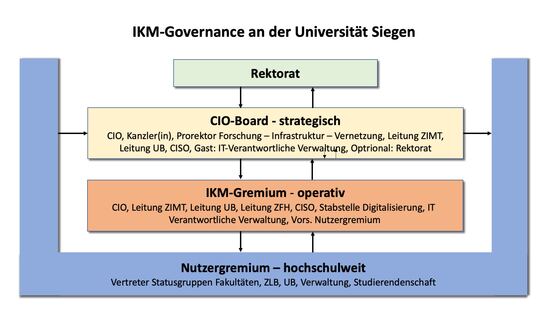
Information management at the University of Siegen is characterized by a level model in which the strategic, operational and participative levels are clearly outlined on the one hand and, on the other, are clearly interlinked in a closed loop.
The Rectorate is responsible for the guidelines and strategy for the entire "Information Management" area. The CIO Board, chaired by the CIO, is responsible for the strategic management of the entire division. Prioritizations are made, projects are commissioned, approved and accepted and strategic decisions of the Rectorate are prepared on the basis of proposals from the operational level (IKM).
The members of the IKM Committee form a collegial network that regularly coordinates its activities, processes and prepares current IKM/digitalization topics and projects and makes decisions that are not of overriding strategic importance for the university. The IKM committee discusses and prepares meetings and documents for the CIO Board. The direct reporting line of the heads of institution to the CIO Board or CIO is not affected by the IKM committee. Information to and from users is handled via the User Panel. The governance structure is illustrated in the following diagram: