Measurement and Control Engineering – Mechatronics Working Group
Prof. Dr.-Ing. Oliver Nelles
Data-Driven Modeling (Module)
Neural Networks and Fuzzy Systems, System Identification, Data-Driven Methods for Fault Diagnosis
Neural Networks and Fuzzy Systems
Introduction to the modeling of nonlinear processes using characteristic maps, neural networks, and fuzzy logic. Offered during the winter semester. Course load: 2 SWS.
Topics:
- Overview: Static Nonlinear Models
- Overview: Optimization Methods
- Mapping Functions and Polynomials
- Multilayer perceptrons
- Radial Basis Function Networks
- Locally Linear Models
- Fuzzy Logic and Fuzzy Systems
- Nonlinear dynamic models
- Model Structure and Complexity
- Applications
Contact:
System Identification
This course (2 SWS, 3 CP) focuses on the identification of linear dynamic models from measurement data. Various model types—with (Infinite Impulse Response, IIR) and without (Finite Impulse Response, FIR) feedback—are introduced, and their advantages and disadvantages are discussed.
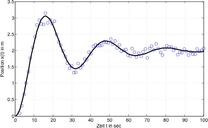
A key component of the course is an introduction to methods for estimating model parameters and the influence of measurement noise on the accuracy of parameter estimation. Furthermore, the manner in which a dynamic system is excited during data acquisition is of great importance for successful system identification. Therefore, various excitation signals are presented and their effects are discussed.
The course is primarily conducted as an independent project using MATLAB:
- Approximately 4 double-period lectures introducing the topic.
- Course notes for further study.
- Project work (MATLAB programming).
- Final presentation on the results of the project (20 min).
- Oral exam.
Contact:
Data-Driven Methods for Fault Diagnosis
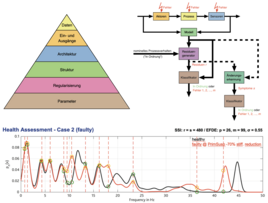
This course provides an introduction to the application of machine learning methods in the field of fault detection and diagnosis in engineering.
Topics
- Background, Motivation, Literature
- Fundamentals of Fault Detection and Diagnosis
- 2-class classifiers
- 1-Class Classifiers
- Nearest Neighbor Methods
- Classification Trees (CART)
- Support Vector Machine (SVM) Classifiers
- Estimation of Probability Densities
- Distribution of Data Points
- Application Example: Fault Diagnosis on a Bogie
- Application Example: Fault Diagnosis on a Railroad Track