Data Gold and Digital Health
From November 20 to 26, 2025, the project week “Digital Health—Interdisciplinary Challenges from International Perspectives” took place in Cologne and Heidelberg. Twenty-four former researchers from 22 countries participated.
The robotic seal “Paro” serves as an electronic companion to help combat loneliness and feelings of disorientation in people with dementia. Apps provide information about medical conditions. Digital games train the brain to combat memory loss: These are just a few examples of the many new developments and potential applications of digital technologies in healthcare. “The question is always: What do we want from the technology?” emphasized Dr. Erik Norman Dzwiza-Ohlsen of the Husserl Archive at the University of Cologne during his lecture at the start of the project week “Global Digital Health—Interdisciplinary Challenges from International Perspectives.” The event took place from November 20 to 26 in Cologne and Heidelberg.
Bright Minds from Around the World
Bright minds from around the world gathered for the event. The conference week was jointly organized by six project partners—the Universities of Siegen, Cologne, Heidelberg, and Münster—together with the German Cancer Research Center (DKFZ) and the Karlsruhe Institute of Technology (KIT). At the University of Cologne’s International House (UzK), the 24 participating alumni researchers from 22 countries kicked off the event with an interactive “speed dating” session, during which they discussed their scientific careers and what they hoped to gain from their participation. There was a warm welcome as the “alumni” reunited with the scientists with whom they had collaborated for a time during their research stays at the four German universities, as well as at the DKFZ and KIT.
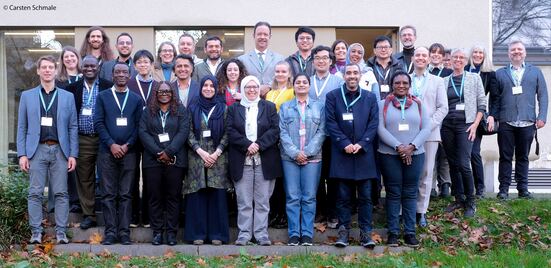
The DAAD-funded initiative, which was jointly conceived by the project partners as a grant proposal, brings together researchers from the participating universities and centers of excellence for an exchange. Professor Christoph Strünck of the University of Siegen emphasizes that it is an investment in a unique scientific network. The political scientist is a co-initiator and one of the key academic advisors for the week-long event, which features a distinguished lineup of participants (click here for an interview with Prof. Strünck). “This face-to-face dialogue on site unleashes tremendous energy!”
From Ethics to Costs
At the start of the extensive program—which drew a total of around 60 participants over the course of the week—the focus was, among other things, on overarching ethical, philosophical, social, and (human) rights aspects of the topic, as well as on the opportunities and challenges posed by demographic change and an aging society. How should the technology be used? How does it contribute to well-being? How should the systems be financed? Seven days filled with lectures, project presentations, and tours of cutting-edge research facilities in Cologne and Heidelberg, interspersed with discussions and opportunities to exchange experiences.
Digital health, e-health—a rapidly evolving field worldwide; data is considered the “gold” of the 21st century. The use of electronic systems, AI, and related technologies opens up a wide range of applications in healthcare—for example, in the early medical detection of diseases and in therapy—as well as in health administration. The projects range from electronic health records to the use of artificial intelligence in skin cancer screening, from health apps and improved global pandemic predictions using health data to e-learning and online consultations for patients in countries with limited access to medical care (see project examples).
Whether it’s e-learning in medical education in sub-Saharan Africa or public awareness of the link between climate change-related stress and breast cancer in Nigeria: the alumni researchers provided insights into their wide-ranging areas of focus and the varying conditions in their home countries—from Mexico to Norway to Japan, spanning every continent except Australia.
“It’s an international and interdisciplinary exchange; we get to learn about different projects and developments, which I find very exciting,” says a participant from Egypt; a colleague from Pakistan adds: “I’m also particularly interested in the funding requirements for projects—financing issues are very important to us.” Computer science experts engaged in conversation with biochemists, medical professionals with app developers, and lawyers with social scientists—all looking beyond their own fields: “So, what are you working on right now?”
Challenges Posed by an Aging Society
One of the key focuses was on the aging society and related developments, such as an increase in diseases, reduced mobility, and higher costs for society. Furthermore, one of the ideas discussed was that telemedicine and mobile applications—such as fitness apps or virtual consultations—could improve healthcare access even in remote regions. The project team emphasizes in the proposal that collected digital health data could become increasingly important globally for preventive measures, such as in the spread of epidemics and pandemics. In addition to developing and establishing ethical standards, another key factor is the extent to which new technologies could make healthcare delivery and management more efficient and “cost-effective”—for example, through improved preventive measures and early detection systems.
Renowned leading researchers complemented the project week with presentations. On the opening evening, Professor M. Cristina Polidori, head of the Gerontology Research Unit at the University Hospital of Cologne and a member of the CECAD Cluster of Excellence, discussed the challenges and prospects of global digital health with a focus on healthy aging.
Tours of CECAD at the University Medical Center Cologne (UzK) and the Max Planck Institute for Biology of Aging in Cologne, as well as a later lab tour at the Heidelberg Institute for Geoinformation Technology (HeiGIT), the DKFZ Dieter Morszeck Biorepository, and the Heidelberg Ion Beam Therapy Center (HIT). “Exciting! We’re taking so many vivid impressions back with us to our home countries,” praised participants in the project week. “And the connections we’ve made provide a solid foundation for building even closer networks.”
Eva Winkler, a renowned professor of translational medical ethics at Heidelberg University and vice chair of the German Ethics Council, delivered the closing remarks. Do new technologies benefit our well-being—including from ethical, legal, and social perspectives? There it was again: the original question.
Highlights from the project week in Cologne and Heidelberg


The project week was funded by the DAAD with grants from the Federal Foreign Office (AA) and the Federal Ministry for Economic Cooperation and Development (BMZ).
The interviews were conducted by Martina Windrath, a freelance journalist based in Cologne.
More articles on the project week: