The working group introduces itself
Our research ranges from incompressible to compressible and supersonic turbulent flows. Our research focuses on the numerical and experimental analysis of turbulence, aeroacoustics and flow control. For this purpose, we use Direct Numerical Simulation (DNS), Large-Element Simulation (LES) and statistical methods (RANS). We develop and extend numerical methods for solving the Navier-Stokes equations, e.g. the Lattice-Boltzmann method (LBM). In addition, the chair has an aeroacoustic wind tunnel
with a low-reflection semi-free-field room with sound-absorbing lining. Further details on the main areas of focus can be found below.

News from our working group
- Partnership with Kenya: Dr. Stahl visited the University of Nyeri in Kenya with Prof. Carolus (em.) and Alicia Platt. The partnership has already existed for 10 years. You can find more information in our report. link
- New doctoral student: Ben Picard will start his doctorate at the chair in July. He will be supervised together with Prof. Reith (Bonn-Rhein Sieg University of Applied Sciences)
- Dr. Stahl started as an academic advisor at our chair. She will take over teaching from Prof. Carolus (emeritus) and will conduct research in the field of experimental and numerical aeroacoustics.
- The course "Experimental Measurement Techniques in Aeroacoustics and Aerodynamics" ( 4MBBA7301V) is a new addition to the teaching portfolio. Dr. Stahl will cover the basics of flow measurement technology and wind tunnel technology through to experimental design and implementation. Link
- The lecture Turbomachinery and Turbomachines will take place for the last time this summer semester.
Über unsere Arbeitsgruppe
Kurzvorstellung der Arbeitsgruppe in Zitatform
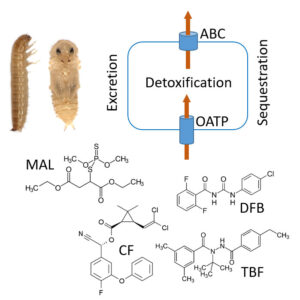
"Chitin ist ein weit verbreitetes Polymer aus N-Acetylglucosamin-Einheiten, das für die chemisch/pharmazeutische Industrie zunehmend an Bedeutung gewinnt. In der Natur findet sich dieses faserartige Molekül unter anderem in den Zellwänden von Pilzen und in mechanisch widerstandsfähigen Bioverbundstoffen wie den Panzern von Krebstieren und Insekten. Chitin lässt sich aber auch in der peritrophischen Matrix nachweisen, einer schleimartigen Pseudomembran im Verdauungstrakt von Invertebraten. Unsere Arbeitsgruppe beschäftigt sich mit dem Metabolismus von Chitin bei Pilzen und Insekten. Dabei untersuchen wir mit molekularbiologischen und biochemischen Methoden die verschiedenen Proteine, die für die Biosynthese, Modifizierung und Degradation von Chitin benötigt werden. Daneben interessieren wir uns für die Wirkmechanismen von Inhibitoren der Chitinsynthese, die als Fungizide und Insektizide breite Verwendung finden."
Our research profile
Main research areas
The main focus of the chair is the investigation of turbulent flows. For this purpose, canonical flows (e.g. free jet, mixing layers, channel and pipe flows, isotropic and homogeneous turbulence) as well as realistic configurations from industry were investigated.
We are particularly interested in compressibility effects in sub- and supersonic flows, altered energy transfer and heat transfer. In this context, intrinsic compressibility effects (fluctuations in dilatation due to pressure fluctuations) or so-called "variable property effects" (the effects of large differences in density or temperature or due to different species in mixing processes) are specifically investigated.
At the same time, we are trying to find out how turbulent and laminar flows can be specifically influenced. For this purpose, the adjoint Navier-Stokes equations were solved to minimize cost functions, e.g. to reduce noise or friction drag. Other possibilities were also used, including the targeted generation of wall oscillations to reduce the resistance of wall-bound flows.
The chair has decades of experience in performing direct numerical simulations (DNS), large eddy simulation (LES) or statistical modeling (RANS). Many pioneering DNS have been performed or, for example, filter-based LES models have been developed, as well as automated methods for physically based grid generation for RANS models motivated by dissipation elements.
In recent years, much expertise has been built up in the field of Lattice-Boltzmann Simulation (LBM). New methods (Semi-Lagrangian LBM (SLLBM) have been developed for incompressible and compressible flows, which can avoid the coupling of time and space steps(NATRIUM). In addition, an LBM solver based on PyTorch was written(LETTUCE), which enables, for example, automatic differentiation or the use of machine learning methods. As a result, LBM methods with neural collision operators or optimized non-reflective boundary conditions were developed.
The chair has recently acquired an aeroacoustic wind tunnel
of Göttingen design with an open measuring section (details here). The chair uses this to conduct research in the field of aeroacoustics of turbulent flows, flanked by numerical simulations.
Main research areas
- Turbulence
- Supersonic flows
- Investigation of intrinsic and variable-density compressibility effects
- Mixing processes
- Aeroacoustics
- Machine learning (e.g. in flow control, modeling)
- Flow control (Adjoint Navier-Stokes equations, active and passive flow control)
- Lattice-Boltzmann method
- Modeling (RANS, LES)
Publications
Selected publications
Compressibility effects and turbulence scalings in supersonic channel flow
Compressibility effects and turbulence scalings in supersonic channel flow
Reduction of outflow boundary influence on aerodynamic performance using neural networks
Reduction of outflow boundary influence on aerodynamic performance using neural networks
Oscillating grid Turbulence: the influence of Reynolds number and forcing
Oscillating grid Turbulence: the influence of Reynolds number and forcing
Lattice Boltzmann method with artificial bulk viscosity using a neural collision operator
Lattice Boltzmann method with artificial bulk viscosity using a neural collision operator
Supersonic shear and wall-bounded flows with body-fitted meshes using the semi-Lagrangian lattice Boltzmann method: Boundary schemes and applications
Supersonic shear and wall-bounded flows with body-fitted meshes using the semi-Lagrangian lattice Boltzmann method: Boundary schemes and applications
Machine-learning-enhanced collision operator for the lattice Boltzmann method based on invariant networks
Machine-learning-enhanced collision operator for the lattice Boltzmann method based on invariant networks
Current and completed projects
Research and industry projects
Just completed:
- Drag reduction of compressible turbulent flows by wall-based manipulation(M. Ruby, PhD thesis).
- Control of turbulent boundary layer flow by weak volume forces (G. Khujadze, DFG)
- Industrial projects with Dango & Dienenthal and SPG Steiner GmbH.







Contact the working group
Postal address
University of Siegen
Prof. Dr. Holger Foysi
Chair of Fluid Mechanics
Paul-Bonatz-Str. 9-11
57076 Siegen
Visitor address
University of Siegen
Chair of Fluid Mechanics
3rd,floor, PB-A 324
Email: holger.foysi@uni-siegen.de
Paul-Bonatz-Str. 9-11
57076 Siegen
Secretariat
Please contact the secretariat,
Mrs. Petra Hatzig:
Phone: ++49-(0)271-740-4682
Fax : ++49-(0)271-740-2666