Measurement and Control Engineering – Mechatronics Working Group
Prof. Dr.-Ing. Oliver Nelles
Digital Engineering
LATEST: Slides from the Digital Engineering introductory session, October 2026:
The Departments of Electrical Engineering , Computer Science, and Mechanical Engineering at the School of Science and Technology at the University of Siegen have been offering the following three innovative degree programs as bachelor’s degrees (7 semesters) since the 2024–25 winter semester and as master’s degrees (3 semesters) since the 2026 summer semester:
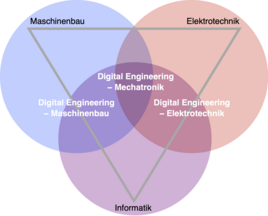
The goal of these degree programs is to integrate engineering and computer science. They combine the essential elements of an engineering program with practice-oriented components of computer science, particularly software engineering and machine learning.
Digital Engineering offers challenging degree programs that address the key challenge of future industrial value creation: the integration of traditional engineering tasks and software.
This flyer summarizes the key points of the new “Digital Engineering” degree programs.
You can find the most important information in the FAQs (PDF):
Recommended by
More information (PDF):
The three degree programs have different focuses on the various engineering disciplines (listed in credit points):
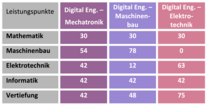
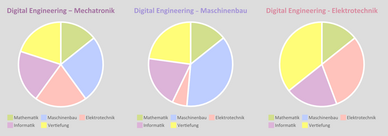
A more detailed list of the courses in the three degree programs:
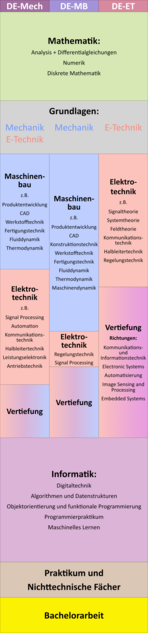
- Advanced Mathematics I and II
- Discrete Mathematics
- Numerical Methods or Advanced Mathematics III
- Digital Technology
- Algorithms and Data Structures
- Object-Oriented and Functional Programming
- Programming Practicum
- Introduction to Machine Learning
Possible Fields of Work
- Development and software implementation of new functions in control units, control systems, monitoring and diagnostic systems, and for virtual sensors, ...
- Optimization of process automation
- Robust AI applications in industry
- Data mining: discovering, utilizing, and visualizing relationships, correlations, patterns, and clusters in large, high-dimensional datasets
- Cyber-physical systems that integrate mechanical, electrical/electronic, and software components and combine cybernetics with mechatronics
- Monitoring and predictive maintenance require robust models that combine physical understanding with data-driven learning methods, thereby increasing reliability while simultaneously reducing costs
- Efficiency optimization through model-based approaches—the models can be derived from physics (white-box), learned from data (black-box), or generated from a combination of both (gray-box)
- Test bench automation and optimization through intelligent design of experiments
- Transition from traditional hardware solutions to flexible software implementations
- Metamodeling of CAD/CAE designs using neural networks for rapid optimization
- Industry 4.0, e.g., networking, cloud integration, big data, encryption, visualization, and interpretation of complex, nonlinear, multivariate relationships
- Automation using autonomous vehicles
- Integration of modern image and video processing into process automation, particularly quality control
- Machine optimization through networking and AI
- Processing of cloud data with the goal of optimized control of production processes, e.g., in additive manufacturing (3D printing)
- Knowledge Transfer Management: Support for maintenance and repair work using augmented reality, data gloves, and similar technologies
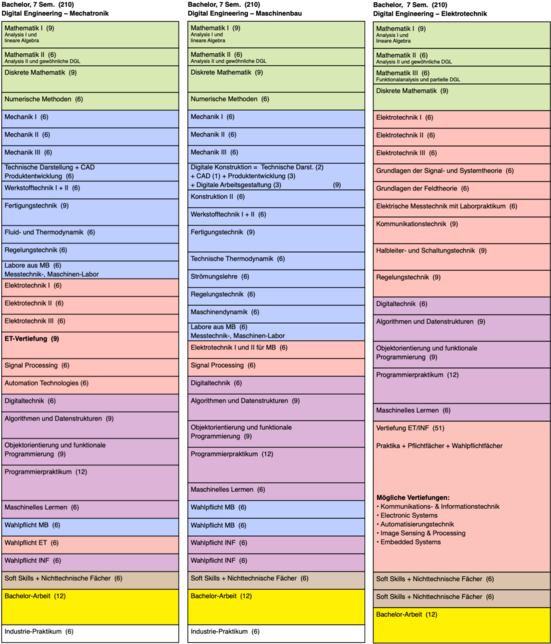
Bachelor’s Degree Program
Bachelor’s in Digital Engineering: Modules
Study Plans for All Degree Programs (PDF):
Master’s Program
It is recommended to follow the7-semester Bachelor’s program in Digital Engineering with a3-semester Master’s program. This offers the following options:
| Bachelor’s | Digital Engineering – Mechatronics | Digital Engineering – Mechanical Engineering | Digital Engineering – Electrical Engineering |
| Master's | Mechatronics (English) |
Digital Engineering – Mechanical Engineering (German / English, depending on the choice of modules) |
Digital Engineering – Electrical Engineering (German / English, depending on the choice of modules) |
Further information on the master’s programs (PDF):
6-semester Bachelor’s program … What’s next?
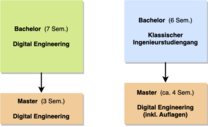
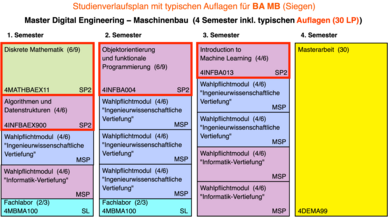
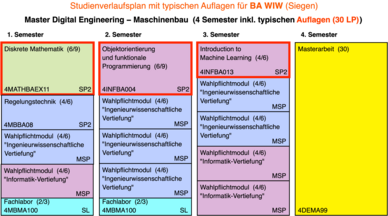
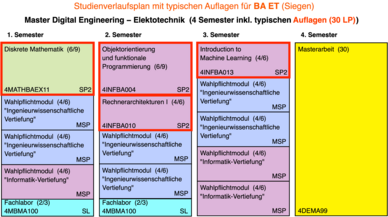
The following three overviews serve as a guide for possible 4-semester Master’s study plans in Digital Engineering—Mechanical Engineering or Electrical Engineering for graduates of a 6-semester Bachelor’s program. The required courses are outlined in red and fit seamlessly into the program. As is easy to see, these required courses cover a large portion of the computer science content from the Bachelor’s program in Digital Engineering—Mechanical Engineering or Electrical Engineering. This allows graduates of, for example, traditional mechanical engineering, industrial engineering (WIW), or electrical engineering programs to launch their careers in the digital age with this master’s degree.