Completed doctorates and honorary doctorates from the Faculty of Arts and Humanities
You can do a doctorate in all subjects of the Faculty of Arts and Humanities. Here you will find an overview of completed doctorates at the Faculty of Arts and Humanities as well as honorary doctorates.
The Faculty of Arts and Humanities can award honorary doctorates to individuals who have made outstanding achievements in one of its subjects. Since its foundation in 2011, it has already awarded this distinction three times. Seven other honorary doctorates have been awarded by the former Faculties 1 and 3 since the university was founded.

Doctorates at the Faculty of Arts and Humanities since 2016
- Baumgart, Lea: Intradiegetic ruptures and the reality of the subject. Investigations into the tradition of a subject-dependent realism in fictional narrative texts in contemporary German-language literature since modernism. Supervision: Prof. Dr. Michael Multhammer, Prof. Dr. Maren Lickhardt.
- Berlich, Sebastian: The so-called pop literature. Concept, genre and evaluation. Supervision: Prof. Dr. Niels Werber, Prof. Dr. Thomas Hecken.
- Böing, Mira: Discursive Addressing and Self-Positioning in the Participatory Context of Social Urban Development. A relational-power-reflexive approach to addressee-oriented impact research. Supervision: Prof. Dr. phil. Dagmar Hoffmann, Prof. Dr. Chantal Munsch.
- Börner, Viviane: #notmybuergermeister. Linguistic-communicative practices for de/legitimation in mayoral communication. Supervision: Prof. Dr. Stephan Habscheid, Prof. Dr. Cornelius Schubert
- Briese, Vanessa: Travelogues of late modernity. Travel bloggers and their publications between the web and the literary world. Supervision: Prof. Dr. Jörg Döring, Prof. Dr. Christopher Busch.
- Faber, Hans: The role of collective identification for the success of geopolitical strategies. Supervision: Prof. Dr. Wolfgang Bergem, Prof. Dr. Sigrid Baringhorst.
- Fuhlrott, Mareike: Language-forming textbook tasks in subject lessons - Qualitative content analysis and intervention. Supervision: Prof. Dr. Torsten Steinhoff, Prof. Dr. Katrin Kleinschmidt-Schinke.
- Gibson-Kunze, Martin: Companies as addressees of the social question. The socio-political role of companies in a German-British comparison. Supervision: Prof. Dr. Christoph Strünck, Prof. Dr. Sebastian Koos.
- Gropengießer, Martin: Bringing a little sea air into the German classroom! - The influence of the Flottenverein on schools in the German Empire using the example of Westphalia 1898-1914. Supervision: Prof. Dr. Bärbel Kuhn, Prof. Dr. Angela Schwarz.
- Kokorin, Ginger Isabelle: Eroticism. Cultural-philosophical reflections. Supervision: Prof. Dr. Michael Bongardt, PD Dr. Hilmar Schmiedl-Neuburg.
- Krayter, Stephan: Medicalization and Psychologization in scientific and public discourses - The perception of poverty, unemployment and childhood development. Supervision: Prof. Dr. Claus Wendt, Prof. Dr. Christoph Strünck.
- Nesterenko, Iryna: Domestic Politics of Gas Pipelines in Europe. A Comparative Analysis of the Nabucco, Nord Stream and Nord Stream 2. Supervision: Prof. Dr. Robert Kaiser, Prof. Dr. Christoph Strünck.
- Pasche, Nathalie: "Like a big cool family". Police difference smoothing in the context of bureaucracy and collegiality. Supervision: Prof. Dr. Stefan Kutzner, Prof. Dr. Marina Richter.
- Pinsker, Tom: Experiencing history. Personal appropriation and reception of history in digital games. Supervision: Prof. Dr. Angela Schwarz, Prof. Dr. Noyan Dinçkal.
- Schebesta, Annika: NNN compounds in English: Investigating the interface of morphology, lexical frequency and the phonetic signal. Supervision: Prof. Dr. Gero Kunter, Prof. Dr. Ingo Plag.
- Siembab, Matthias: Challenges in the transition from school to training and work: The role of vocational orientation and social contexts. Supervision: Prof. Dr. Wolfgang Ludwig-Mayerhofer, Prof. Dr. Matthias Pollmann-Schult.
- Voigt, Franziska: Imagination and time in the Critique of Pure Reason: "the ability to imagine an object even without its presence in the view". Supervision: Prof. Dr. Cord Friebe, Prof. Dr. Ralf Bader.
- Wallrafen, Susanne: Unfulfilled needs? Out-of-home mobility of older people in residential long-term care facilities. Supervision: Prof. Dr. Christoph Strünck, Prof. Dr. Claudia Müller.
- Weber, Milan: "Leap into History": Historical staging and the popularization of history in digital games. Supervision: Prof. Dr. Angela Schwarz, PD Dr. Tobias Winnerling.
- Cho, Yun Kuk: The Doctrine of Providence of John Calvin. An investigation into the discussion of God's providence and the reality of evil in the doctrine of providence based on I,16-18 of John Calvin's Institutio (1559). Supervision: Prof. Dr. Georg Plasger, Prof. Dr. Marco Hofheinz.
- Donadon, Lia Roxana: Tango and Comic: A Comparative Study of the Cultural Poetics of Discepolín and Quino in 20th Century Argentina during the década infame and the década rebelde. Supervision: Prof. Dr. Daniel Stein, Prof. Dr. Christian von Tschilschke.
- Garibbo, Marcello: Successive Synthesis and Continuous Change. Kant and the paradox of time consciousness. Supervision: Prof. Dr. Cord Friebe and Prof. Dr. Gabriele Gava.
- Gilli, Lorenz: Deciding, experiencing and remembering: Aisthetic experiences with DJ sets of electronic dance music. Supervision: Prof. Dr. Peter Matussek, Prof. Dr. Michael Rappe.
- Harder, Jamie Lee: Unraveling Breastfeeding Patterns in Mexico - A Case Study of Influential Factors in Early Health Choices. Supervision: Prof. Dr. Claus Wendt, Prof. Dr. Christoph Strünck.
- Heck, André: "The archive of living documents." A historical praxeology of the digital Harold Garfinkel archive. Supervision: Prof. Dr. Tristan Thielmann, Prof. Dr. Carolin Gerlitz.
- Hector, Tim Moritz: Smart speakers as participants in a conversation? Linguistic practices in the process of domestication
of media with voice user interfaces. Supervision: Prof. Dr. Stephan Habscheid, Prof. Dr. Karola Pitsch. - Jähnchen, Viktoria: The verdict of the vulgar: The controversy between Friedrich Schiller and Friedrich Nicolai considered as a conflict agenda of the popular. Supervision: Prof. Dr. Michael Multhammer, Prof. Dr. Niels Werber.
- Kirchbach, Matthias: Migration after 1945 in the regional culture of remembrance in the Siegerland. Supervision: Prof. Dr. Bärbel Kuhn, Prof. Dr. Reinhild Kreis.
- Klimke, Annemarie: Super-emotions. An emotion-theoretical consideration of the superhero genre in comics. Supervision: Prof. Dr. Daniel Stein, Prof. Dr. Marie Schröer.
- Rösen, Kenneth: Social inequality and the political struggle for education. The role of trade unions in the conservative education state. Supervision: Prof. Dr. Alexander Wohnig, Prof. Dr. Bettina Lösch.
- Rukiye, Canli: Media of Sufism: Cultural Transformations of (Mevlevi) Sufi Teachings and Practices. Supervision: Prof. Dr. Erhard Schüttpelz, Prof. Dr. Martin Zillinger.
- Berger, Stephanie: Surreal subversion of mourning. A qualitative study on the special situation of parents with dead children. Supervision: Prof. Dr. Ulrich Riegel, Prof. Dr. Mirjam Zimmermann.
- Borbach, Christoph: SIGNAL PROPAGATION DELAYS. A media history of the operationalization of signal propagation times, 1850-1950. Supervision: Prof. Dr. Tristan Thielmann, Prof. Dr. Wolfgang Ernst.
- Bouchard, Hans: El señor YouTube and the worlds of platforms: Mexico in the virtual-media spaces of production and networking. Supervision: Prof. Dr. Yasmin Temelli, Prof. Dr. Vittoria Borsò.
- Breger, Maximiliam: Torture situations and knowledge flows. Sociological reflections on violence against prisoners of the "War on Terror". Supervision: Prof. Dr. Katharina Inhetveen, Prof. Dr. Cornelius Schubert.
- Goodness, Thomas Dieter: Coming, staying and going again - monastic space as a refuge for asylum seekers. Supervision: Prof. Dr. Katharina Inhetveen, Prof. Dr. Christian Lahusen.
- Hartmann, Nadine: "Thinking like a girl" - thinking the girl. Figuration, fil(l)iation, sexual difference. Supervision: Prof. Dr. Cornelia Wild, Prof. Dr. Kathrin Busch.
- Klesse, Jacqueline: How deinstitutionalized is marriage? Couples' interpretations of marriage before and after marriage. Supervision: Prof. Dr. Wolfgang Ludwig-Mayerhofer, PD Dr. Olaf Behrend.
- Knorr, Katharina: Writing as a life task. On the unheard-of poet Josef Wilms. Supervision: Prof. Dr. Jörg Döring, Prof. Dr. Georg Stanitzek.
- Linden, Philipp Alexander: Does the dose make the poison? - Medicalization of unemployment in the German welfare state and its consequences. Supervision: Prof. Dr. Claus Wendt, Prof. Dr. Christoph Strünck.
- Nähr-Wagener, Sebastian: Topical Rationality in the Digital Age. On the pragmatics of argumentation rules, the justification of inference rules of general terminology formation and the connection between argumentation and digitization. Supervision: Prof. Dr. Dr. Carl Friedrich Gethmann, Prof. Dr. Armin Grunwald, Prof. Dr. Marion Heinz.
- Och, Anastasia-Patricia: Gender-specific parainteraction in multimodal text types on YouTube. An investigation of adolescent media practices. Supervision: Prof. Dr. Stephan Habscheid, Prof. Dr. Dorothee Meer.
- Wagenknecht, Andreas: Speaking with a talker. A practice-theoretical reconstruction of technically supported communication. Supervision: Prof. Dr. Tristan Thielmann, Prof. Dr. Imke Niediek.
- Bahar, Golpar: Relativization and accessibility: the formation and use of English relative clauses by Azerbaijani, German, Kurdish Sorani, and Persian learners of English. Supervision: Prof. Dr. Gero Kunter, Prof. Dr. Petra M. Vogel.
- Barion, Marcel: Props. On the specifics of action-related things. Supervision: Prof. Dr. André Barz, PD Dr. Andreas Rauscher.
- Birkner, Michael Gregor: The "Weimar Compromise": Negotiations of Autonomy and Sovereignty in the Duchy of Saxe-Weimar-Eisenach. Supervision: Prof. Dr. Niels Werber, Prof. Dr. Georg Stanitzek.
- Durán Mogollón, Lía Margarita: Living to Tell the Tale: Making Sense of the Field of Young Activism. Supervision: Prof. Dr. Christian Lahusen, Prof. Dr. Katharina Inhetveen.
- Gkolfinopoulos, Andreas: Germany as a magnet for highly qualified people from Greece?- A qualitative empirical study on actual and potential migrants from the medical, scientific and IT sectors. Supervision: Prof. Dr. Sigrid Baringhorst, Prof. Dr. Uwe Hunger.
- Hansen, Christopher: Shared Universe Construction in Comic and Film. The Narrative Structure of an Expansive World created via a Network of Marvel Properties. Supervision: Prof. Dr. Anja Müller, Prof. Dr. Daniel Stein.
- Hardy, Stéphane: Der largonji du louchébem - Eine kulturhistorische, lexikologische und soziolinguistische Analyse der Geheimsprache der Pariser Metzger. Supervision: Prof. Dr. Franz-Josef Klein, Prof. Dr. Britta Thörle.
- Herold, Marc: Models of reality and post-factuality. On the state of the real in media studies. Supervision: Prof. Dr. Rainer Leschke, Prof. Dr. Gebhard Rusch.
- Kaplan, Ina: Attitudes of student teachers towards linguistic-cultural diversity in the institution of school - a qualitative study. Supervision: Prof. Dr. Gesa Siebert-Ott, Prof. Dr. Stephan Habscheid.
- Leite Cabrera Pereira da Rosa, Daniel: Kant's Philosophy of Maxims. Supervision: Prof. Dr. Dieter Schönecker, Prof. Dr. Robinson dos Santos.
- Ullrich, Maria Elisabeth: Participation after flight: Civil society negotiations of citizenship in the reception context. Supervision: Prof. Dr. Sigrid Baringhorst, Prof. Dr. Elke Winter.
- Tomabechi, Nao: Supervillain Comics: The Significance of the Supervillains in American Superhero Comics. Supervision: Prof. Dr. Daniel Stein, Prof. Dr. Julia Leyda.
- Villioth, Lisa: Protest activists of the environmental protection movement on the net and on the street - prerequisites and motives for participation. Supervision:Prof. Dr. Sigrid Baringhorst, Prof. Dr. Dagmar Hoffmann.
- Woo, Hyun Ah: National Socialist perpetration in autobiographical family literature. Argumentations and narrative strategies. Supervision: Prof. Dr. Peter Matussek, PD Dr. Michael Lommel.
- Anderson, Paul: Role of civil society organizations and traditional authorities towards effective participation in decentralization and local government. A case study of selected municipalties in Ghana. Supervision: Prof. Dr. Christoph Strünck, Prof. Dr. Johannes Schädler.
- Boersma, Asher: The Shore turns the Ship: A (Historical) Media Ethnography of Inland Navigation and Control Rooms. Supervision: Prof. Dr. Niels Werber, PD Dr. Cornelius Schubert.
- Boven, Patrick van: "Abraham's Sacrifice" (Gen 22) in Religious Education. Exegetical, reception-historical, empirical and religious-didactic approaches. Supervision: Prof. Dr. Thomas Naumann, Prof. Dr. Mirjam Zimmermann.
- Erdmann, Dominik: Alexander von Humboldt's writing workshop - Totalansichten aus dem Zettelkasten. Supervision: Prof. Dr. Andrea Polaschegg, JProf. Dr. Nacim Ghanbari.
- Fassel, Michael: Narrating dementia. Supervision: Prof. Dr. Georg Stanitzek, Prof. Dr. Gregor Schuhen.
- Graser, Aaron: The Stranger's Testimony to Jesus - Examination of the Narrative Representation of Testimony to Jesus in the Gospel of John. Supervision: Prof. Dr. Bernd Kollmann, Prof. Dr. Ruben Zimmermann.
- Grünendahl, Sarah J.: (Un-)Homely Refuge Canada: U.S. American War Resisters' Divergent Migration Experiences. Supervision: Prof. Dr. Christoph Strünck, Prof. Dr. Karin Schittenhelm.
- Kirchartz, Melina: Risky Thinking. On the function of metaphors and analogies in media studies using the example of the human-machine relationship. Supervision: Prof. Dr. Rainer Leschke, Prof. Dr. Jens Schröter.
- Kohout, Annekathrin: The Nerd. Development of a social figure. Supervision: Prof. Dr. Thomas Hecken, Prof. Dr. Georg Stanitzek.
- Krüger, Lea: Generation books. Novels and zeitgeist publications since the 1990s. Supervision: Prof. Dr. Thomas Hecken, Prof. Dr. Michael Multhammer.
- Obermeier, Elena: Differentiating reading? Reciprocal reading in the 8th grade English classroom. Supervision: Prof. Dr. Markus Kötter, Prof. Dr. Matthias Trautmann.
- Pacas Castro, Luz Elisabeth: The changing representation of the heroic figure in Chilean textbooks - historical memory in the context of divergent fields. Supervision: Prof. Dr. Christian Lahusen, Prof. Dr. Christoph Strünck.
- Prust, Christian: The new natural law and sexual ethics. Supervision: Prof. Dr. Dieter Schönecker, Prof. Dr. Michael Bongardt.
- Schäfer, Gregor: Spatial and social mobility of doctoral candidates in the context of Europeanization and internationalization in higher education. Supervision: Prof. Dr. Karin Schittenhelm, Prof. Dr. Christine Teelken.
- Specht, Theresa: The boumgarten in courtly literature. Narrative creation of a space for action and imagination. Supervision: Prof. Dr. Hans Rudolf Velten, Prof. Dr. Nathanael Busch.
- Weitz, Jennifer: Prospects of success? Full-time school and dual vocational training in the course of time. Supervision: Prof. Dr. Wolfgang Ludwig-Mayerhofer, Prof. Dr. Kathrin Leuze.
- Wolters, Laura: Collective sexual violence: A sociological study of violence. Supervision: Prof. Dr. Katharina Inhetveen, Prof. Dr. Wolfgang Knöbl.
- Austermann, Julia: Visualization of the Political - Homophobia and Queer Protest Culture in Poland since 1980. Supervision: Prof. Dr. Susanne Regner, Prof. Dr. Claudia Kraft.
- Brus, Anna: Colonial art in symmetrical perspective. Julius Lips and the inversion of the gaze. Supervision: Prof. Dr. Erhard Schüttpelz, Prof. Dr. Joseph Imorde.
- Goll, Philipp: The Republic of Petra and Uwe Nettelbeck (1976-2008). Supervision: Prof. Dr. Georg Stanitzek, Prof. Dr. Erhard Schüttpelz.
- Görlich, Patrick: More willingness to participate in politics through 'real action' via the Internet in politics lessons? A quasi-experiment with 9th grade students. Supervision: Prof. Dr. Sigrid Baringhorst, Prof. em. Dr. Bernd Fichtner.
- Groth, Daniel: Space - Weapon - Body. The First World War in German and Austrian museums and exhibitions. Supervision: Prof. Dr. Bärbel Kuhn, Prof. Dr. Angela Schwarz.
- Kettenring, Stefan: "...because it is beauty through which one wanders to freedom." Art-religious Implications in Schiller's Treatise on the Aesthetic Education of Man in a Series of Letters. Supervision: PD Dr. Hans-Joachim Jakob, JProf. Dr. Michael Multhammer.
- Klemmt, Jutta: Narrativity as a way of interpreting "creation". Theoretical foundations - investigation of the sustainable gain in knowledge through a narrative approach to Genesis 1:1-2:4a in grade 5. Supervision: Prof. Dr. Mirjam Zimmerman, Prof. Dr. Thomas Naumann.
- Löhr, Meike: Energy transitions: An analysis of phases and actor coalitions in Denmark, Germany and France. Supervision: Prof. Dr. Christoph Strünck, Prof. Dr. Jannika Mattes.
- Lucke, Alexa: Schiller's aesthetic letters as literature. Supervision: Prof. Dr. Niels Werber, Prof. Dr. Nicolas Pethes.
- Luschei, Frank: It's beautiful here! Or is it? Concept and measurement of the attractiveness of cities and municipalities. Citizens' assessments of the attractiveness of their city and their contribution to clarifying processes of internal migration. Supervision: Prof. Dr. Christoph Strünck, JProf. Dr. Sabine Meier.
- May, Jonas: Laicity and social democracy. A comparative study of programmatic, religious and ideological politics in France, Spain and Germany. Supervision: Prof. Dr. Sigrid Baringhorst, Prof. Dr. Christoph Strünck.
- Pakhomova, Svetlana: Economic coercion and foreign policy: Evaluating the success of Russian bargaining with Ukraine, Belarus and Moldova. Supervision: Prof. Dr. Rüdiger Kipke, Prof. Dr. Valerij Ljubin.
- Richtera, Roman: Remembrance politics and memory practices in the educational context - On the connections between history, politics and memory in schools. Supervision: Prof. Dr. Wolfgang Bergem, Prof. Dr. Felicitas Macgilchrist.
- Scheicher, Mathias: (Re-)configurations of online cultures of remembrance of the Shoah. Media practices between remembering and forgetting. Supervision: PD Dr. Sandra Nuy, Prof. Dr. Jens Schröter.
- Schlinkmann, Eva: Communicative reconstruction in the theater intermission. A genre analysis of intermission conversations in the theater. Supervision: Prof. Dr. Stephan Habscheid, Prof. Dr. Britta Thörle.
- Schmidt, Elke: Love and meaningfulness. A philosophical attempt. Supervision: Prof. Dr. Cord Friebe, Prof. Dr. Christoph Demmerling.
- Taha, Nadine: The laboratory of US-American industrial research and its media practices (1870-1950). Supervision: Prof. Dr. Erhard Schüttpelz, Prof. Dr. Jens Schröter.
- Vataman, Maja: Migration - Adolescence - Identity. Case studies on the identity construction of Jewish adolescents from the former Soviet Union in Germany. Supervision: Prof. Dr. Stephan Kutzner, Prof. Dr. Micha Brumlik.
- Weiß, Bastian: Automatic hermeneutics? An epistemological reflection on the possibility of algorithmic text interpretation. Supervision: Prof. Dr. Rainer Leschke, Prof. Dr. Dieter Mersch.
- Afet, Nabili: Writing in order to speak! A contrastive study of conversational organization in German and Azerbaijani chat communication. Supervision: Prof. Dr. Petra M. Vogel, Prof. Dr. Stephan Habscheid.
- Albrecht, Eva-Caroline: Biblical text interpretation in the context of children's theology. An investigation into children's interpretation skills, also in relation to the requirements of current core curricula. Supervision: Prof. Dr. Mirjam Zimmermann, Prof. Dr. Thomas Naumann.
- Anuntkosol, Nantana: The staging of authorship in Uwe Timm. Supervision: Prof. Dr. Berbeli Wanning, PD Dr. Urte Stobbe.
- Berger, Larissa: Kant's philosophy of beauty. A commentary interpretation of §§ 1-22 of the Critique of Judgment. Supervision: Prof. Dr. Dieter Schönecker, Prof. Dr. Andrea Esser.
- Dan Ang, Mark: Protest as media practice. A media linguistic investigation of synthetic protest situations with special consideration of Twitter. Supervision: Prof. Dr. Stefan Habscheid, Prof. Dr. Sigrid Baringhorst.
- Englert, Kathrin Kristina: Office and recognition. On the sociology of public administration. Supervision: Prof. Dr. Wolfgang Ludwig-Mayerhofer, Prof. Dr. Berthold Vogel.
- Flucke, Franziska: Bilingual history lessons in Germany and France - A contribution to a European historical awareness in the context of Franco-German relations? Supervision: Prof. Dr. Bärbel Kuhn, Prof. Dr. Ulrich Pfeil.
- Gringmuth, Sven: Proletarian turn. A history of mentality and concepts. Supervision: Prof. Dr. Thomas Hecken, Prof. Dr. Georg Stanitzek.
- Groneberg, Christoph: The process of informal opening. Basic features of a history of ideas and theoretical consideration of the factors and consequences of medial practice. Supervision: Prof. Dr. Gebhard Rusch, Prof. Dr. Gunnar Stevens.
- Hagebeuker, Christoph: Exoticism in the Third Reich: The Colonial in Popular Media and the Mobilization of Germans. Supervision: Prof. Dr. Angela Schwarz, Prof. Dr. Noyan Dinçkal.
- Hirsbrunner, Simon: Opening Science for Future. The Science and Technology of Climate Impact Prediction. Supervision: Prof. Dr. Tristan Thielmann, PD Dr. Cornelius Schubert.
- Koch, Christian: Speaking many Romance languages. Individual polyglotism as a paradigm of multilingualism research. Supervision: Prof. Dr. Britta Thörle, Prof. Dr. Johannes Müller-Lancé.
- Lange, Benjamin: The Judge and his Accusers: A Narrative Study of the Litigation and Trial Motifs in the Gospel of John. Supervision: Prof. Dr. Bernd Kollmann, Prof. Dr. Ruben Zimmermann.
- Ndahayo, Emmanuel: Citizenship through naturalization? Germans of African origin. Supervision: Prof. Dr. Karin Schittenhelm, Prof. Dr. Anja Weiß.
- Reisner, Clemens: "A lively game to be prevented in real life". The Cold War in computer games. Supervision: Prof. Dr. Angela Schwarz, Prof. Dr. Jens Schröter.
- Roder, Sascha: The participation of people with a cochlear implant in society. Supervision: Prof. Dr. Claus Wendt, Prof. Dr. Johannes Schädler.
- Sandoval Velasco, María del Carmen: The changing nature of the European Union in times of crisis: Understanding the dominance of an Asymmetric intergovernamentalism. Supervision: Prof. Dr. Robert Kaiser, Prof. Dr. Daniel Innerarity.
- Shi, Lingzi: Nervous Literature and Nervous Society - Discourses of Illness in Thomas Mann's Early Prose. Supervision: Prof. Dr. Andreas Käuser, Prof. Dr. Volkmar Hansen.
- Siedek-Strunk, Stefanie: Religion under socialism. Protestant prison chaplaincy in the Soviet Occupation Zone and the early years of the GDR (1945 to 1959) with special reference to the work of the state prison chaplain Hans-Joachim Mund. Supervision: Prof. Dr. Veronika Albrecht-Birkner, Prof. Dr. Claudia Lepp.
- Weber, Rebecca: Abject border crossings. Body and resistance in the Latin American novel of the 20th century. Supervision: Prof. Dr. Gregor Schuhen, Prof. Dr. Walburga Hülk-Althoff.
- Becher, Phillip: Fascism research from the right - A. James Gregor and the ideo-centric interpretation of Italian fascism. Supervision: PD Dr. Michael Hirsch, Prof. Dr. Christoph Strünck.
- Deus, Fabian: Revolution - Progress - Evolution. A conceptual-historical study on the evolutionist history and future semantics of German social democracy. Supervision: Prof. Dr. Clemens Knobloch, PD Dr. Ernst Müller.
- Dreschke, Anja: Cologne tribes. Media ethnography of a mimetic culture. Supervision: Prof. Dr. E. Schüttpelz, Prof. Dr. T. Hauschild.
- Foyy, Dmitry: The socio-cultural and political role of Islam in Russian foreign and domestic policy in the 21st century. Supervision: Prof. Dr. Eberhard Schneider, Prof. Dr. Jürgen Bellers.
- Frystaka, Clara Maddalena: Zeit-Schriften. The construction of historical time in modernity using the example of the Polish-language weekly press 'for many' at the end of the 'long' 19th century. Supervision: Prof. Dr. Claudia Kraft, Prof. Dr. Martina Kessel.
- Hrncal, Christine: Obliging, enabling, relieving. Evaluation interactions in intermission conversations in the theater. Supervision: Prof. Dr. Stephan Habscheid, Prof. Dr. Ruth Ayaß.
- Jong Yoon, Yoo: Critical glossary of media-aesthetic motifs in Walter Benjamin's Passages. Supervision: Prof. Dr. G. Stanitzek, JProf. Dr. Nacim Ghanbari.
- Knollmann, David: Nuclear Energy Policy in Germany and the USA. Supervision: Prof. Dr. Simon Hegelich, Prof. Dr. Christoph Strünck.
- Knopp, Vincent: The young Alternative for Germany (JA) in North Rhine-Westphalia - Reconstruction of a party-political profile. Supervision: Prof. Dr. Sigrid Baringhorst, Prof. Dr. Christoph Strünck.
- Leven, Eva-Maria: Professionalism of religious education teachers. Supervision: Prof. Dr. U. Riegel, Prof. Dr. V. Hoffmann.
- List, Volker: Theater als Unterrichtsfach - Didaktische Überlegungen und Konstituenten für ein Konzept für Theaterunterricht. Supervision: Prof. Dr. André Barz, Prof. Dr. Gabriela Paule.
- Reuber, Maria: Fairy tales in transition: Cinderella - A motif-historical study of selected Cinderella adaptations. Supervision: Prof. Dr. Andreas Käuser, Prof. Dr. Kirsten von Hagen.
- Schwab, Anne-Kathrin: "Naked around the fire". Conflicts, power relations and deliberative democracy using the example of an ecovillage. Supervision: Prof. Dr. C. Strünck, Prof. Dr. S. Baringhorst.
- Seithe, Jan: White space. Aesthetics and poetry of white surfaces in typography, literature and visual arts. Supervision: Prof. Dr. Hermann Korte, Prof. Dr. Jospeh Imorde.
- Wahl, Dennis: Literary-theoretical canonization practices. A cultural sociological investigation using the example of Georg Lukács' critical literary-theoretical and literary-historiographical works between 1906 and 1938. Supervision: Prof. Dr. Hermann Korte, Prof. Dr. Marion Heinz.
- Wetzel, Frauke: Becoming at home through history. Ustí nad Labem 1945-2017. Supervision: Prof. Dr. Claudia Kraft, Prof. Dr. Kristina Kaiserová.
- Willkomm, Judith: Knowledge practices beyond the laboratory. An (ethnographic) field study on (bioacoustic) field studies. Supervision: Prof. Dr. Erhard Schüttpelz, Prof. Dr. Jörg Niewöhner.
- Anskeit, Nadine: Writing arrangements in primary school. An empirical study on the influence of the writing task and the writing medium on argumentative and descriptive texts and writing processes in 4th grade. Supervision: Prof. Dr. Torsten Steinhoff, Prof. Dr. Michael Becker-Mrotzek.
- Gellermann, Jan Frederik Carl: Life Courses of Marriage Migrants from Turkey - Three Exemplary Case Studies on Socialization, Habitus and the Processes of Social Establishment. Supervision: Prof. Dr. Stefan Kutzner, PD Dr. Thomas Meyer.
- Grabau, Martina: Gas Games: The change in European foreign gas policy as a result of the Ukraine crisis. Supervision: Prof. Dr. Simon Hegelich, Prof. Dr. Christoph Strünck.
- Hennig-Klein, Eva-Maria: Identity and plural education in multilingual French learning groups: Concept modeling and empirical study. Supervision: Prof. Dr. Adelheid Schumann, Prof. Dr. Dagmar Abendroth-Timmer.
- Huynh, Ilham: Doing Emotions. On the multimodal production of emotionality in Turkish everyday narratives. Supervision: Prof. Dr. Stephan Habscheid, Prof. Dr. Susanne Günthner.
- Klug, Martin: Aggregation of interests in consumer organizations. A qualitative case analysis of the Verbraucherzentrale Nordrhein-Westfalen e.V. Supervision: Prof. Dr. Christoph Strünck, Prof. Dr. Klaus Schubert.
- Krüger, Josephine: The acquisition of nominal phrase syntax: Attribution and schematization as syntactic procedures for the construction of object-related reference. Supervision: Prof. Dr. Clemens Knobloch, Prof. Dr. Petra Vogel.
- Rüßmann, Lars: Writing promotion through language promotion. An intervention study on the effectiveness of linguistically profiled writing arrangements in multilingual secondary schools. Supervision: Prof. Dr. Torsten Steinhoff, Prof. Dr. Nicole Marx.
- Seibert, Kristina: Beautiful place - beautiful murder? The region as a constitutive element in current German-language regional crime fiction. Supervision: Prof. Dr. Niels Werber, Prof. Dr. Thomas Hecken.
- Stawarz, Nico: Employment histories in modern societies. Analysis of intragenerational social mobility. Supervision: Prof. Dr. Wolfgang Ludwig-Mayerhofer, Prof. Dr. Reinhard Pollak.
- Wicht, Alexandra: Spatial conditions of vocational training paths. Influences of socio-spatial contexts on vocational orientation and access to training in Germany. Supervision: Prof. Dr. Wolfgang Ludwig-Mayerhofer, Prof. Dr. Alexandra Nonnenmacher.
- Bernshausen, Tim: "Out to repossess our land": The dispute over evolution as a battle for the future of America. Supervision: Prof. Dr. Angela Schwarz, Prof. Dr. Christian Lahusen.
- Baumann, Carolin: Meaning and use of German modal verbs. Readings and special uses between lexical unity and contextual multiplicity of modal verb meanings. Supervision: Prof. Dr. Petra M. Vogel, Prof. Dr. Clemens Knobloch.
- Boller, Alessandra: "Rethinking 'the Human' in Dystopian Times: Modiefied Bodies and the Re/Deconstruction of Human Exceptionalism in Margaret Atwood's MaddAddam Trilogy and Kazuo Ishiguro's Never Let Me Go". Supervision: Prof. Dr. Anja Müller, Prof. Dr. Eckart Voigts.
- Butz, Lena: POPARTPOP. Performative strategies and socio-political engagement in the work of Lady Gaga. Supervision: Prof. Dr. Volker Roloff, JProf. Dr. Gregor Schuhen.
- Dabóczi, Viktoria: Word and word types from the perspective of spoken language. An attempt at a theoretical and experimental foundation of the word from the perspective of spoken language and its effect on the classification of parts of speech in German. Supervision: Prof. Dr. Clemens Knobloch, Prof. Dr. Mathilde Hennig.
- Daub, Jürgen: System, communication and service - A system-theoretical-empirical study on the development conditions of service productivity in the social system company. Supervision: Prof. Dr. Wolfgang Ludwig-Mayerhofer, PD Dr. Thomas Meyer.
- Dewenter, Bastian: Of enthusiasts, theater directors and charlatans. The theater discourse in E.T.A. Hoffmann's tales. Supervision: Prof. Dr. Hermann Korte, Prof. Dr. Berbeli Wanning.
- Edelmann, Jana: The institutional reform process of the Italian political system: between path dependency and change leadership. Supervision: Prof. Dr. Robert Kaiser, Prof. Dr. Günther Pallaver.
- Enners, Julian: 'Kanon im Kanon' - und Bibeldidaktik. A biblical didactic study on the 'canon in the canon' of selected biblical didactic concepts, curricula and religion books. Supervision: Prof. Dr. Mirjam Zimmermann, Prof. Dr. Georg Plasger.
- Glaser, Katja: Street Art & new media. Supervision: Prof. Dr. Jens Schröter, Prof. Dr. Isabell Otto.
- Grabau, Martina: Gas Games: The change in European foreign gas policy as a result of the Ukraine crisis. Supervision: Prof. Dr. Simon Hegelich, Prof. Dr. Christoph Strünck.
- Hähnel, Paul Lukas: Federal mediation of interests in the German Empire (1871-1914). Coordination, cooperation and interdependence in the political field of food regulation. Supervision: PD Dr. Christian Henrich-Franke, Prof. Dr. Gerold Ambrosius.
- Höfer, Philipp: Functioning and Change of Federal Co-Determination in the German Empire (1871-1914) - Contents, Structures and Processes of National Influence on Imperial Financial Policy. Supervision: PD Dr. Christian Henrich-Franke, Prof. Dr. Gerold Ambrosius.
- Hyeongjoo, Kim: On the Empiricity of "I think" in Kant's Critique of Pure Reason. Supervision: Prof. Dr. Dieter Schönecker, Prof. Dr. Robinson dos Santos.
- Knetsch, Markus: B2B communication: With the social media spiral to the social enterprise. An examination with special consideration of a constructivist perspective. Supervision: Prof. Dr. Gebhard Rusch, Prof. Dr. Gustav Bergmann.
- Knipp, Raphaela: Walk-in literature. A literary and cultural studies study on literary tourism. Supervision: Prof. Dr. Niels Werber, Prof. Dr. Jörg Döring.
- Meiler, Matthias: Eristisches Handeln in wissenschaftlichen Weblogs. Media linguistic basics and analysis. Supervision: Prof. Dr. Stephan Habscheid, Prof. Dr. Winfried Thielmann.
- Naumann, Kai: In the eye of the beholder. Gazes and spectators in the work of Dario Argento. Supervision: Prof. Dr. André Barz, PD Dr. Marcus Stiglegger.
- Niesyto, Johanna: The minimal politics of Wikipedia. Supervision: Prof. Dr. Sigrid Baringhorst, Prof. Dr. Christoph Strünck.
- Nowak, Frauke: Nanotechnology as a collective symbol. Experiment on the spatial semantics of a key technology. Supervision: Prof. Dr. Niels Werber, PD Dr. Cornelius Schubert.
- Paßmann, Johannes: What was Twitter? A media ethnography. Supervision: Prof. Dr. Erhard Schüttpelz, Prof. Dr. Jörg Döring.
- Scharf, Stefanie: Femininity and national self-image. The representation of women and their function in Vietnamese film art from the 1960s to the present day. Supervision: Prof. Dr. Jürgen Kühnel, Prof. Dr. Jörg Döring.
- Solau-Riebel, Petra: Siegerländer Sprachatlas. Phonetic geography. Supervision: Prof. Dr. Petra M. Vogel, Prof. Dr. Elke Hentschel.
- Suter, Simone: Between empowerment, paternalism and discipline - a sociological study on health promotion in schools. Supervision: Prof. Dr. Stefan Kutzner, Prof. Dr. Ursula Streckeisen.
- Vazquez, Julian: Private care of relatives alongside work - compatibility challenges between socio-political necessity and operational possibilities: a comparative study in the service sector on company offers as an aspect of internal employer branding. Supervision: Prof. Dr. Christoph Strünck, Prof. Dr. Daniela Braun.
- Witterhold, Katharina: Political consumers on the social web. Practices of mediation between citizen and consumer identity. Supervision: Prof. Dr. Sigrid Baringhorst, Prof. Dr. Jörn Lamla.
- Xu, Ning: A Comparative Study of Female-themed Art Films from China and Germany. Supervision: Prof. Dr. Peter Matussek, Prof. Dr. Jens Schröter.
- Zahn, Edwin: "America in Color" - the Representation of the American Foreigner in Max Frisch. Supervision: Prof. Dr. Hermann Korte, PD Dr. Hans-Joachim Jakob.
Honorary doctorates
The honorary doctorates in chronological order:
Navid Kermani receives honorary doctorate
The writer and native of Siegen has been awarded an honorary doctorate by the Faculty of Arts and Humanities at the University of Siegen for his outstanding academic and non-academic work and his keynote speech on the "generic masculine" sparked a lively discussion.
The orientalist, Islamic scholar, writer, speaker and intellectual Dr. Navid Kermani has received an honorary doctorate from the Faculty of Arts and Humanities at the University of Siegen. The award ceremony took place as part of the University of Siegen's 50th anniversary celebrations and, as so often these days, the Friedrich-Schadeberg-Hörsaal on the Lower Castle Campus was filled with many interesting and interested guests, including Isabel Pfeiffer-Poensgen, North Rhine-Westphalia's Minister of Culture and Science. A not inconsiderable proportion of the audience knew the guest of honor personally, as Navid Kermani, who lives in Cologne, was born and grew up in Siegen. The city with which the 54-year-old has family ties, where he gives many readings, where he went to school ("A school career that was not always straightforward."), which is a literary venue ("Great Love") and where he has now "become a part of the University of Siegen" by receiving an honorary doctorate, as Rector Prof. Dr. Holger Burckhart emphasized.
The Rector was visibly pleased that the event, which had to be postponed several times due to the pandemic, could now take place in this cordial setting. No distance between the podium and the audience. This was partly due to the fact that Prof. Dr. Jörg Döring drew a line between the academic and the personal in his laudatory speech when describing Kermani's academic and non-academic achievements and introduced the guests to an Islamic scholar as well as a philologist, travel reporter, speaker and public intellectual. "Navid Kermani's speeches are reprinted and listened to. His public eloquence has revived interest in rhetoric," praised Döring. The guest of honor - accustomed to making grand appearances - was nevertheless personally touched at this location and on this occasion. "This is a special day for me," emphasized Kermani, also referring to his family and the people of Siegen, whom Döring had mentioned in his laudatory speech.
The certificate was presented by Prof. Dr. Veronika Albrecht-Birkner, Vice Dean for Studies and Teaching at the Faculty of Arts and Humanities. With the honorary doctorate, the Faculty is honoring an Islamic scholar, philologist and writer. "An intellectual who can think constitution and Hölderlin, crises and Kafka together," said Albrecht-Birkner. The audience rose to its feet for a long round of applause and there was a sense of genuine joy in the hall, even beyond academic recognition.
The guests were now eagerly awaiting the speech that Kermani would give on this occasion. The topic of his lecture, "The generic masculine", had already provoked reactions ranging from "enthusiasm to horror", as Rector Burckhart revealed.
Kermani developed the topic in his own literary and theological way, drawing comparisons with other languages and societies. Is the generic - or translated: neutral - masculine exclusive or pragmatically important? "No language in the world mentions all genders every time it talks about a mixed group of people, that would be too cumbersome for everyday language and too unwieldy for poetry," said Kermani. Language is an expression of reality, including social reality and possibly inequality. "But it is not an instrument for changing reality." Kermani assumes that the generic masculine will disappear from the German language. But, says the 54-year-old: "I hope that the gender-neutral use of masculine nouns and pronouns will not be misunderstood as a provocation, at least in my lifetime."
The audience did not feel provoked during the discussion on the topic, but certainly encouraged to express opposing views. Minister Isabel Pfeiffer-Poensgen, linguist and Vice-Rector Prof. Dr. Petra M. Vogel, theology professor Dr. Thomas Naumann (both from the University of Siegen) and German studies expert Thomas Kronschläger (TU Braunschweig) took part in the panel discussion. Kermani explained that he had chosen this topic out of respect for the university, which has a strong tradition of German studies. "And the topic is being strongly promoted by universities." He appealed to students not to be told how to write. "I get nervous about language regulations from above," Kermani admitted. There is no such compulsion at the University of Siegen, emphasized Prof. Vogel. But there is a guideline for gender-appropriate language, added Naumann, which he struggles with. "Because I'm torn about how to do it right." Guidelines guide, they don't force, Kronschläger interjected. "Times are changing. We have to learn to rethink."
Minister Pfeiffer-Poensgen explained that it is important to leave it up to the individual to decide how they use language. "Everyone must be given this freedom." Social change doesn't just happen, said Kermani in response to a question, but for many, gendering has become a struggle. "But grammar is the wrong field for this fight. The instrumentalization of language not only damages the language, but also the struggle," he emphasized. Guides such as the university's were not an imposition "from above", but rather the expression of a movement from below, the panelists from the audience countered.
Moderator Armin Himmelrath sprinted around the lecture hall with a microphone to capture the opinions and made it clear: "The discussion is not over at this point." The university has set up an online forum to collect further opinions on Navid Kermani's theses. The new honorary doctor wants to remain in conversation at and with his University of Siegen.
Rector Prof. Burckhart presented Navid Kermani with the commemorative volume "fünfzig. Between spaces. The University of Siegen from 1972 to 2022" and also thanked Minister Isabel Pfeiffer-Poensgen: "Like Navid Kermani, you also have a heart for Siegen. Our festival week is characterized by the dialogue between culture and science, so I would also like to thank you in recognition of your work for art and culture, which has been outstanding, especially during the pandemic in Germany."
The ceremony was accompanied by music from Prof. Martin Herchenröder (piano) and Carin Levine (flute). In addition to works by Bach, the musicians also played the piece "Letzte Sicherheiten", which Herchenröder, as a representative of New Music, wrote for Navid Kermani.
In the foyer, visitors were able to view an exhibition by students of art, architecture and social work. They had studied Navid Kermani's literary work and the architecture of the city of Siegen.

Source: Press office of the University of Siegen/Zeppenfeld 2022: https: //www.uni-siegen.de/start/news/oeffentlichkeit/974987.html
[14.01.2025].
Freedom as a life theme - honorary doctorate for Heino Falcke
As part of a ceremony, the Faculty of Arts and Humanities awarded the Protestant theologian Dr. Dr. h.c. Heino Falcke as the 30th honorary doctor of the University of Siegen on November 29, 2012. With Heino Falcke, the Faculty honored the retired Erfurt provost above all for his extraordinary commitment as a Protestant theologian critical of the state and church in the GDR, whose work, life and research were dedicated to the topic of "Christian freedom". This was the second honorary doctorate awarded by the Faculty of Arts and Humanities since it was founded in 2011.
Heino Falcke, born in 1929, has provided significant impetus for the conciliar process for peace, justice and the integrity of creation since the 1980s, as Prof. Dr. Veronika Albrecht-Birkner (Protestant Theology, Schools of Philosophy) explained in her laudatory speech. This applies not only to his academic work in the form of numerous publications, but also to his extraordinary political commitment, which, through his work in the Ecumenical Council of Churches, already took a global horizon into account during the GDR era and made it fruitful in the work of local grassroots groups under the motto "Think globally - act locally". Heino Falcke's grassroots work, which was rather distanced from the leadership of the Protestant Church in the GDR, was one of those who directly prepared for the fall of communism. "You took the GDR seriously as a place of proclamation", said laudator Prof. Dr. Heinz-Günther Stobbe (Catholic Theology, Schools of Philosophy) and: "Your life and work combine conscious confessionalism and an ecumenical spirit".
Heino Falcke studied theology in Berlin from 1946 and in Göttingen from 1948. He also completed two guest semesters in Basel. In Basel, he was an assistant to the influential theologian Karl Barth. In 1952, Falcke decided to go to the GDR as a pastor. His reasoning was: "Pastors and theologians of the Confessing Church in the 'Third Reich' had influenced me, and I was convinced that the theology I had learned from them was better suited to the churches that were under communist rule and oppressed by it." After two years as a study inspector at the preacher's seminary in Wittenberg, Falcke became an assistant to the Chair of Systematic Theology at the Rostock Theological Schools. A dissertation topic agreed with Karl Barth, "The Social Theory of Friedrich Schleiermacher", was continued in Rostock and completed in 1958 with a doctorate in theology. His habilitation followed in 1961. In order to avoid conflicts of loyalty as a state-employed professor in the GDR, he became a pastor. Finally, he was a Protestant provost in Erfurt from 1973 to 1994.
Source: Kordula Lindner-Jarchow, Freiheit als Lebensthema - Heino Falcke zum Ehrendoktor ernannt, Press and Information Office of the University of Siegen, November 30, 2012.

Faculty of Arts and Humanities awards its first honorary doctorate to Pastor Ulrich Weiß
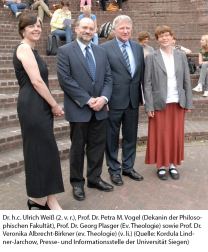
On May 11, 2011, the University of Siegen awarded its 28th honorary doctorate to Pastor Ulrich Weiß (1941-2011). This was the first honorary doctorate to be awarded by the Faculty of Arts and Humanities, into which the former Departments 1 to 3 have been merged since the beginning of 2011.
The decision followed a suggestion from the Protestant Theology department of the Faculty of Arts and Humanities. The award honored a personality who did not carry out his special research achievements in a purely academic environment, who was rooted in the region and was considered an expert par excellence in regional church history. The combination and communication of practice and science was particularly emphasized.
Rector Prof. Dr. Holger Burckhart was also delighted with the award: "With this award, we are showing that we also appreciate and recognize exceptional careers of an academic nature." He added: "With Mr. Weiß, we are gaining a personality of great regional commitment and exceptional academic presence in the reappraisal of regional history."
Ulrich Weiß was born in Altenhundem in 1941 and grew up in Niederdielfen. He completed his Abitur at the Löhrtor-Gymnasium in Siegen and studied theology in Tübingen, Heidelberg and Göttingen. He completed his vicariate as an inspector of the Reformed House of Studies in Göttingen and in the Christuskirche congregation in Siegen. After his second theological examination, he spent two years as a study inspector at the Reformed seminary in Wuppertal. Both positions as inspector in Göttingen and Wuppertal show that Ulrich Weiß was always interested in combining science and practice. For twenty-three years he was pastor of the Christus-Kirchengemeinde in Siegen (1978 to 2001), as well as deputy superintendent for many years and a member of the regional synod of the Protestant Church.
In numerous publications and countless lectures, Ulrich Weiß rendered outstanding services as a mediator of theological and, above all, church and theological history. At the Wednesday Academy and at the University of Siegen, he repeatedly offered events - increasingly after his retirement - in which he mostly reflected on regional church history and at the same time highlighted the special features of the various church groupings. His research interest lay in the critical monitoring of the Reformed churches; other focal points included the church history of Hohenlimburg and the history of the revivalist movement in Siegen and Nassau. Ulrich Weiß died on June 30, 2011 at the age of 70.
Source: Kordula Lindner-Jarchow, University of Siegen verleiht Pfarrer Ulrich Weiß die Ehrendoktorwürde, Presse- und Informationsstelle University of Siegen, May 16, 2011.
Honorary doctorate for Prof. Dr. Hans-Ulrich Gumbrecht
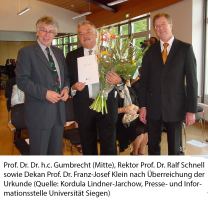
With Hans Ulrich Gumbrecht, the University of Siegen honored a "scholar" in the truest sense of the word on 27 June 2007. A Romance philologist by training, or even better: a Hispanist, it is difficult today to categorize him in just one discipline.
Working in Department 3 at the University of Siegen from 1983 to 1989, he made a lasting contribution to the establishment of a humanities research training group funded by the German Research Foundation (DFG), the first of its kind at a German university. Renowned scholars such as Jürgen Habermas, Niklas Luhmann, Jean-Francois Lyotard and Paul Watzlawick taught and worked at the Research Training Group "Forms of Communication as Forms of Life".
Research and teaching at the University of Siegen was at an excellent level long before terms such as "excellence initiative" or "elite education" were on everyone's lips. In addition to the Siegen Graduate School, the colloquia held at the InterUniversity Center Dubrovnik formed a further basis for the international reputation that Hans-Ulrich Gumbrecht and, with him, Siegen Romance Studies increasingly gained. The colloquia in Dubrovnik (at that time still in Yugoslavia) were the main way in which cooperation between academics from East and West was intensively initiated even before the disappearance of the Iron Curtain. A number of guests from the GDR and other Eastern European countries found their first substantial opportunities to work in a Western context in Siegen during Gumbrecht's time.
Numerous monographs, the co-editorship of books and anthologies, almost 300 academic essays, countless shorter academic articles and a wealth of commentaries, interviews and statements, including on scientific and cultural policy issues, bear witness to his unbroken creative power to this day. His experience as a professor at Stanford University in California and his countless visits to universities and research institutes around the world have enabled Hans-Ulrich Gumbrecht to comment critically on science policy trends in Germany and Europe. His contributions to a renowned German daily newspaper, including the "Year of the Humanities 2009", show him to be a profound connoisseur and critic of his own discipline. The University of Siegen awarded him an honorary doctorate in recognition of his outstanding academic achievements and, in this particular case, for the inspiration that the humanities scholars in Siegen have drawn and continue to draw from his work, even though he has long since moved his academic work to another location.
Prof. Dr. Dr. h.c. Gumbrecht is the 5th honorary doctor of the former Faculty 3 of the University of Siegen. The international recognition of the Romance philologist is also reflected in honorary doctorates from the universities in Montevideo, Montreal, St. Petersburg, Greifswald, Lisbon, Marburg and Aarhus.
Source: Kordula Lindner-Jarchow, Honorary doctorate for Prof. Dr. Hans-Ulrich Gumbrecht, Press and Information Office University of Siegen, June 28, 2007.
Honorary doctorate for Prof. Dr. Wolfgang Iser - an "ornament to the university"
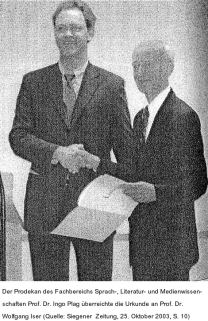
On October 24, 2003, the then Department of Linguistics, Literature and Media Studies awarded another honorary doctorate to the internationally renowned English scholar Prof. Dr. Wolfgang Iser (1926-2007) from the University of Konstanz and the University of California (Irvine).
Wolfgang Iser studied English, Philosophy and German in Leipzig, Tübingen and Heidelberg. He obtained his doctorate in Heidelberg in 1950, where he also habilitated seven years later. In 1960, he accepted an appointment at the University of Würzburg, where he took up the Chair of English Studies. After teaching at the University of Cologne for three years, he moved to the University of Constance in 1966. Together with Hans Robert Jauß and Hans Blumenberg, he was one of the founders of the research group "Poetics and Hermeneutics". He received international recognition for the development of his theory of the aesthetics of effect.
In addition to his outstanding academic achievements, his stimulating influence on the expansion of the literary studies orientation of the Siegen faculty was particularly acknowledged during the academic ceremony. Wolfgang Iser had visited Siegen several times for the purpose of networking literary, cultural and media studies and also gave the lecture at the opening of the research college "Intermediality" in June 2002.
University Rector Prof. Dr. Theodora Hantos described the honoree as a personality who dared to think in new ways, who was committed to supporting young academics and who, like few academics in the post-war period, had helped the German humanities achieve international recognition. Prof. Dr. Wolfgang Iser is an "ornament to the university". In his laudatory speech, Prof. Dr. Ludwig Pfeiffer praised the English scholar as a formative figure on the literary studies scene.
In his speech entitled "On the Concept of Culture", Prof. Dr. Wolfgang Iser emphasized the University of Siegen's willingness to experiment and expressed his gratitude for the special award, which made him feel a special sense of belonging to the University of Siegen.
In addition to the honor from the University of Siegen, Iser received the same award from the universities of Sofia, Bucharest and Giessen. He was also an honorary member of the British Comparative Literature Association and the Modern Language Association of America (MLA). He was also made an Honorary Foreign Member of the American Academy of Arts and Sciences. Prof. Dr. Wolfgang Iser died on January 24, 2007 at the age of 80.
Source: Siegener Zeitung, October 25, 2003, p. 10.
Honorary doctorate for Prof. Dr. George Mosse - "A modest gesture of reparation"
With the award of an honorary doctorate to Prof. Dr. George Mosse on November 6, 1998, the University of Siegen continued its tradition of honoring outstanding academics who were persecuted under National Socialism as a small gesture of reparation.
Rector Prof. Dr. Albert Walenta was delighted that the eighty-year-old historian from the University of Wisconsin had traveled to Siegen especially to receive the award. However, this is not the first time that Prof. Dr. George Mosse has visited the city of crowns. He had already visited Siegen in 1977, when he came to the city for a colloquium on the First World War.
In his laudatory speech, literary scholar Prof. Dr. Klaus Vondung made it clear how much recognition Mosse's writings have received beyond the field of history. The historian had gained an international reputation above all for his studies on the world of thought and the political symbolism of the völkisch and National Socialist milieu in Germany since the late German Empire. He came to the conclusion that National Socialism had been able to develop so strongly in Germany primarily because it had appropriated myths in German culture and used them - in a perverted form - to attract a larger following. Mosse's thematic focus was closely related to his own biography. He was born in Berlin in 1918, the son of an officer and grandson of the newspaper publisher of the same name, Rudolf Mosse. However, Mosse was forced to leave Germany after the Nazis seized power due to his Jewish faith and emigrated first to England and later to the USA, where he began his academic career. He received his doctorate from the prestigious Harvard University in 1946 and rose to become one of the leading historians of National Socialism. Vondung emphasized that the honorary doctorate primarily distinguished the historian Mosse. "But it should also be a modest gesture of reparation and a gesture to say thank you for helping us Germans to understand what went wrong in our history."
Due to the great impact of his academic work, Prof. Dr. George Mosse received numerous other awards, including the Goethe Medal in 1988 and the Leo Baeck Medal of the institutes of the same name in 1998. At the University of Wisconsin, the Humanities Building was named after him and in 2000, the American Historical Association established an award for outstanding work in the intellectual and cultural history of Europe since 1500 called the "George L. Mosse Prize". The scholar died on January 22, 1999, shortly after receiving an honorary doctorate from Siegen in Madison, Wisconsin.
Sources: Siegener Zeitung, November 7, 1998, p. 4; Westfälische Rundschau, No. 263, November 7, 1998, p. RSI 3.

"Personality from the field" receives honorary doctorate
On May 8, 1998, Eckart Stein, Editorial Director of "Das kleine Fernsehspiel" at ZDF, was awarded an honorary doctorate. It was the third award of this kind from the former Faculty 3. Dean Prof. Dr. Burkhart Schaeder paid tribute to Stein's close links to the Siegen media studies course and the special research area 240 "Quality-oriented media development and planning". Prorectors Prof. Dr. Hans-Jörg Deiseroth praised the new honorary doctor as a "personality from the field". Practical relevance is particularly important at the local university.
The life and work of Eckart Stein were the focus of the lecture by Prof. Dr. Helmut Schanze from the Collaborative Research Centre 240. Stein succeeded in achieving a special quality in television programming with the "Kleines Fernsehspiel". Numerous up-and-coming filmmakers have gained a foothold in this profession thanks to his commitment. Schanze paid tribute to Stein as a man who had helped to shape, experience and record the change in the media. With his work, he had made a decisive contribution to the emergence of the New German Cinema.
The laudatory speech was held by Berlin filmmaker Jutta Brückner, who had received her first commission from Stein in March 1975. The honoree had supported her with benevolence and criticism. "There was little money and a lot of freedom in small television drama. A tremendous amount of art and sincerity were possible." She thanked Stein for making it possible for her to become a filmmaker.
In addition to the honorary doctorate from the University of Siegen, Eckart Stein received numerous other awards, including the Adolf Grimme Prize for the conception of the entire series "Das kleine Fernsehspiel" (1977), the Galilei Prize of the Council of Europe (1988) and the German television award "Telestar" (1994).
Source: Siegener Zeitung, May 11, 1998, p. 5.

Honorary doctorate for Prof. Dr. Magdalena Sokolowska - combining academic work with social commitment
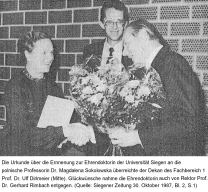
The first honorary doctorate of the former Faculty 1 was awarded to the internationally renowned Polish sociologist Magdalena Sokolowska on October 29, 1987. She had already been a guest of the Research Institute for Humanities and Social Sciences in 1978 and had subsequently held several visiting professorships. She also initiated the partnership agreement between the University of Siegen and the Institute of Philosophy and Sociology of the Polish Academy of Sciences. Numerous joint research projects between German and Polish academics have been carried out as part of this cooperation.
Rector Prof. Dr. Rimbach recalled the fate of the Polish scientist, who was expelled from Germany in 1939 and deported to Bavaria in 1943 as a forced laborer to an SS brigade leader. "It would be only too natural for someone who has experienced something like this to want nothing more to do with the Germans for the rest of their lives," explained the Rector. The fact that Magdalena Sokolowska, on the other hand, acted as a "bridge builder" was therefore all the more worthy of recognition.
In his laudatory speech, Prof. Dr. Rainer Geißler emphasized that the Polish medical sociologist was held in high esteem by colleagues, health policy makers and the medical profession. Her dissertation on the influence of housing density on the incidence of scarlet fever had already indicated the direction of her interest. Magdalena Sokolowska had combined her scientific work with a pronounced social commitment. Even in her work as a company doctor, she had distinguished herself with an inexhaustible drive to get things moving, create something new and help people.
Since the 1960s, Prof. Dr. Magdalena Sokolowska had been an employee and advisor to the World Health Organization. From 1978-1982 she was Vice President of the International Sociological Association. The Polish scientist died in 1989 at the age of 67.
Source: Siegener Zeitung, October 30, 1987, p. 2, p. 1.
The honorary doctorate for Prof. Dr. Leo Löwenthal as a sign of reconciliation
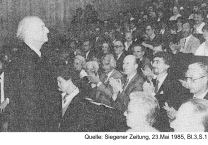
In the presence of numerous guests from politics, academia, the judiciary, administration and the student body, Prof. Dr. Leo Löwenthal (1900-1993) was awarded an honorary doctorate by Faculty 3 of the University of Siegen on 24 May 1985 in the Blue Lecture Hall. It was the second honor of this kind awarded by the department.
In his welcoming address, Rector Prof. Dr. Gerhard Rimbach referred to the Jewish wisdom "The secret of reconciliation is memory" and asked whether the Jewish scientist was at all prepared to accept the honorary doctorate. In anticipation of the National Socialist tyranny, Prof. Dr. Löwenthal had emigrated to the USA in 1933. In this context, Prof. Dr. Gerhard Rimbach recalled the failure of German academics to stand up for their Jewish colleagues. The German student body had also prepared the Holocaust with its book burnings. The willingness to accept the honorary doctorate is therefore a sign of reconciliation - said Rimbach - with which the guilt of Germans is forgiven.
In his laudatory speech, Prof. Dr. Hans Gumbrecht paid tribute to the life and work of the Jewish scientist with the lecture "Leo Löwenthal - a (not only intellectual) concept of style". After studying law, mathematics, philosophy and sociology, his interest in Zionism and the European Enlightenment provided the initial impetus for his research work. In 1926, he began his work at the Institute for Social Research in Frankfurt am Main, whose move abroad (first to Switzerland, then to the USA) he had prepared before the National Socialist seizure of power. From America, he fought against National Socialism through academic reviews of propaganda articles and speeches.
In 1956, Löwenthal received a professorship at the University of Berkeley, where he continued to work after his retirement. Together with Theodor Adorno, Max Horkheimer and Herbert Marcuse, he was one of the co-founders of Critical Theory.
The literary sociologist received further honorary doctorates from the University of Hamburg and the Free University of Berlin. He was awarded the Theodor W. Adorno Prize in 1989. Prof. Dr. Leo Löwenthal died on January 21, 1993 in Berkeley, California.
Source Siegener Zeitung, May 23, 1985, B.1, p. 3.
An act of reparation - the honorary doctorate for Käte Hamburger
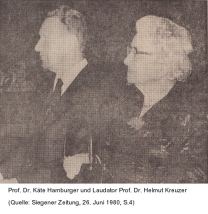
On June 25, 1980, the Department of Linguistics and Literature awarded its first honorary doctorate. The award went to the renowned Germanist Prof. Dr. Käte Hamburger (1896-1992). In the presence of numerous professors, lecturers and students, founding rector Artur Woll emphasized that, in addition to honoring her academic achievements, the appointment was also an act of reparation that could be carried out without prejudice, especially by newly founded universities. Expelled by the National Socialists due to her Jewish ancestry, Käte Hamburger emigrated to Sweden in 1934. After working there as a journalist, writer and language teacher, she returned to Germany from exile in 1956. In 1922, she had published a work on Friedrich Schiller entitled "Schiller's Analysis of Man as the Basis of his Philosophy of Culture and History. Ein Beitrag zum Problem des Individualismus, dargestellt auf Grund seiner philosophischen Schriften" with Clemens Baeumker in Munich.
In his laudatory speech on Hamburger's academic work, Prof. Dr. Helmut Kreuzer highlighted her achievement in identifying the Kantian influences in the works of important playwrights and novelists. He also highlighted her work "The Logic of Poetry", in which she examined the effect of poetic language and arrived at a new approach that no longer takes poetic aesthetics as its starting point, but poetic logic.
In her keynote speech, Prof. Dr. Käte Hamburger addressed the topic "Fear and pity - a Lessing problem". Starting from the Aristotelian definition of tragedy, which is based on the four concepts of pity, fear, affects and purification, Käte Hamburger presented both of the latter concepts as controversial, not only because of their Aristotelian origin, but also because of the irritations they caused in the 16th and 17th centuries. The poetry of the 18th century was therefore characterized solely by the terms "pity" and "fear". Lessing had set Aristotle's model in absolute terms and attempted to resolve the contradictions that arose in the definition of pity and fear by placing pity in the service of humanity.
In addition to an honorary doctorate from the University of Siegen, Prof. Dr. Käte Hamburger was awarded the Federal Cross of Merit in 1966, the Medal of Merit of the State of Baden-Württemberg in 1984 and the Schiller Memorial Prize in 1989. The University City of Göttingen honored Käte Hamburger with the naming of a street and the Federal Ministry of Education and Research with the funding program for the humanities, the "Käte Hamburger Kolleg". She died at the age of 95 on April 8, 1992 in Stuttgart.
Source: Siegener Zeitung, June 26, 1980, p. 4.