Machine learning and real care data: New overview of heterogeneous treatment effects
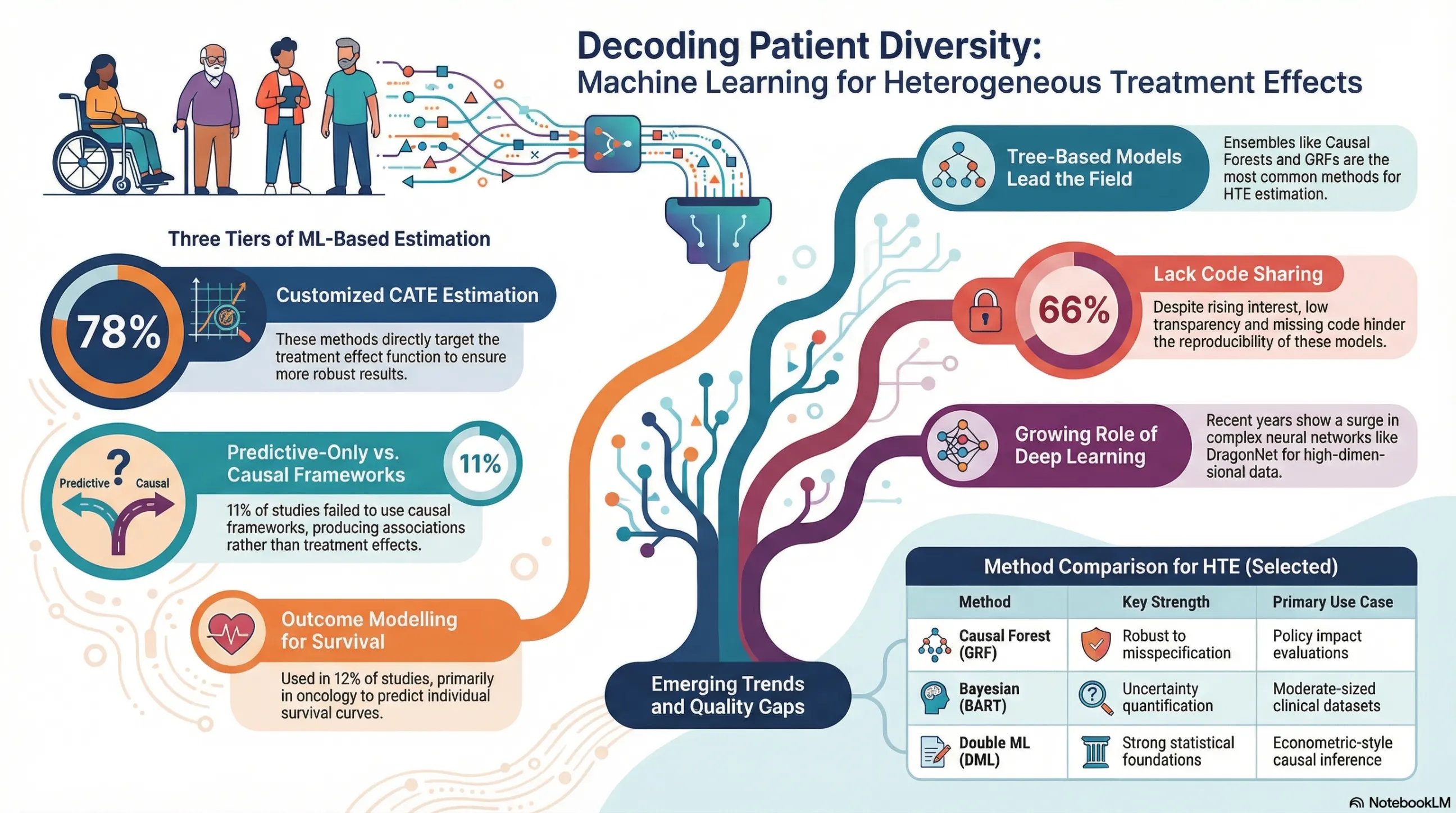
How differently patients react to the same treatment is a key question for targeted and efficient healthcare. In a recent review article, researchers from the University of Hamburg and the University of Siegen systematically analyze how machine learning methods are used to estimate heterogeneous treatment effects (HTEs) based on real-world data.
The study, which appears in the journal Value in Health, analyzes 74 international papers published between 2014 and 2025. The authors categorize the methods used into three groups:
(1) purely predictive approaches without causal identification,
(2) causal outcome models and
(3) specialized methods for the direct estimation of conditional average treatment effects (CATE).
The results show that tree-based methods and specialized CATE methods are increasingly used, while their application in health economic research is still limited. At the same time, the analysis points to considerable differences in the methodological quality and transparency of the studies. In particular, there is a need for further improvement in reporting standards, validation and reproducibility.
The article thus provides a structured orientation for researchers who want to use machine learning to analyse heterogeneous treatment effects in real health care data and makes an important contribution to the further development of evidence-based, individualized health care and policy analyses.