Patented hydrogel: New approach for safe wound healing

The skin is the largest human organ. If it is injured, bacteria can enter the body through wounds and, in the worst case, cause life-threatening infections. To improve wound healing and prevent bacterial infections, chemists at the University of Siegen and the Amsterdam University Medical Center have developed an innovative, therapeutic hydrogel for wound dressings. It protects wounds, supports healing and effectively combats infections - including those caused by multi-resistant bacteria. The scientists have already patented their invention. However, further research and development work is still required before the product is ready for the market.
Muhammad Atif, who studied chemistry in Pakistan and China and then came to the University of Siegen as part of the EU's "STIMULUS" program, was in charge of the project. "STIMULUS" is a Marie Skłodowska-Curie funding program for young scientists, which focuses on the development of intelligent wound dressings to fight infection. "I am very happy that I was accepted into the program and thus had the opportunity to develop the hydrogel together with colleagues. The fact that this has resulted in a patent is of course a great success," says Atif, who is also currently completing his doctoral thesis on his innovation.
In the macromolecular chemistry laboratory at the University of Siegen, the Pakistani-born scientist developed a method of producing polymers - i.e. large molecules - and then bonding them together using light irradiation: First to form chains and then three-dimensional networks. If these are made to swell with water, a hydrogel is created. "The hydrogel is a solid, but it contains a lot of water - its consistency can be compared to gelatine," says Prof. Dr. Ulrich Jonas, who is supervising Atif's doctoral thesis. The highlight: a protein is also embedded in the hydrogel, which has antimicrobial properties and can prevent wound infections.
Prof. Dr. Sebastian Zaat's research group at the Amsterdam University Medical Center, where Muhammad Atif spent several months conducting research as part of the program, contributed its expertise on the protein. "The great advantage of this protein is that there is no known resistance to it - unlike many antibiotics that have been used to prevent and treat infections to date," explains Atif. The protein is firmly anchored in the hydrogel and does not enter the patient's body. It acts like a "contact poison" directly via the gel surface: If bacteria come into contact with it, they are rendered harmless.
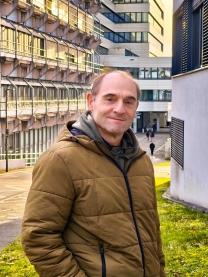
For Prof. Jonas, another advantage of the novel hydrogel is its tissue-like structure: "In appropriately equipped wound dressings, the hydrogel can swell in the aqueous wound medium and does not stick to the skin. This allows the wound to heal better." The hydrogel is also permeable to air and drains wound fluid. Frequent dressing changes, which can cause wounds to re-open, are no longer necessary: A color indicator can optionally be integrated into the hydrogel to provide an early indication if harmful bacteria are present in the wound.
Further research is required to transfer the hydrogel to medical use. For example, a way must be found to combine the hydrogel with a wound dressing - this requires technological development work in cooperation with industrial partners. In addition, methods must be found to produce the hydrogel and the embedded protein in larger quantities, explains Prof. Jonas. And last but not least, it is important to scientifically prove the compatibility for humans.
Muhammad Atif and Prof. Jonas see great potential in their development: "Resistance is increasing worldwide, while at the same time more and more people are suffering from chronic wounds - for example as a result of diabetes. According to forecasts, infections caused by antibiotic-resistant microorganisms could replace cancer as the most common cause of death by 2050. Innovations such as the newly developed hydrogel are therefore urgently needed."
STIMULUS is a European training network (in the European Union's Horizon 2020 research and innovation program under the Marie SKODOWSKA-CURIE grant) that enables participating young scientists to receive unique training in various disciplines - including stays at partner universities and research institutions. Further information can be found here: https://www.stimulus-etn.eu/
The scientists are supported by PROvendis GmbH - a central service provider for knowledge and technology transfer in NRW - when it comes to patenting and finding industrial partners for further development steps.