Signaling pathways in the intestine: Siegen research opens up new therapeutic opportunities

Signaling pathways in the intestine: Siegen research opens up new therapeutic opportunities
6 to 8 million people worldwide suffer from chronic inflammatory bowel diseases such as Crohn's disease or ulcerative colitis. Until now, these diseases have been considered incurable. One of the causes is a malfunction of the immune system in the intestine. Starting in April, biologists at the University of Siegen will be investigating exactly how the intestinal immune system works in a new research project. The results could provide the basis for the development of new drugs. At the same time, the researchers want to make a contribution to animal welfare with their work: instead of conventional laboratory animals such as mice, they are using the larvae of the red-brown flour beetle for their experiments. The German Research Foundation (DFG) is funding the project with almost 300,000 euros.
"The intestine is one of the largest organs in humans. Due to its large surface area, it is particularly good at absorbing vital substances, but on the other hand it also offers a large surface area for infections by microorganisms," says project leader Prof. Dr. Hans Merzendorfer. To protect itself from infections, the intestine has an innate immune system that activates various defense mechanisms when necessary. A special enzyme called "dual oxidase", which is located in the cells of the intestinal wall, plays an important role in this. Its task is to produce so-called "reactive oxygen species" (ROS) "at the touch of a button" - these molecules act like a kind of biological disinfectant spray that kills dangerous bacteria in the intestine - while protecting healthy intestinal bacteria.

How exactly the mechanism works was not fully understood for a long time - until now. "We were able to identify a specific protein that sits on the surface of the intestinal cells and works like a sensor. You can think of it like a doorbell that is activated from the outside but sends a signal to the inside of the cell," explains Prof. Merzendorfer. If pathogenic bacteria enter the intestine, the process is started automatically: The bacteria release certain chemical substances that are registered by this protein and "press" the doorbell, so to speak. The protein then triggers a signaling chain inside the cell that activates the dual oxidase and leads to the production of ROS - enabling the immune system to fight the dangerous bacteria.
"In diseases such as Crohn's disease or ulcerative colitis, the control of the signal chain is disrupted and too much ROS is produced," explains doctoral student Kim Venus from Prof. Merzendorfer's team. The new research project therefore builds on the working group's previous findings and takes a closer look at the immune processes in the intestine. "We want to gain an even better understanding of the individual components of this signaling chain and their complex interaction," says Venus. For example, the researchers want to find out exactly which molecules activate the doorbell protein. This knowledge could be used in future to develop new drugs that restore the disrupted signaling pathway in patients.
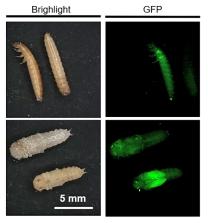
In their laboratory experiments, the biologists are not using traditional laboratory animals such as mice, but the tiny larvae of the red-brown flour beetle. Several tens of thousands of beetles and larvae are already waiting to be used in the laboratory refrigerator. "In principle, the immune system in the larvae's gut works in exactly the same way as our own. In fact, we find closely related proteins, receptors and signaling pathways in the insects that function in a similar way to those in humans," says Prof. Merzendorfer. In order to make the processes visible under the microscope, the larvae are fed with fluorescent particles. If inflammatory processes take place in their intestines, the way in which the larvae glow under the microscope changes.
In addition to medical findings, the team also wants to make a contribution to animal welfare with this project. "Science is called upon to reduce and improve research with mammals as much as possible. We are demonstrating that experiments that would have traditionally been carried out on mice in the past also work with beetle larvae," says Merzendorfer. At the same time, the scientists want to work with intestinal tissue from sick people to test whether their findings can be transferred to the human body. To this end, they will cooperate with clinics in the region. The project is scheduled to run for a total of three years.


