In contrast to other forms of energy, renewable energies cause significantly fewer greenhouse gas and other harmful emissions. Nevertheless, any energy generation involves the consumption of nature and an impact on the cultural landscape. Consequently, environmental and natural impacts must be minimized during the construction of such plants and interventions in ecosystems must be reversible, i.e. unlike in the case of climate change, it must be possible to reverse any consequential damage. The aim must be to achieve an energy transition that is compatible with nature. As clean technologies for generating electricity, hydropower, onshore and offshore wind energy and photovoltaics are components for implementing the climate targets. In addition to the known positive effects, such as the avoidance of CO2 and air pollutants, ground-mounted PV systems, for example, can contribute to nature and species conservation as well as soil and water protection. For example, ground-mounted PV systems offer the opportunity to take land out of intensive use, as the PV system reduces the economic disadvantages that can arise from extensive cultivation. Extensive cultivation contributes to the development of diverse vegetation structures and thus to increasing biodiversity in the agricultural landscape. In general, sites such as (disused) landfills and dumps or conversion areas with a high degree of sealing or standing water are also suitable for open-space PV systems. Onshore and offshore wind turbines are often the subject of controversy. On the one hand, these produce clean electricity, but on the other hand they can have a negative impact on the habitats in their vicinity. Climate change also has an impact on hydropower (drought, heavy rainfall, dwindling glaciers, changes in the bedload balance) and requires a review of the technical facilities and their risk management, also with regard to the downstream waters. An essential aspect that is often neglected is the foundation, i.e. the anchoring of the facilities in the subsoil. This is an important part of the planning and the stability assessment under the consequences of climate change. The primary goal must therefore be to minimize the negative effects of renewable energies and to use and promote positive effects for nature, agriculture and society. In addition to clean fresh water and fertile soils, the population, agriculture and businesses also need energy. Here it is also important to supply rural areas with decentralized or semi-decentralized solutions, for example to give smaller farms or village communities access to renewable energy and, if necessary, to create additional income through its production.
Seminar in Brazil - Part 1
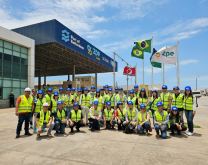
The first part of the two-part seminar on "Soil and water in the context of renewable energy" took place from September 14 to 21, 2024 under the direction of the Chair of Geotechnics at the University of Siegen. The seminar was held in Fortaleza, Brazil. It was attended by 40 experts from twelve Latin American countries as well as from Germany and Spain. The purpose of the seminar was to exchange information on hydropower and the expansion of wind energy on land and at sea. Aspects of climate change, environmental compatibility and geotechnical aspects were discussed, as well as forms of participation, education and training, and just transition. An excursion, group work and a think tank were used for further exchange of information. The first part of the seminar was successfully concluded with valuable discussions and ideas.
Seminar in Argentina - Part 2
The second part of the seminar on "Soil and water in the context of renewable energy" took place from March 30 to April 5, 2025 under the direction of the Chair of Geotechnical Engineering at the University of Siegen. The seminar was held in Mendoza, Argentina. It was attended by 45 experts from thirteen Latin American countries as well as from Germany and Spain. The purpose of the seminar was to exchange information on ground-mounted photovoltaic systems. Aspects of climate change, nature and environmental protection, opportunities and challenges as well as geotechnical aspects were discussed, as well as forms of participation, training and further education and just transition. An excursion, group work and a think tank were used for further information exchange. The second part of the seminar was successfully concluded with valuable discussions and ideas.

Everything at a glance
-

Duration
01.01.2024 - 31.12.2025 -

Funding
DAAD
