Skip to main content

Transnational Renaissance: The Making of a Modern Idea Between Germany and Italy

The conference, held from November 20 to 24, 2023, at Villa Vigoni (Menaggio, Italy), focused on examining the linguistic, historical, and philosophical origins of the modern concept of the Renaissance. The emphasis was on the appropriation and transformation of German scholarship in 19th-century Italy, either directly or through French mediation. The hypothesis pursued was that this transfer of knowledge redefined the “Rinascimento” – both as a term and as a historiographical idea.


Professorship for History of Philosophy


Foto der Villa Vigoni

Project Description

The symposium examined the historical and contemporary development of Renaissance philosophy, with a focus on the contested nature of this historiographical concept and its institutional development. The goal was to trace the evolution of the term “Renaissance” from the 19th century to contemporary academic practice and to emphasize the transnational and interdisciplinary dynamics that shaped it.

Key themes included:

  1. Historiographical foundations: The conference highlighted new interpretations of Renaissance sources, the early emergence of the term “Renaissance,” and the influence of figures such as Marco Sgarbi and Lucas Burkart. Special attention was given to the role of France in shaping the term, particularly through the works of Hegel and Cousin, as well as their influence on Italy and Britain.

  2. Global and transnational perspectives: The concept of the “Global Renaissance” was explored through case studies of Soviet historiography and the transatlantic exchange between Italian and American scholars in the late 19th century. The conference emphasized the role of scholarly migration in shaping historiographical thinking.

  3. Methodological approaches: Three reading seminars promoted interdisciplinary exchange on Renaissance philosophy, focusing on its reception in literature, political agendas, and the evolving meanings of terms like “Rinascimento” and “Risorgimento.” Contributions from young scholars played a key role in these discussions.

  4. Institutionalization of Renaissance Philosophy: The influence of major 20th-century philosophers such as Cassirer, Kristeller, and Garin on the field was also discussed. The concluding panel discussion addressed the institutional presence of Renaissance philosophy and its future in academia, emphasizing the importance of European collaboration for its long-term relevance.

The conference, which involved researchers from Germany, Italy, France, Switzerland, and the United Kingdom, opened a broader debate on the future of Renaissance philosophy as an academic discipline.

Everything at a Glance

  • Icon Kalender

    Duration
    19.11.2021 – 24.11.2023 (ended)

  • Icon Tag

    Research Area
    Historiography, Reception of the Renaissance

  • Icon Abzeichen Euro

    Funding
    DFG (Deutsche Forschungsgemeinschaft)


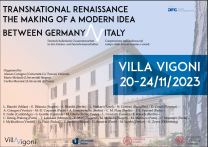
Plakat der Tagung in der Villa Vigoni


Link to the Programme

Project Organizers

The conference was organized by Mario Meliadò (Universität Siegen) in collaboration with Alessio Cotugno (Università di Venezia) and Cecilia Muratori (Università di Pavia) as part of the DFG program “German-Italian Collaboration in the Humanities and Social Sciences.”


Flyer zum Transnational Renaissance-Projekt