Measurement and Control Engineering – Mechatronics Working Group
Prof. Dr.-Ing. Oliver Nelles
Doctoral Dissertations
Theses from the Research Group
2012 Hayn, Henning
Development of a Haptically Assisted Control Concept for Hydraulic Excavators
Download
2013 Hartmann, Benjamin
Local model networks for the identification and experimental design of nonlinear systems
Download
2018 Belz, Julian
Fighting the Curse of Dimensionality with Local Model Networks
Download
2019 Schillinger, Mark
Safe and Dynamic Design of Experiments
Download
2020 Mayer, André
Analysis of System-Wide Interrelationships in Hybrid Powertrain Concepts
with regard to customer-relevant requirements
Download
2021 Münker, Tobias
Machine Learning with Finite Impulse Response Models
Download
2022 Schüssler, Max
Machine Learning with Nonlinear State-Space Models
Download
2024 Voigt, Tim
Design of Experiments Methods for the Experimental Modeling of Existing Mechatronic Processes
Download
2025 Glass, Leon
Gray-Box System Identification Using Continuous-Time Local Model Networks
Download
2026 Peter, Timm
Preprocessing for Data-Driven Modeling with Probability Density Estimation
Download
2026 Smits, Volker
Machine Learning with Space-Filling Design of Experiments for Nonlinear Dynamic Systems
Nonlinear System Identification
Book Recommendation
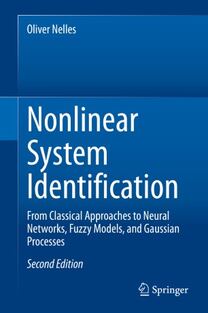
Information from the Publisher (SpringerLink)
Introduction
This book provides engineers and scientists in academia and industry with a thorough understanding of the underlying principles of nonlinear system identification. It equips them to apply the models and methods discussed to real-world problems with confidence, while also making them aware of potential difficulties that may arise in practice.
Moreover, the book is self-contained, requiring only a basic understanding of matrix algebra, signals and systems, and statistics. Accordingly, it can also serve as an introduction to linear system identification and provides a practical overview of the major optimization methods used in engineering. The focus is on gaining an intuitive understanding of the subject and the practical application of the techniques discussed. The book is not written in a theorem/proof style; instead, the mathematics is kept to a minimum, and the ideas covered are illustrated with numerous figures, examples, and real-world applications.
In the past, nonlinear system identification was a field characterized by a variety of ad hoc approaches, each applicable only to a very limited class of systems. With the advent of neural networks, fuzzy models, Gaussian process models, and modern structure optimization techniques, a much broader class of systems can now be handled. Although one major aspect of nonlinear systems is that virtually every one is unique, tools have since been developed that allow each approach to be applied to a wide variety of systems.
Keywords
Fuzzy and neuro-fuzzy models, linear optimization, nonlinear local optimization, linear and nonlinear dynamic system identification, identification of dynamic systems, local model networks, HILOMOT, nonlinear finite impulse response (NFIR), long short-term memory (LSTM) networks
DOI
https://doi.org/10.1007/978-3-030-47439-3
Print ISBN
978-3-030-47438-6
Online ISBN
978-3-030-47439-3
Fundamentals of Electrical Engineering for Self-Study
Book Recommendation
Volume 1: Direct Current Circuits (2nd Edition - VDE-Verlag)

Information from the Publisher (SpringerLink)
Contents
To facilitate self-study, detailed explanations, reviews, examples, and exercises are necessary. The extensive material has therefore been divided into four volumes, which are structured to allow for a comprehensive coverage of the material equivalent to a two-semester course with six semester-week hours per week. In some places, the text goes beyond the basics and provides an introduction to theoretical electrical engineering. Here, the reader can delve deeper or skip ahead as desired without encountering gaps in understanding in the subsequent material.
Volume 1 begins with simple direct-current circuits, which are extended to include nonlinear circuits, such as those with current-dependent resistors. This is followed by calculation methods for large networks. Semiconductors and their circuits, as well as conduction mechanisms in liquids and gases, round out the discussion of direct current circuits. Finally, the book covers inhomogeneous flow fields.
Target Audience
This book is intended to serve as a resource for students of electrical engineering, computer science, physics, economics, and mechanical engineering. It is intended as a study guide for universities and colleges. Due to its structure, self-study is possible even without attending lectures. Therefore, high school students can also use the book for career orientation and college preparation between graduating from high school and beginning their studies.
About the Authors
Prof. Dr.-Ing. Oliver Nelles is a professor at the University of Siegen in the Chair of “Measurement and Control Engineering—Mechatronics” in the Department of Mechanical Engineering, School IV, and continues the series “Fundamentals of Electrical Engineering for Self-Study,” founded by Prof. Dr.-Ing. Dieter Nelles.
Prof. Dr.-Ing. Dieter Nelles most recently held the Chair of “Electric Power Supply—Power Plant Engineering and Power Transmission” at the University of Kaiserslautern. After completing his studies at the Technical University of Darmstadt, he began working at AEG in 1966 as a development engineer. After earning his doctorate in Berlin in 1972 in the field of electrical power grid stability, he became head of the Technical-Scientific Department at AEG. From there, he moved to the University of Kaiserslautern in 1982 and established the Chair of “Electric Power Supply—Power Plant Engineering and Power Transmission.”
Book Details
2nd, revised edition 2022, 280 pages, DIN A5, hardcover
ISBN
978-3-8007-5640-7, e-book: ISBN 978-3-8007-5641-4
Volume 2: Electric Fields (2nd edition—VDE-Verlag)

Information from the publisher
Contents
Volume 2 begins with homogeneous electrostatic fields and covers capacitance. It then introduces alternating fields, including time functions, phasor diagrams, and complex calculations. The charging processes that occur when switching capacitive circuits are also briefly outlined. Homogeneous fields are discussed in terms of the superposition of current fields and electric fields. The book concludes with Fourier series.
Book Details
2nd, revised edition 2022, 299 pages, DIN A5, hardcover
ISBN
978-3-8007-5799-2, e-book: ISBN 978-3-8007-5800-5
Volume 3: Magnetic Fields (2nd edition—VDE-Verlag)

Information available from the publisher
Contents
Volume 3 begins with a description of magnetism in a homogeneous field, magnetic materials, and, in particular, iron saturation. Starting with short conductors carrying current, the book then discusses magnetic fields and their forces in elongated conductors. A significant portion of the book is devoted to the description of the laws of induction. The book concludes with Maxwell’s equations, which serve as a bridge to theoretical electrical engineering.
Book Details
2nd, revised edition 2023, 329 pages, DIN A5, hardcover
ISBN
ISBN 978-3-8007-5802-9, e-book: ISBN 978-3-8007-5803-6
Volume 4: AC Circuits (2nd edition—VDE-Verlag)

Information from the publisher
Contents
Volume 4 begins with a review of periodic quantities from Volumes 2 and 3. It provides a detailed treatment of circuits consisting of resistors, capacitors, and inductors. Transformers are also included in these networks. The volume concludes with three-phase power technology, beginning with residential electrical installations and ending with a brief description of electrical machines.
Book Details
2nd, revised edition 2023, 341 pages, DIN A5, hardcover
ISBN
ISBN 978-3-8007-5805-0, e-book: ISBN 978-3-8007-5806-7