Measurement and Control Engineering – Mechatronics Working Group
Prof. Dr.-Ing. Oliver Nelles
Research Topics: Hermann Klein
Nonlinear State-Space System Identification
Nonlinear state-space representations (NLSS) are the most general and abstract mathematical descriptions of dynamic systems. Compared to common feedback approaches such as Nonlinear Autoregressive models with eXogenous Inputs (NARX), nonlinear state-space models
- are more powerful because they use internal state feedback rather than output feedback,
- construct modeled state variables,
- require more sophisticated optimization techniques using recurrent gradients,
- can be easily extended to multiple-input multiple-output (MIMO) processes.
The integration of neural networks into a state-space framework provides a flexible black-box modeling approach for the identification of nonlinear processes. In particular, the Local Model State Space Network (LMSSN) has proven to be a powerful tool for accurately modeling various real-world applications as well as benchmark systems. (Figure 1 shows the block diagram of the LMSSN. For detailed information, see also [1].)
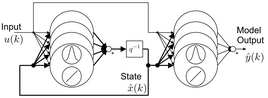
Figure 1: Block diagram of the discrete-time Local Model State Space Network.
In machine learning, recurrent neural networks (RNNs) such as the Long Short-Term Memory (LSTM) or the Gated Recurrent Unit (GRU) are popular approaches for time series modeling. From a system identification perspective, RNNs can be viewed as NLSS models. In contrast to RNNs, NLSS models offer several advantages:
- Separation between the dynamic order and the number of neurons
- Fewer model parameters
- Comprehensibility of model parameters
- Compact representation
- Deterministic modeling leads to reproducibility
- Fewer tuning parameters
From a control-oriented perspective, LMSSNs are related to Takagi-Sugeno state-space systems or linear-parameter-varying (LPV) systems. Due to its local linear models, it strikes a balance between linear and nonlinear modeling approaches.
In LMSSNs, the required global nonlinear approximators are generated through linear models that are active in local regions. A key feature of this approach is that these regions are learned from data in an efficient and demand-oriented manner, aided by tree-construction algorithms such as the Local Linear Model Tree (LOLIMOT) or the Hierarchical Local Model Tree (HILOMOT).
Gray-Box State Space Modeling
Generally, black-box modeling approaches yield high modeling performance but are difficult—or even impossible—to interpret. If a successful identification task requires criteria beyond modeling performance, such as interpretability, sparsity, and robustness, gray-box modeling techniques offer advantages over black-box approaches. In addition to measurement data for parameter estimation, prior knowledge of the process is incorporated into model training. The purpose of this research is to develop general-purpose gray-box state-space methods that are not restricted to specific processes.
In engineering applications, prior knowledge is often available in the form of a symbolic linear system of differential equations based on first principles. Gray-box state-space identification incorporates prior knowledge by initializing with a linear model of the process. This linear model can contain various forms of prior knowledge, e.g.,
- physical parameters,
- interpretable state representations where state variables correspond to physical quantities, and/or
- relationships between different state variables through a specific canonical form.
In the next step, this linear model is refined to match the true nonlinear process behavior. The Local Linear Model Tree algorithm can be used to learn the model’s operating- and state-dependent behavior while maintaining the initial interpretable structure.
With the help of this gray-box strategy, it is possible to extract physical information from measured data, as the nonlinear effects are isolated within the model structure.
For example, unknown internal nonlinear dynamics can be captured by this proposed gray-box approach. Figure 2 below illustrates the separation between a linear equation of motion and a hysteretic memory, suitable for modeling the Bouc-Wen benchmark dataset [2].
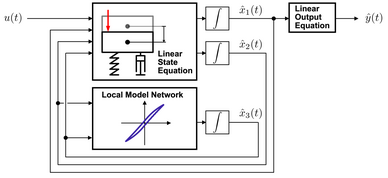
Figure 2: Example of a gray-box LMSSN model for a hysteretic oscillator.
References
| [1] | Max Schüssler. "Machine Learning with Nonlinear State Space Models." Ph.D. dissertation. University of Siegen, 2022. |
| [2] | Hermann Klein and Oliver Nelles. “Identification of Gray-Box Hysteresis State Space Models.” In: Book of Abstracts—8th Workshop on Nonlinear System Identification Benchmarks: Lugano (Switzerland), April 24–26, 2024. |
| [3] | Hermann Klein, Max Schüssler, and Oliver Nelles. “Physical Interpretability of Data-Driven State Space Models.” In: Proceedings—Workshop on Computational Intelligence: Berlin, November 23–24, 2023. |
| [4] | Hermann Klein, Max Schüssler, and Oliver Nelles. “Physical-Inspired State Space Structure for Nonlinear Gray-Box Modeling.” In: 10th International Conference on Control, Decision and Information Technologies (CoDIT). IEEE |