Measurement and Control Engineering – Mechatronics Working Group
Prof. Dr.-Ing. Oliver Nelles
Research Topics: Tarek Kösters
Adaptive Local Model Networks (ALMN)
System identification is the task of estimating dynamic models from finite, noisy measurement data. Two identification scenarios can be distinguished. If data from the process have been collected and a model of the process is subsequently estimated, the procedure is called offline system identification. In contrast, when the data are presented as individual data samples and the model is updated based on the given sample, the task is referred to as online identification. Typically, there are two reasons for using online identification. One reason is the lack of a dataset needed to estimate a process model offline. A second, more common reason is the application of the model in a time-varying scenario, which means that the process changes over time.
My work addresses the second case. My research focuses on the use of local model networks (LMNs) for this purpose. The mathematical framework of an LMN is based on the weighted superposition of different local linear models. This allows for the use of the least squares method or the recursive least squares algorithm to estimate the local model parameters offline or online, respectively [7, 6]. Our work primarily focuses on two aspects of adaptation. On the one hand, we investigate different adaptation methods to achieve a situation-dependent update behavior for the local model parameters. To this end, we focus in particular on incorporating regularization and time-varying forgetting factors into the adaptation method [3, 2]. This enables different model updates based on the current excitation conditions as well as the current process variation.
On the other hand, we work on the effective utilization of local and global update strategies. In general, adaptation of the local model parameters results in local updates of the entire model, which means that the model changes strictly only in regions where new data are present. This typically enhances the robustness of the adaptation compared to globally defined model structures (e.g., polynomials), especially for unbalanced excitation scenarios. However, if global shifts occur throughout the entire process, global updates may be necessary. For this purpose, we developed a global model extension and its corresponding adaptation algorithm, as shown in Fig. 1. With the global update of the model, only simple changes to the model’s behavior can be made; however, these changes affect the model globally. Local updates, in contrast, enable complex model updates that affect the model only locally.
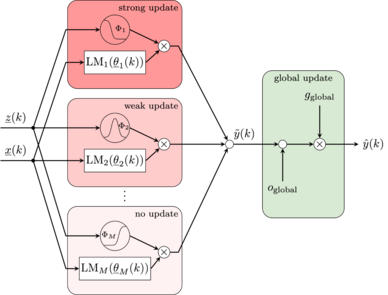
Figure 1: Local model network with global and local adaptation options.
Process Optimization of a Combine Harvester
As an application example, our work focuses on the separation process of a combine harvester. A combine harvester integrates the task of collecting and separating grain crops into its various components. Its main task is to separate the valuable grains from the rest of the plant, a process that takes place in the threshing, separation, and cleaning sections of the combine harvester (see Fig. 2). In this process, various adjustment options account for the different situations the combine harvester encounters. Due to the interaction of the combine harvester with natural materials and various crop types, optimal process settings are neither known in advance nor constant throughout the harvesting process.
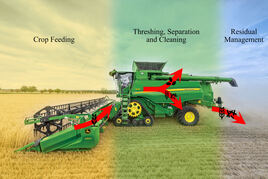
Figure 2: Typical distribution of combine harvester tasks along the machine body (adapted from [1])
The goal of this work is to optimally set the adjustment options offered by the combine harvester to control the separation process, given the current operating conditions. For this purpose, a model-based optimization algorithm is used (see Fig. 3). To account for the variable conditions encountered by the combine harvester, no time-invariant models are used; instead, model adaptation is employed. It utilizes Adaptive Local Model Networks (ALMN), as explained above, to adapt the model to the encountered conditions [5, 4]. This, in turn, allows the optimization to adjust the combine harvester settings accordingly.
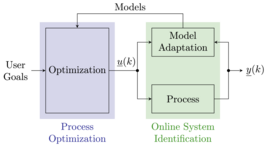
Figure 3: Process optimization scheme for the combine harvester separation process.
References
| [1] | Deere & Company. X Series Combines. Online. 2023. |
| [2] | E. Horita et al. “A leaky RLS algorithm: its optimality and implementation.” In: IEEE Transactions on Signal Processing 52.10 (2004), pp. 2924–2936. |
| [3] | Christopher Illg et al. “Adaptive System Identification with Regularized FIR Models.” In: IFAC-PapersOnLine 55.12 (2022), pp. 1–6. |
| [4] | Tarek Kösters and Oliver Nelles. “Adaptive Nonlinear Dynamic System Identification for the Separation Process of a Combine Harvester.” In: AgEng 2024 Athens. 2024, pp. 301–307. |
| [5] | Tarek Kösters and Oliver Nelles. “Nonlinear Dynamic System Identification of a Separation Unit for Raw Materials.” In: 2023 IEEE Conference on Control Technology and Applications (CCTA). 2023, pp. 992–997. |
| [6] | Edwin Lughofer. Evolving Fuzzy Systems—Methodologies, Advanced Concepts, and Applications. Berlin, Heidelberg: Springer, 2011. |
| [7] | Oliver Nelles. Nonlinear System Identification. Springer International Publishing, 2020. |