What is material fatigue?
Material fatigue is one of the key challenges in the safe and reliable design of technical components. In service, materials are often subjected to varying or recurring mechanical loads that can lead to the formation and propagation of microscopic cracks, even at stresses below the static strength. Since fatigue damage usually develops gradually and is initially barely visible from the outside, understanding it is of great importance for assessing safety, service life, and reliability.
At the Chair of Materials Science and Testing, we investigate how fatigue damage develops, which factors determine its growth, and how materials and components can be designed to be more resistant to cyclic loading. Key factors in this context include material composition, microstructure, surface condition, manufacturing process, heat treatment, residual stresses, environmental influences, and the type and magnitude of the mechanical load.
Research at the Department
Understanding Material Behavior, Evaluating Damage Mechanisms, and Improving Component Safety
At the Chair of Materials Science and Testing, we view material fatigue as the interplay of material, process, microstructure, and loading. The focus is on how manufacturing and machining processes affect the microstructure and, consequently, fatigue and damage behavior.
To this end, we combine mechanical testing methods with metallographic and microscopic characterization. This allows us to systematically investigate the relationships between material condition, crack initiation, crack propagation, and failure behavior. A particular focus is on the evaluation of damage mechanisms and the derivation of materials science-based solutions for research and industrial applications.
Methods and Skills
From cyclic testing to fracture surface analysis


Investigation of material behavior under repeated loading to evaluate service life, the onset of damage, and failure behavior.

Determining the relationship between the load level and the achievable number of load cycles as a basis for evaluating fatigue strength.

Analysis of crack propagation under cyclic loading to assess damage development, remaining service life, and failure risk.


Preparation and microscopic examination of microstructures, cracks, and defects to classify material characteristics relevant to damage.

High-resolution analysis of fracture surfaces, crack origins, and failure mechanisms at the microstructural scale.

Chemical and crystallographic characterization of localized material regions to evaluate the influence of microstructural factors on fatigue behavior.
Projects in this subject area
Overview of Research Projects in the Field of Material Fatigue and Cyclic Material Damage
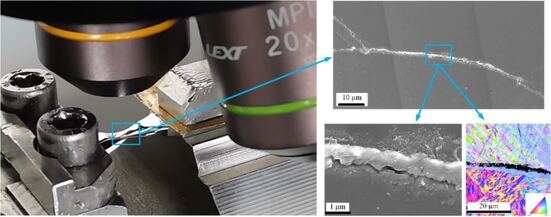
In contrast to crack initiation and longitudinal crack propagation, the propagation of microstructurally short cracks in martensitic spring steels remains largely unexplored. Accordingly, there is also a lack of knowledge regarding the influence of residual stresses occurring within the component on this phase of material damage. Consequently, the technical crack initiation phase—which can account for more than 90% of the service life in the HCF range—has not yet been described in a model-based manner and thus remains beyond general understanding. The project aims to elucidate in detail the mechanisms of material damage in martensitic spring steels caused by short-crack growth and to develop a materials science-based simulation of the growth behavior of fatigue short cracks within the framework of mechanism-oriented modeling based on the boundary element method. This will lay the foundation for understanding the metallophysical processes in martensitic spring steels subject to residual stress under cyclic loading with uniaxial and biaxial, plane stress states in the HCF range. Based on these results, it should be possible to improve the prediction of service life for martensitic spring steels, thereby enabling application-oriented verification of operational safety and higher material utilization.
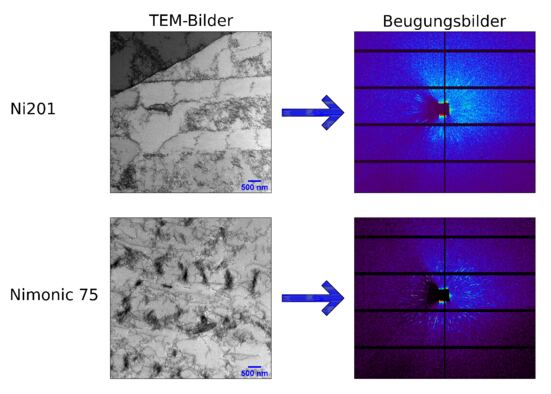
To date, the development of fatigue damage in metallic materials can only be determined in the stage prior to crack formation using time-consuming and, in most cases, destructive methods. However, characterizing the existing microstructure with regard to dislocation arrangements would aid in predicting the remaining service life. The project presented here therefore pursues an approach that uses Laue diffraction to non-destructively determine microstructural changes within a very short time. This involves the use of white X-ray light and an energy-dispersive area detector, enabling spatially and energy-resolved measurements. The broadening of the measured X-ray reflections correlates directly with the dislocation density of the material and thus also with the existing fatigue stress.
It is well known that the failure mechanisms in HCF and VHCF are completely different. HCF is dominated by PGB-induced crack initiation from the surface. VHCF behavior is strictly determined by the material state. Single-phase (fcc) ductile materials are classified as Type I, in which crack initiation originates mainly from the surface, as the surface is roughened by irreversible slip processes. This is the case when the macroscopic stress is well below the classical fatigue limit and crack initiation via the formation of a persistent slip band (PGB) (strain localization) is not possible. On the other hand, crack initiation below the surface is primarily determined by the presence of nonmetallic inclusions in the material, which are classified as Type II (mostly high-strength steels).
Against this background, we plan to investigate the VHCF behavior of Type 304 austenitic stainless steel (which is commonly used as a structural material in components) under two conditions: i) in the annealed state, in which the material behaves like Type I, with failure initiated by cracks originating at the surface, and ii) in the pre-stressed state, in which strain-induced martensite is introduced into the material, which can increase notch sensitivity within the material during VHCF cycles, thereby facilitating internal crack initiation (Type II behavior). The study will help to understand the different failure mechanisms for the various material conditions and to revise the conventional design curve in light of the available test data. The information obtained from the study will therefore be important for ensuring structural integrity and will provide key design inputs.
The 718Plus alloy not only offers optimal properties at room temperature and high temperatures, but also combines good formability and weldability, which is why it can serve as a potential replacement for commercially available superalloys in turbine disc applications. Although the properties of 718Plus are comparable to those of commercial alloys at higher temperatures, they decline drastically during prolonged holding times. Numerous attempts have been made to improve performance, but a systematic study of the role of the size of the strengthening precipitates, their size distribution, and their effects on damage mechanisms is still pending. Synergistic effects resulting from grain boundary precipitates (δ) and interactions with the surrounding matrix have always been present. Modifying the size, volume fraction, and distribution of γ‘ precipitates can improve the behavior of LCF and CFI. To determine the effects of the modified microstructure on crack propagation, the specimens are also subjected to crack propagation tests under various environmental conditions to identify synergistic effects. To understand the effects of the modified microstructure on the material’s LCF life, delta precipitation at the grain boundaries must be prevented. The main objective of this project is to determine the effects of low-cycle fatigue and the interaction between creep and fatigue on the service life of alloys with a modified microstructure and to understand the damage mechanisms involved. This could provide new insights for further modifying the alloy to achieve better and more efficient properties. Standard specimens made of 718Plus will also be subjected to the same test protocol to establish a comparative database. Transmission electron microscopy is used to better understand dislocation interactions and the formation of substructures under test conditions, and to establish structure-property correlations in order to predict the material’s behavior in various operating conditions.
Contact
Are you interested in the topic of material fatigue, looking for a thesis topic, or would you like to discuss a materials science-related issue with us? Contact us!
