Welcome to the Chair of Geotechnical Engineering
The Chair of Geotechnics deals with tasks from soil and rock mechanics, earthworks, foundation engineering and special civil engineering as well as engineering geology.
The Chair cooperates with the Chairs of Hydromechanics and Hydraulic Engineering as well as Water Management Risk Assessment and Climate Impact Research in the Research Institute Water and Environment.






Our research profile
Our chair is concerned with the safety and reliability of geotechnical structures. In the context of the second generation of Eurocode 7, we investigate the application of probabilistic methods to practical engineering problems.
Another research focus is on offshore geotechnics, in particular the simulation of sediment redistribution and the modeling of soil-structure interaction in dynamic structural analysis. We also work on geotechnical issues relating to onshore and offshore wind turbines and ground-mounted photovoltaic systems.
Research work on the load-bearing behavior of full displacement bored piles and biologically based ground improvement contributes to sustainability and resource efficiency in foundation engineering and special civil engineering. In cooperation with the Water and Environment Research Institute, we also deal with geotechnical aspects of water and flood protection.
The members of our department are actively involved in specialist bodies, committees and working groups.
- DIN working committee on safety in earthworks and foundation engineering (deputy chair Prof. Dr.-Ing. Kerstin Lesny)
- DGGT AK 2.15 Reliability-based methods in geotechnics
(Chairwoman Prof. Dr. Kerstin Lesny) -
ISSMGE TC205 Safety and Serviceability

Our projects
You can find out more about our research projects here.
Main research areas
- Safety and reliability of geotechnical structures
- Geotechnical aspects of wind energy and ground-mounted PV systems
- Offshore geotechnics
- Sustainability and resource efficiency in geotechnical engineering
Publications
Probabilistic Soil Stratification from CPT Data using Gaussian Mixture Models and Inverse Transformation Sampling for Slope Reliability Assessment
Probabilistic Soil Stratification from CPT Data using Gaussian Mixture Models and Inverse Transformation Sampling for Slope Reliability Assessment
Understanding the concept of safety and reliability introduced by the 2nd generation Eurocode 7
Understanding the concept of safety and reliability introduced by the 2nd generation Eurocode 7
Bestimmung charakteristischer Werte nach Anhang A des EN 1997-1: Methoden und Anwendung unter Berücksichtigung ergänzender Guidelines
Bestimmung charakteristischer Werte nach Anhang A des EN 1997-1: Methoden und Anwendung unter Berücksichtigung ergänzender Guidelines
Determination of representative ground properties according to the new Eurocode 7 (FprEN 1997:2024),Bestimmung repräsentativer Baugrundkenngrößen nach dem neuen Eurocode 7 (FprEN 1997:2024)
Determination of representative ground properties according to the new Eurocode 7 (FprEN 1997:2024),Bestimmung repräsentativer Baugrundkenngrößen nach dem neuen Eurocode 7 (FprEN 1997:2024)
Requirements for Flood-Driven Forecasting Systems for Small and Medium-Sized Catchments in Germany
Requirements for Flood-Driven Forecasting Systems for Small and Medium-Sized Catchments in Germany
Nutzen zuverlässigkeitsbasierter Methoden bei der Bewertung wasserbaulicher Infrastruktur
Nutzen zuverlässigkeitsbasierter Methoden bei der Bewertung wasserbaulicher Infrastruktur
Working group 2.15 of the DGGT "Reliability-based methods in geotechnics"
In spring 2022, the board of the DGGT (Deutsche Gesellschaft für Geotechnik e.V.) decided to establish a new DGGT working group entitled "Reliability-based methods in geotechnics", which has since been incorporated into the "Earthworks and Foundation Engineering" specialist section.
Probabilistic or reliability-based approaches in geotechnical engineering have gained in importance in recent years and, with Eurocode 7 currently being revised, reliability-based methods will in future be permitted on an equal footing with standard design methods.
The aim of the new working group is to prepare the probabilistic methods in geotechnics in a user-oriented manner and to develop recommendations and instructions for action.
Detailed information can be found on the DGGT homepage.
On November 20 and 21, 2025, the DGGT Academy and the AK 2.15 of the DGGT e.V. in cooperation with the Stuttgart University of Applied Sciences offered a workshop on "Reliability-based design in geotechnics using the example of retaining structures".
The workshop was held as a practical short course in which the participants independently applied reliability-based methods with the help of suitable software under guidance.
The aim was to apply theoretical knowledge directly to practical engineering issues. Introductory lectures explained the philosophy and theoretical background of reliability-based methods.
The application of the Monte Carlo Simulation (MCS) and the First Order Reliability Method (FORM) as probabilistic methods was explained by means of the verification of a gravity wall for sliding and ground failure and the determination of the embedment depth of a flexible shoring wall and the reference to a design according to the known partial safety concept was established.
For more information, please refer to the flyer.
On November 19 and 20, 2024, BAM and DGGT AK 2.15 together with the DGGT Academy in Berlin organized a workshop for the introduction to reliability-based design.
On the first day, a short course offered the opportunity to learn the basics of reliability analysis and work on tasks on the PC under guidance.
The second day offered an exciting hybrid lecture event on the safety philosophy according to the new EC7 and application examples from science. You can find more information in the flyer.
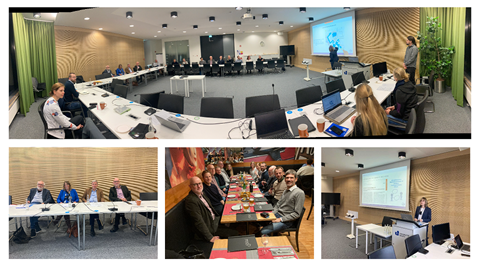
On 14.11.2023, the DGGT working group 2.15 "Reliability-based methods in geotechnics" organized a half-day workshop on the topic "How safe are our structures?" The workshop was a complete success with 120 participants online and on site. After the interesting technical presentations, which highlighted application examples in particular, the use of reliability-based methods was discussed in an exciting and sometimes controversial debate. The workshop followed on from the first structure paper of AK 2.15, which was published in GEOTECHNIK (issue 3, 2023). The detailed schedule including presentations can be found in the program.
In the following we provide the presentations and the structure paper password-protected to the participants of the workshop:
Statistical methods for determining characteristic values (E. Tafur, DB Engineering & Consulting)
Application examples from the Netherlands (T. Schweckendick, Deltares)


Further information
We are happy to support you and, as experts for geotechnics in accordance with DIN 1054 and DIN 4020, offer advice and assistance with geotechnical issues. Geotechnical investigations and calculations, the development of special test facilities or scaled model tests can be implemented on a project-oriented basis. In addition, the support and expert evaluation of construction tasks is also possible in cooperation with external partners. The soil mechanics laboratory has extensive facilities for carrying out soil mechanics laboratory tests, including in accordance with the DIN EN ISO 17892 series of standards and the currently valid German industry standards. This includes tests for the classification of soils, soil engineering tests and tests on deformation and strength behavior such as compression and shear tests through to triaxial tests, even for large sample diameters.
Dynamic probing devices (DPL, DPM and DPH) are available for geotechnical exploration in the field. Direct explorations can be carried out as small boreholes. Furthermore, static and dynamic plate load tests, all in-situ density tests and density tests with the isotope probe can be carried out. A test pit, an earth pressure box and an open hall are available for large-scale tests and earthworks tests.
Current and future challenges - from the dual control principle to AI
March 09 and 10, 2023
The expected increase in extreme weather events due to climate change poses considerable challenges for the built environment and requires the development of suitable adaptation strategies. Geomeasurement technology is of particular importance in this context because, combined with mathematical-mechanical modeling, it provides the basis for the assessment of possible geomechanical risks and for the planning measures to be derived from them. In this symposium, around 70 participants explored current developments, the possibilities and limitations of geomeasurement technology in an interdisciplinary and thematically broad context. As part of this program, an honorary doctorate was also awarded to Em.o. Univ.-Prof. Dipl.-Ing. Dr. techn. Dr. h.c. mult. Heinz Brandl. We would like to thank all participants for two exciting days! Our special thanks go to the Brandl family.
Proceedings
The conference proceedings have been published in the publication series of the Research Institute Water and Environment and are available online at Opus Siegen
online.
The press article on the award of the honorary doctorate can be found here.

The Chair of Geotechnics at the University of Siegen regularly organizes field trips with a variety of topics from the field of geotechnics. The excursions are mainly offered as part of the courses and often in cooperation with engineering associations or partner companies from the construction industry. They are primarily aimed at the participating students. The participation of external persons is possible if there is sufficient capacity. If you are interested, please contact us
with us.
Construction site excursion to the Netphen wastewater treatment plant in July 2023
Construction site excursion to Siershahn in November 2022
Construction site excursion to Landeskroner Weiher in January 2025
