Measurement and Control Engineering – Mechatronics Working Group
Prof. Dr.-Ing. Oliver Nelles
7. Design of Excitation Signals
for Identification
Goals
- Excitation of all relevant frequencies and amplitudes.
- Uniform coverage of the input space with data.
Approach: OMNIPUS − Optimal Excitation Signal Generator
- Building a signal generator that is not limited to a specific signal type such as APRBS, chirp, etc.
- Model-free (only a rough assumption about the dominant pole is required).
Advantages
- Universally applicable.
- Constraints can be easily incorporated (e.g., input or input rate limits).
- Can be used to optimize the data distribution of existing measurements.
- Can be extended to the multivariate case (multiple inputs).
- Can be tailored to specific dynamic realizations (NARX, NOBF, NFIR).
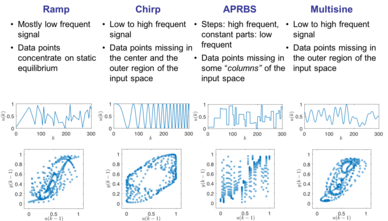
Popular Excitation Signals
Interpretation of an Input Space in NARX Configuration
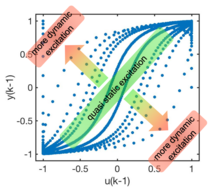
- Classification of regions in the input space:
- Quasi-static region along the diagonal
- More dynamic excitation toward the upper-left and lower-right corners
- A good approximation of the system in highly dynamic regions is necessary for high-performance control (e.g., MPC-based)
Optimized Excitation Signal
- Instead of N-dimensional optimization of u(1), u(2), …, u(N):
- Iterative optimization:
- Subsequent 2-dimensional optimizations
- Amplitude and sequence length as optimization parameters
- ⇒ Increased robustness
- Scalable to multiple inputs
Optimization result:
Optimized Nonlinear Input Signal (OMNIPUS)

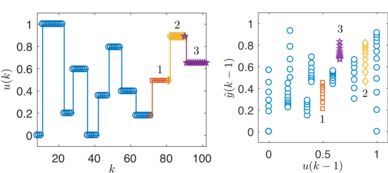
Optimization of Sequences
- The sequence with the highest quality is appended to the signal
- Quality function:
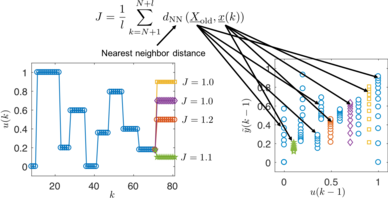
- Iterative optimization
- Taking the “old” signal into account
- Future sequences are not considered in the optimization
Implementation of Constraints
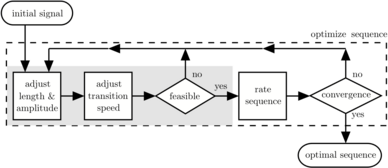
- Most processes have input constraints:
- Amplitude constraints
- Velocity/Rate Constraints
- - Higher-order constraints (acceleration constraints)
- The gray-shaded area highlights constraint handling
- Feasibility check
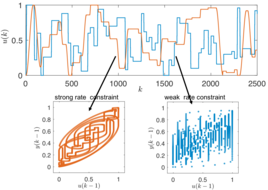
- Increasing constraints:
⇒ Reducing the feasible regions of the (pseudo) input space
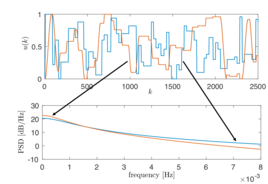
Increasing restrictions:
⇒ Less frequent signals
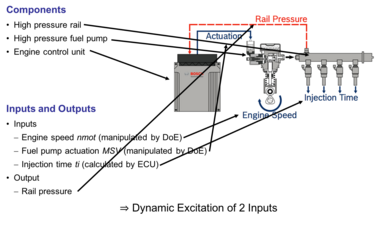
Example: The High-Pressure Fuel Supply System
Results
Qualitative Analysis – Local Model Networks
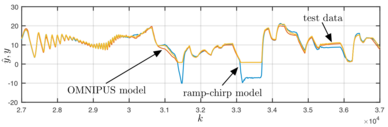
- Ramp-chirp is significantly worse in steady-state regions
- The model occasionally simulates negative rail pressure!
- The OMNIPUS model best fits the test data
- Significant difference between the OMNIPUS model and ramp-chirp mode
- Large differences in error values
- OMNIPUS data is mostly significantly better

Conclusions
Popular Signal Types
- Popular excitation signals for nonlinear identification are analyzed
- Input space coverage is discussed
OMNIPUS
- The objective is similar to that of static DoE strategies: uniform data distribution
- Input space established using a linear model
- Iterative optimization of the excitation signal
- Increased robustness due to subsequent 2-dimensional optimizations
- Easy implementation of constraints
Results on the High-Pressure Fuel Supply System
- OMNIPUS covers extreme regions of the input space with data
- OMNIPUS identifies infeasible regions of the input space
- Ramp-chirp exhibits dramatically incorrect extrapolation behavior