Interconnected Automation Systems (IAS)
At the Chair of Interconnected Automation Systems (IAS) at the University of Siegen, we drive basic and applied research on design automation of software and hardware to improve the reliability, efficiency and sustainability of modern cyber-physical infrastructures - from industrial and mechatronic systems to energy conversion applications and electrical power systems.


Mission statement
We conduct rigorous, open and responsible research on interconnected automation systems and translate sound modeling, control and data-driven methods into trustworthy technologies that increase safety and reliability, reduce energy plus resource consumption and strengthen resilient infrastructures for the benefit of society. In teaching, we qualify engineers and researchers to combine a physical-analytical understanding of systems with computer-aided and data-oriented tools so that they can actively shape future generations of automation and energy systems.
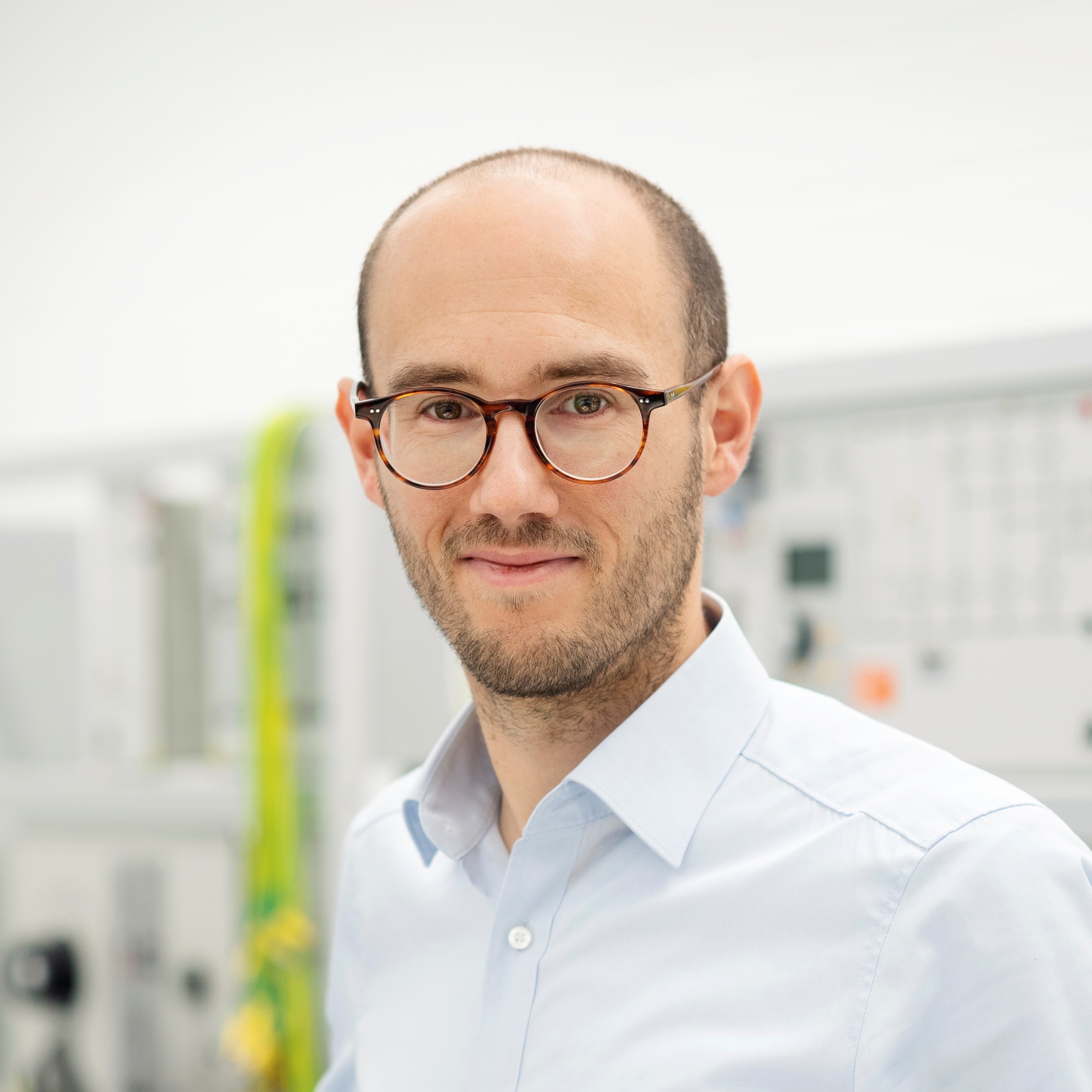
Chair's head
Research profile
We research networked cyber-physical systems in industrial automation and mechatronics as well as in electrified energy technologies. Central fields of application are electric drives, power electronic converters, energy storage systems and charging infrastructures as well as networked electrical energy systems such as microgrids - with the aim of enabling more reliable, efficient and resilient operation under real operating conditions.
Our work covers the entire innovation chain from basic research to industrial transfer. A particular focus is on translating theoretical concepts into practical proof-of-concepts, supported by rapid software and hardware prototyping. Experimental validation, including targeted measurement campaigns on relevant test benches, is an integral part of our research process.
Open science is a cornerstone of our research practice. We publish open source software, reproducible workflows and other open resources to enable transparent evaluation, benchmarking and rapid knowledge transfer for students, researchers and industry partners. Our open source contributions can be found on GitHub: https://github.com/IAS-Uni-Siegen
Focus areas
- Optimal control methods (e.g., reinforcement learning, differential predictive control)
- Hardware design, optimization and testing of power electronic converters (component and system level)
- Hybrid modeling and system identification (combination of expert and data knowledge)
- Condition monitoring, diagnostics and digital twins (e.g. using fault and anomaly detection)
- State and parameter estimation (observer, co-estimator)
- Software-driven automation (reproducible design toolchains, verification and benchmarking)
Latest publications
Comparison and Selection of Topology for Three Phase PV Inverters based on Power GaN Devices
Comparison and Selection of Topology for Three Phase PV Inverters based on Power GaN Devices
Harmonic Current Correction for Common Mode Voltage Reduction and Narrow Pulse Elimination Method in DC-AC Matrix Converter
Harmonic Current Correction for Common Mode Voltage Reduction and Narrow Pulse Elimination Method in DC-AC Matrix Converter
Protocol for conducting advanced cyclic tests in lithium-ion batteries to estimate capacity fade
Protocol for conducting advanced cyclic tests in lithium-ion batteries to estimate capacity fade
Topology Comparison to Generate Output Currents of Specific Shape
Topology Comparison to Generate Output Currents of Specific Shape
Hybrid control of interconnected power converters using both expert-driven droop and data-driven reinforcement learning approaches
Hybrid control of interconnected power converters using both expert-driven droop and data-driven reinforcement learning approaches
Nonlinear Efficiency-Optimal Model Predictive Torque Control of Induction Machines
Nonlinear Efficiency-Optimal Model Predictive Torque Control of Induction Machines
Reducing Contact Bouncing of a Relay by Optimizing the Switch Signal during Run-Time
Reducing Contact Bouncing of a Relay by Optimizing the Switch Signal during Run-Time
A Systematical and Analytical Driver Layout Design Procedure for Parallel GaN GIT Power Semiconductors
A Systematical and Analytical Driver Layout Design Procedure for Parallel GaN GIT Power Semiconductors
Design of a Calorimetric Measurement System for Determination of the Power Losses in Magnetic Components
Design of a Calorimetric Measurement System for Determination of the Power Losses in Magnetic Components
Power Flow Control Strategy Based on Space Vector Modulation of a Three-Port Converter
Power Flow Control Strategy Based on Space Vector Modulation of a Three-Port Converter
Stray Loss Formulation for Inverter-Driven Induction Motors for a Wide Range of Switching Frequency and Motor's Loading
Stray Loss Formulation for Inverter-Driven Induction Motors for a Wide Range of Switching Frequency and Motor's Loading
Dual-Active Bridge Sequential Pareto Optimization for Fast Pre-Design and Final Component Selection
Dual-Active Bridge Sequential Pareto Optimization for Fast Pre-Design and Final Component Selection


Opening hours secretariat
Opening hours
Postal address
University of Siegen
Chair of Interconnected Automation Systems (IAS)
Hölderlinstraße 3
57076 Siegen
Visitor address
University of Siegen
Chair of Interconnected Automation Systems (IAS)
H-A Level 4
Room: H-A 4106/3
Hölderlinstraße 3
57076 Siegen
Secretariat
Secretary: Lada Lübke
Phone: +49 (0)271 / 740-3305
Fax: +49 (0)271 / 740-13305
Room: H-A 4106/3
E-Mail: IAS-office@eti.uni-siegen.de