Working Together to Further Develop Effective Teaching

What makes for good teaching? How can the quality of one’s own teaching be continuously improved? What might a well-coordinated support program look like? The Center for Academic Teaching (ZFH) at the University of Siegen addresses these questions. What began as a project position has, over the past 20 years, become an integral part of academic staff development. The anniversary provided an opportunity to recognize the importance of university pedagogy and the ZFH for the University of Siegen.
In her welcoming remarks, Prof. Dr. Veronika Albrecht-Birkner, Chair of the ZFH Advisory Board, traced the development of this field of activity. University pedagogy had been present at the university since 2002. In 2006, the project office at that time was affiliated with the Prorectorate for Studies and Teaching, and beginning in 2007, the field became part of the University of Siegen’s Center of Excellence (KoSi). With the establishment of a certificate program, systematic professional development for faculty members was expanded. In the process, it became increasingly clear how beneficial continuing education in higher education pedagogy is for the university and its reputation.
In 2019, the Center for Academic Teaching (ZFH) was founded. The name itself signaled a conceptual shift: rather than focusing solely on higher education pedagogy, the center’s focus has since broadened to encompass higher education teaching as a whole.
The center’s work centers on the structural development of teaching, the design and implementation of professional development programs, the creation of knowledge databases, individual and structural consulting scenarios, and the exploration of diverse teaching and learning formats—always with an eye toward technological opportunities and challenges as well as social responsibility.
“Highlighting exemplary teaching and learning practices and creating spaces for exchange and scholarly discourse on university pedagogy remain the priority,” emphasizes Sandra Schönauer, director of the ZFH, who has been active in this field since 2007.
The fact that the university focused on diverse—and thus also digital—teaching formats early on proved to be an advantage, particularly during the COVID-19 pandemic. The existing expertise and technical infrastructure made it easier to respond to the changing demands. Even today, the ZFH addresses current developments shaping academic education. These include digitalization, diversification, internationalization, and education for sustainable development.
The ZFH’s programs support faculty in strengthening their subject-specific, pedagogical, and personal competencies. Topic-specific workshops are supplemented by classroom observations, peer consultation, and individual support—for example, in the creation of teaching portfolios. In addition, the ZFH provides online information, guides, tips, and related links on topics related to higher education pedagogy. The content is regularly reviewed and adapted to current challenges and developments.
The focus is not merely on teaching new methods, but also on providing the opportunity to critically reflect on one’s own teaching. Questions such as “Am I doing this well?” or “Am I doing this well enough?” are part of everyday life for many instructors. The ZFH creates a space to engage with these questions, exchange experiences, and gain new perspectives.
Prof. Silke Bock from the Technical University of Central Hesse provided a professional highlight for the anniversary with her guest lecture titled “The Effectiveness of Higher Education Pedagogy Measures.” This also focused on the question of how teacher training programs work and what contribution they can make to improving higher education teaching.
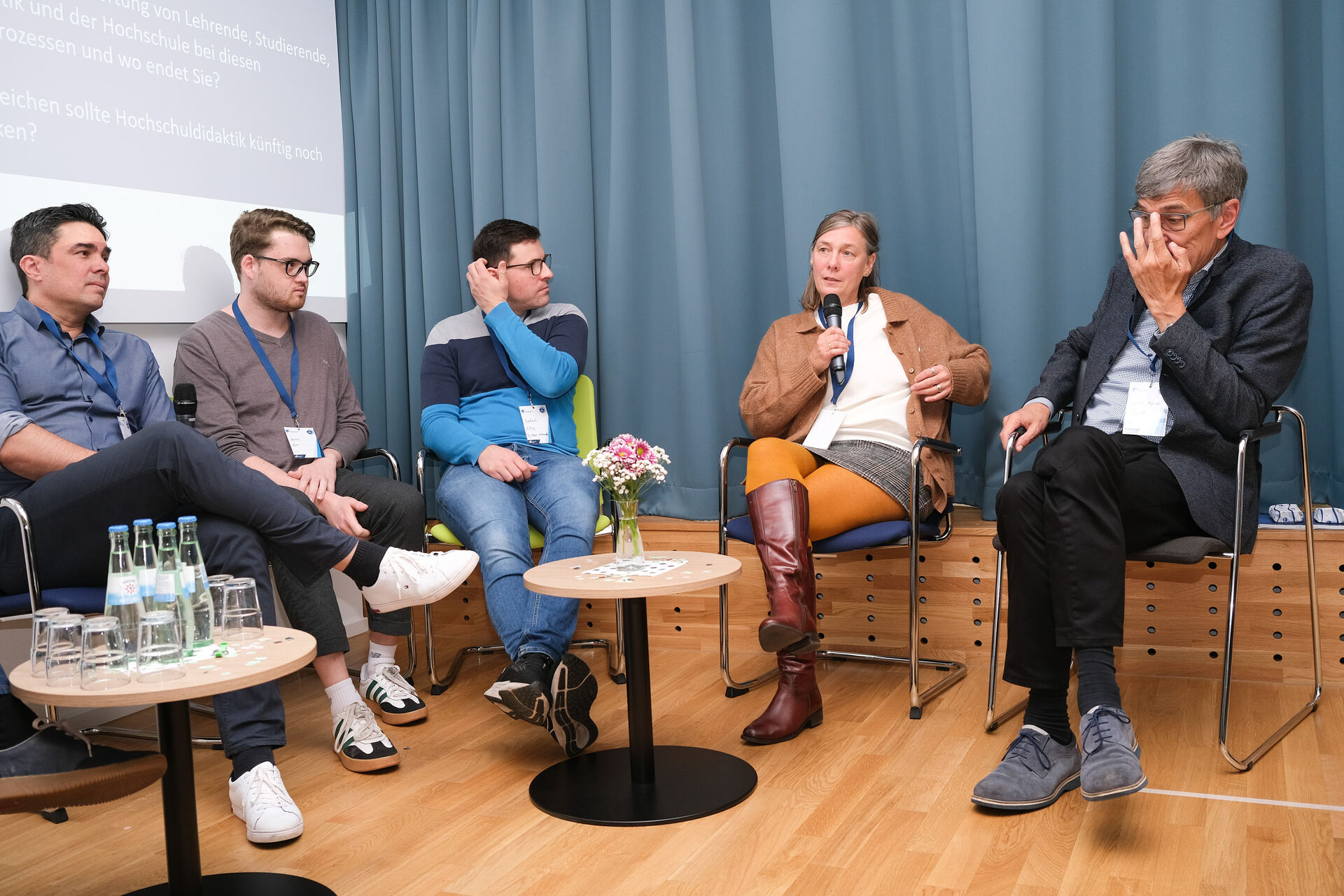
In a subsequent fishbowl discussion, representatives from the teaching community, the student body, and the ZFH discussed the impact and future of higher education pedagogy with guests from the audience.
A highlight was the ceremonial presentation of the comprehensive certificates for the NRW higher education pedagogy certificate program “Professional Teaching Competence for Higher Education” by Vice Rector Dr. Barbara Müller-Naendrup.
An analog and digital journey through time in the supporting program traced the developments of the past 20 years and provided an opportunity for anecdotes, memories, and outlooks for the future.
At the anniversary event, Sandra Schönauer emphasized the importance of collaborative work: “Higher education pedagogy, university teaching—these are complex concepts. Thanks to the collaboration of many stakeholders within the university over the past 20 years, as well as a small but strong team, these concepts and the profiles, ideas, and actions behind them have come to life. That’s something we can celebrate.”