Skip to main content

Exploring ultrafast dynamic matter with coherent X-rays

We study the structure and dynamics of complex materials and biological systems using advanced coherent X-ray scattering, ultrafast experiments, and data-driven analysis across multiple time and length scales at leading facilities, including DESY, the European XFEL, the ESRF, and beyond.

Here are a few examples of our research topics: 

  • Sow dynamics in protein condensates
  • Ultrafast dynamics in magnetic materials with complex chiral spin structures 
  • Ultrafast dynamics of solids excited by high-intensity lasers
  • Big data analytics in X-ray science  
  • AI-based workflows for optimization and automation
xray-synchrotron

New Publication: Transient Laser-Induced Surface Structures Revealed by Time-Resolved EUV Scattering

Our article “Transient laser-induced periodic surface structures revealed by time-resolved EUV diffuse scattering” has been published in Laser & Photonics Reviews.

Led by first author Dmitriy Ksenzov, together with Christian Gutt and an international team of researchers from Germany, Italy, France, and the United States, the study provides new insight into the earliest stages of laser-induced surface pattern formation.

Using time-resolved extreme ultraviolet (EUV) diffuse scattering at the FERMI free-electron laser in Trieste, the researchers investigated the response of metallic films and multilayers to femtosecond laser irradiation at fluences well below the damage threshold. The experiments revealed transient surface patterns with the characteristic reciprocal-space signatures of laser-induced periodic surface structures (LIPSS).

Remarkably, these structures emerge within only a few picoseconds after laser excitation and disappear again over several hundred picoseconds, leaving no permanent modification of the surface.

The transient patterns originate from interference between the incident laser beam and light scattered by the intrinsic surface roughness. This produces a spatial modulation of the absorbed energy and, consequently, of the temperature. The resulting nonuniform heating induces thermoelastic surface displacements, which decay as the spatial temperature modulation relaxes over several hundred picoseconds.

The results shed light on the mechanisms involved in the early stages of laser-induced surface pattern formation and demonstrate how time-resolved EUV scattering can directly probe ultrafast surface dynamics in reciprocal space.

Publication:
D. Ksenzov et al., “Transient laser-induced periodic surface structures revealed by time-resolved EUV diffuse scattering,” Laser & Photonics Reviews (2026).

Read the article: https://doi.org/10.1002/lpor.71817

SNIB_logo
General Public

SNIB2026

SNIB2026 will unite Germany’s synchrotron, neutron, ion, and accelerator communities to exchange ideas, share expertise, and shape the future of large-scale research infrastructures.

About Our Group

Combining advanced X-ray scattering and data science
photon

We are an interdisciplinary research group dedicated to understanding the structure and dynamics of complex materials and biological systems using advanced X-ray scattering techniques. By combining cutting-edge experiments and data science, we investigate how matter evolves from ultrafast femtosecond processes to slow collective dynamics.

We use state-of-the-art coherent X-ray methods to study structural correlations, non-equilibrium phenomena, and dynamic processes that are inaccessible using conventional techniques.

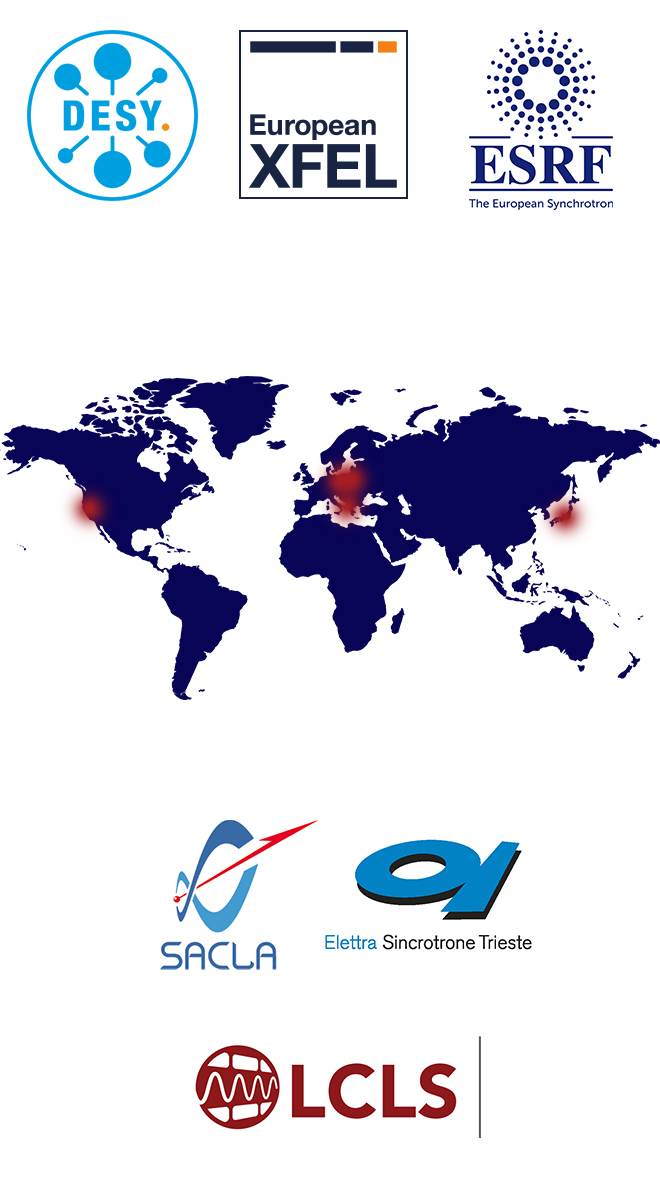
Our experiments are conducted at some of the world’s leading X-ray research facilities, including: DESY (Germany), European XFEL (Germany), ESRF (France), FERMI (Italy), SACLA (Japan), and LCLS (USA).

We welcome motivated students, doctoral researchers, and collaborators interested in X-ray science, ultrafast phenomena, data-driven research, and advanced scattering methods. Discover our research, publications, facilities, and opportunities to become part of our scientific community.

Our Research Profile

Discover the expertise, facilities, and research areas that define our scientific profile

Our research combines coherent X-ray scattering, ultrafast spectroscopy, and data-driven science to investigate how complex materials and biological systems evolve across multiple time and length scales. We study non-equilibrium dynamics in soft matter, proteins, magnetic materials, and extreme states of matter using synchrotron and free-electron laser facilities. A central focus of our work is the development of next-generation experimental methods, including low-dose XPCS, autonomous AI-driven beamline experiments, and advanced analysis approaches for large-scale photon science.

By integrating advanced experimental techniques with autonomous workflows, artificial intelligence, and large-scale data analysis, we aim to uncover processes that were previously inaccessible. Our interdisciplinary approach brings together physics, materials science, biology, and computation to develop new methods and generate insights relevant to both fundamental and applied research.


From molecular motion to ultrafast transformations, we make complex dynamics visible.


Research Focus Areas

  • Ultrafast Dynamics and Coherent X-ray Science
  • Dynamics of Biological and Soft Matter Systems
  • Autonomous Experiments and AI-Driven Beamline Science
  • XFEL Studies of Ultra-Intense Laser–Matter Interaction
  • Ultrafast Surface Dynamics in Magnetic Materials


B. M. Murphy, A. Götz, C. Gutt, C. McGuinness, H. M. Rønnow, A. Schneidewind, et al.

FAIR data – the photon and neutron communities move together towards open science

Zongxia Guo, Raphael Gruber, Dmitriy Ksenzov, Cyril Léveillé, Matteo Pancaldi, Emanuele Pedersoli, et al.

Ultrafast dynamics of chiral spin structures in synthetic antiferromagnets

Instrumentation for low-dose XPCS
-

Instrumentation for Low-Dose XPCS

GHz-XPCS
-

GHz-XPCS

mora

Agha Mohammad Raza

Research Associate
Personal profile photo

Dr. Özgül Kurtuluş Öztürk

Research Associate
Lisa_PP

Dr. Lisa Randolph

Research Associate
Personal profile photo

Dr. Aliaksandr Leonau

Research Associate (XFEL Schenefeld)
Personal profile photo

Randeer Pratap Gautam

Research Associate (DESY Hamburg)
Personal profile photo

Jenny Schrage

Research Associate
Profilfoto

Adrian Maximilian Roda Lentz

Wissenschaftlicher Mitarbeiter TU Dortmund (Delta)

The primary goal of my research is to enable autonomous XPCS experiments to study how proteins move and interact within complex, gel-like environments. Specifically, I focus on biopolymer proteins like ferritin navigating through a hydrogel network, like hyaluronic acid.

Contact Us

Opening hours

Monday 09:00-16:00 Tuesday 09:00-16:00 Wednesday 12:00-14:00 Thursday 09:00-14:00

Postal address

University of Siegen
Department of Physics
Faculty of Natural Sciences and Technology
University of Siegen
Walter-Flex Street 3 
57072 Siegen

Visitor address

University of Siegen
Department of Physics

Faculty of Natural Sciences and Technology
University of Siegen
Walter-Flex Street 3 
57072 Siegen

Secretariat

Sharon Harvey

School IV - Department of Physics 
Solid-State Physics Office, AR-NL 306
University of Siegen
Adolf-Reichwein-Str. 2
57076 Siegen
Tel: +49 (0) 271 740 3760