Rent a Prof – Bringing the University into the Classroom
Are you a teacher or Rector at a school in the vicinity of the University of Siegen and would like to incorporate a specialized lecture by a faculty member from the Faculty of Arts and Humanities into your classroom? We would like to give students a glimpse into research and academia, as well as university studies and teaching. Please feel free to contact us if, for example, you teach an advanced course for which one of the topics listed below might be relevant, or if you are interested in a presentation on the degree programs offered by the Faculty of Arts and Humanities. We will put you in touch with the faculty members or academic advisors and find a suitable date.
Selection of Topics from the Faculty of Arts and Humanities
Topics in Natural Sciences and Technology

Interested?
Please contact us!

Tina Karina Katz
Contact
Geschäftsführung mit den Schwerpunkten Studium und Lehre, Digitalisierung und Fakultätsmarketing
Urlaub vom 14.09. bis 02.10.2026
Testimonials
As part of the "Rent a Prof" project, Prof. Dr. Albrecht-Birkner visited the Evangelisches Gymnasium Bad Marienberg on Thursday, November 7. You can find a report on the school's website.
(Text and pictures by Ibrahim Kaddoura, teacher at the Clara Schumann Comprehensive School)
Update 15.04.25 - Read also: Interview with participating pupils in the magazine "Integrierte Schulen Aktuell" (issue 1/2025)
On October 2, 2024, Prof. Dr. Daniel Stein from the University of Siegen visited the Clara-Schumann-Gesamtschule in Kreuztal and gave an impressive lecture on the upcoming US presidential elections. The event took place as part of the long-standing cooperation between the University of Siegen and the comprehensive school and was organized through the "Rent-a-Prof" program, which offers schools the opportunity to integrate expert lectures into lessons.
Prof. Dr. Stein, Professor of American Studies, is an expert in American cultural studies and offered the students an exciting insight into the significance of elections in the USA. He began with an overview of the global political and economic role of the United States and explained why it is important to pay close attention to these elections. Particularly fascinating was the explanation of the US electoral system, the Electoral College, which Prof. Dr. Stein highlighted both its strengths and weaknesses. He managed to present the complex structures in an understandable way and convey the historical significance of presidential elections.
His lecture focused on the current issues shaping the election campaign, in particular the economy, immigration policy and reproductive rights. Prof. Dr. Stein also explained the political approaches of the two leading candidates, Donald Trump and Kamala Harris, and gave the students an insight into how the election could affect the future of the USA and its foreign policy.
The Q&A session that followed showed how inspired the students were by the talk. They asked questions about the possible changes in US foreign policy and the importance of gender and ethnicity in politics, especially in light of the fact that Kamala Harris could potentially be the first female president and person of color in office. Prof. Dr. Stein answered the questions in detail and gave the students deep insights into the political dynamics of the USA.

This lecture was part of the University of Siegen's "Rent-a-Prof" program, which offers schools in the region the opportunity to bring expertise directly from female academics into the classroom. The aim of the program is not only to give schoolgirls exciting insights into research and science, but also to arouse their interest in university teaching and academic topics.
The collaboration between the Clara Schumann Comprehensive School and the University of Siegen is a wonderful example of how schools and universities can work together to broaden pupils' horizons. The Q2 students thanked Prof. Dr. Stein with a small gift for his engaging lecture, which had a lasting impact on their perspective on the US elections and international politics.
The University of Siegen is looking forward to continuing such valuable collaborations in the future and providing schoolgirls with exciting insights into the world of science. If you, as a teacher or school principal, are also interested in an expert lecture in your classroom, the "Rent-a-Prof" program
is available to help you find a suitable date for a lecture.
On 20 September, Professor Dr. Markus Lersch visited the Stift Keppel grammar school as part of the "Rent a Prof" program and spoke with pupils on the topic of "Protestant - Catholic: What connects us and (still) distinguishes us".
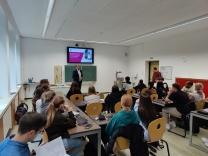
Prof. Lersch on the experience:
"Rent a Prof is a great format from which all sides can only benefit: The students take a look ahead at university teaching and professionalism, the teachers look back on their studies and possibly receive exciting updates and the "profs" have never been harmed by leaving the academic ivory tower...
On 6.12.2024, theoretical philosophy came to the 12th grade (Q1) at Bertha-von-Suttner-Gesamtschule Siegen
The inviting parties - Dr. Christian Prust and Lisa Grübener, who have been active in philosophy didactics at the University of Siegen for many years and teach philosophy at Bertha-von-Suttner-Gesamtschule - lead the two philosophy courses with around 50 students, who were now to be confronted with university philosophy. Prof. Cord Friebe and WiMi Anna-Lisa Nußbaum first introduced the subject in general, but then above all with its interdisciplinary focus on the examination of current sciences such as cognitive science, biology and physics. The discussion about the Libet experiments in brain research and their challenge for the understanding of our free will, which is also known to the general public, had been the subject of the philosophy courses in the weeks before. Now Friebe took up the conception of time in modern physics and worked out the tension between this rather static representation and our dynamic experience of time on the blackboard and in dialog with the students. How does our idea of time passing, of change in the world, fit in with the world view of physics, in which movement processes are represented by coordinate systems in which time and (static) spatial axes do not differ in any way? According to the message, philosophy of science has the important goal of developing possible solutions to such tensions. The pupils were thus given an extremely interesting insight that aroused curiosity and interest.

Topics
Current Course Offerings from the Faculty of Arts and Humanities
- Graphic Novels: An Introduction (Prof. Dr. Daniel Stein)
- The African American Civil Rights Movement in Graphic Novels (Prof. Dr. Daniel Stein)
- Monstrous Histories in Recent African American Graphic Narratives (Prof. Dr. Daniel Stein)
- The Diverse Landscape of Free Churches in the Siegerland Region (Prof. Dr. Albrecht-Birkner)
- The Church in the GDR (Prof. Dr. Albrecht-Birkner)
- Has the Bible Always Existed? (Prof. Dr. Alma Brodersen)
- Anti-Judaism in the New Testament and Today (Prof. Dr. Ruben A. Bühner)
- The Christmas Story—Without Kitsch and Tradition (Prof. Dr. Ruben A. Bühner)
- Jesus and Other Sons of God (Prof. Dr. Ruben A. Bühner)
- “How Did You End Up Studying Theology?”—Life and Work as a Theologian and Religious Education Teacher (Dr. Steffi Fabricius)
- Pop Culture in Religious Education: Academia with Bible Comics and More? (Dr. Steffi Fabricius)
- “Now, in English” – Bilingual Religious Education (Dr. Steffi Fabricius)
- The Reformation and Judaism (Prof. Dr. Georg Plasger)
- The Protestant Church under National Socialism (Prof. Dr. Georg Plasger)
- The Barmen Theological Declaration (Prof. Dr. Georg Plasger)
- German for Students with an Immigrant Background: Introduction to the DSSZ Module (Dr. Lena Decker)
- Language-Sensitive Subject Instruction (Dr. Lena Decker)
- What Is Applied Linguistics? (Prof. Dr. Stephan Habscheid; starting 10/2023)
- It’s All About Small Talk (Prof. Dr. Stephan Habscheid; starting 10/2023)
- Alexa & Co.: From Smart Speakers to Smart Homes (Prof. Dr. Stephan Habscheid; starting 10/2023)
- Populism or Participation? Language in Local Politics (Prof. Dr. Stephan Habscheid; starting 10/2023)
- Key Terms – Language and Strategic Communication in Politics (Prof. Dr. Friedemann Vogel)
- Can Language Be Used to Manipulate People? (Prof. Dr. Friedemann Vogel)
- Politics and Language: The Battle for Minds and Votes (Prof. Dr. Friedemann Vogel)
- The Language of Lawyers: How Laws Become More Understandable (Prof. Dr. Friedemann Vogel)
- "Stinginess Is Cool"—Language in Advertising (Prof. Dr. Friedemann Vogel)
- Language in War, and How Linguists Contribute to Peace (Prof. Dr. Friedemann Vogel)
- On “Masses” and “Floods”—How Metaphors Shape Our Thinking About Refugees (Prof. Dr. Friedemann Vogel)
- David vs. Goliath? – Guerrilla Communication: The Case of “Last Generation” (Prof. Dr. Friedemann Vogel)
- "Jarvis, I have a question:" How do chatbots actually work? (Prof. Dr. Friedemann Vogel)
- The Language of Crisis: How Has COVID-19 Changed Our Communication? (Prof. Dr. Friedemann Vogel)
- "Clothes Make the Man": What Our Language Use Reveals About Us (Prof. Dr. Friedemann Vogel)
- Are names just smoke and mirrors? – What Your Last Name Says About Your Ancestors (Prof. Dr. Petra Vogel)
- Tricky Spelling?—On Radicchio, Gnocchi, and Other Exotic Words (Prof. Dr. Petra Vogel)
- Various lecture topics for advanced German courses, ranging from the Classical and Romantic periods to pop literature and serialized novels/comics (Prof. Dr. Niels Werber)
- Facts and Figures? On History and the Study of History (Prof. Dr. Reinhild Kreis)
- Consumption as History: How Did People Provide for Themselves in the 19th and 20th Centuries? (Prof. Dr. Reinhild Kreis)
- German-American Relations During the Cold War (Prof. Dr. Reinhild Kreis)
- Youth in Competition. Why Have There Been So Many Competitions for Young People Since the 20th Century? (Prof. Dr. Reinhild Kreis)
- Acculturation: The Encounter of Societies, Using Examples from Antiquity and the Early Middle Ages (PD Dr. Jürgen Strothmann)
- Inclusion: Rome and the Roman Empire as an Open System (PD Dr. Jürgen Strothmann)
- No End to Antiquity: On the Emergence of Medieval Societies (PD Dr. Jürgen Strothmann)
- The Self-Governing City as a European Concept (PD Dr. Jürgen Strothmann)
- The Etruscans: Somewhere and Somehow Between Greece and Rome (PD Dr. Jürgen Strothmann)
- Christians in the Roman Empire—Between Integration, Marginalization, and Persecution (Prof. Dr. Andreas Hoffmann)
- Constantine and the “Turning Point”—A Blessing or a Curse in the History of Christianity? (Prof. Dr. Andreas Hoffmann)
- Augustine—A Theological “Giant” with a Fateful Legacy? (Prof. Dr. Andreas Hoffmann)
- The Catholic Church During the Nazi Era (Prof. Dr. Andreas Hoffmann)
- Pius XII—A Pope Facing a Dilemma (Prof. Dr. Andreas Hoffmann)
- The Second Vatican Council—A “Revolution” in the Catholic Church? (Prof. Dr. Andreas Hoffmann)
- Can Religion Be Studied? Theology as an Academic Discipline (Prof. Dr. Markus Lersch)
- Do You Still Believe, or Are You Already Thinking? Faith and Reason in Dialogue (Prof. Dr. Markus Lersch)
- Protestant, Catholic, Orthodox? The Diverse Spectrum of Christian Denominations (Prof. Dr. Markus Lersch)
- Protestant-Catholic: What Unites Us and (Still) Sets Us Apart (Prof. Dr. Markus Lersch)
- "Like=Remember": Cultures of Remembrance of the Shoah in Digital Media (Dr. Mathias Scheicher)
- Why We Have Video Games to Thank for the Intuitive Design of Modern Coffee Makers (Dr. Timo Schemer-Reinhard)
- How Free Are We Humans? On Chance, Coercion, and Freedom (Prof. Dr. Michael Bongardt)
- How Do You Know That? The Difficult Path to Knowledge (Prof. Dr. Michael Bongardt)
- Kant’s Puzzles of Space and Time (Prof. Dr. Cord Friebe)
- The Philosophy of Quantum Mechanics (Prof. Dr. Cord Friebe)
- How Trustworthy Is Science? (Prof. Dr. Cord Friebe)
- Freedom of Speech (Prof. Dr. Dieter Schönecker)
- Poetry Readings (Prof. Dr. Dieter Schönecker)
- What Are Human Rights and Why Do They Apply? (Dr. Thomas Sukopp)
- "God Is Dead." Questions About God’s Existence and Provability (Dr. Thomas Sukopp)
- Is Everything Relative? On the Sense and Nonsense of Cultural Relativism (Dr. Thomas Sukopp)
- Media and Cultural Perspectives: Why Is the Mexican President Ranked No. 6 on the Spanish Streaming Charts? (Hans Bouchard)
- Theater in Foreign Language Instruction (Improvisation, Process Drama, Online Drama, and Puppetry) (Prof. Dr. Dagmar Abendroth-Timmer)
- Learning Languages with All the Senses (Eva Balada Rosa)
- The Kinesthetic Factor in Language Learning (Eva Balada Rosa)
- ¿Con armas de mujer? Female Detective Characters in Latin American Crime Fiction (Prof. Dr. Yasmin Temelli)
- (The Crisis of) the Family in New Middle-Class Culture and Its Consequences (Sociology of the Family) (PD Dr. Olaf Behrend)
- Meaningful but Lower Pay, or a “Bullshit Job”? Decision-Making Challenges Regarding High School Graduation, Vocational Training, or College in the Context of the Financialized Economy (PD Dr. Olaf Behrend)
- Social Inequalities (PD Dr. Yasemin Niephaus)
- Poverty and Wealth (PD Dr. Yasemin Niephaus)
- Phenomena of Violence (PD Dr. Yasemin Niephaus)
- Demographic Processes (PD Dr. Yasemin Niephaus)
- How Bad Is Our Healthcare System, Really? (Prof. Dr. Christoph Strünck)
- Why We Die Sooner Without an Education (Prof. Dr. Claus Wendt)
- Doctors’ Financial Interest in Our Illness (Prof. Dr. Claus Wendt)
- Who wants to go to the hospital? The Danish “Hospital-at-Home” model (Prof. Dr. Claus Wendt)