Measurement and Control Engineering – Mechatronics Working Group
Prof. Dr.-Ing. Oliver Nelles
Research Topics: Max Herkersdorf
Excitation Signal Design for Nonlinear Dynamic Systems
The performance of data-driven techniques depends heavily on the quality of the data used for model training and validation. In the context of nonlinear system identification, these datasets are often not readily available and must be generated using suitable excitation signals.
The approaches investigated are based on the principle that the information an excitation signal provides about a process is inherently linked to the distribution it generates within a model’s input space. Therefore, the excitation signal design methods presented here aim to optimize this distribution, facilitating the acquisition of accurate and comprehensive information about the process behaviors intended to be modeled.
OMNIPUS / IDS-FID Signal Generator
The OptiMized Nonlinear InPUt Signal (OMNIPUS) generator is designed to distribute data points across the model’s input space in a way that ensures comprehensive coverage, reducing gaps and clustering [1]. This space-filling design is particularly suitable for the identification of nonlinear dynamic systems, as it enables data collection across the entire operational range, thereby capturing the full extent of nonlinear behavior. The method relies on an iterative procedure that concatenates optimal sequences, where “optimal” refers to the maximization of a sequence-based space-filling criterion. The criterion is computed using a rough model of the system, which requires minimal process knowledge. Such a proxy model is essential since, in practice, prior knowledge of the system is often limited, making direct access to the process input space infeasible.
Building upon the OMNIPUS approach, the Incremental Dynamic Space-Filling Design (IDS-FID) signal generator represents an advancement with an adjusted optimization criterion. While it continues to prioritize the space-filling criterion, IDS-FID additionally allows for a user-defined focus on dynamic properties of interest during the data collection process [2]. Using the example of a nonlinear first-order Hammerstein process, Fig. 1 illustrates this progression, showing a shift from enhanced acquisition of information about static process behavior in (a) to capturing more transient behavior in (b).
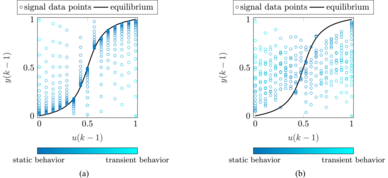
Figure 1: Process input space distributions of a nonlinear first-order Hammerstein process generated from signals using the IDS-FID algorithm, prioritizing static responses in (a) and transient responses in (b). The space-filling criterion is simultaneously addressed, as evidenced by the comprehensive coverage of the entire space.
Receding Horizon Control-Inspired Signal Generator
Drawing inspiration from receding horizon control (RHC), this approach optimizes the excitation signal iteratively, with each iteration focusing on a finite time horizon. After each optimization, the resulting optimal data points are concatenated with the previously optimized signal, and the time horizon is shifted forward. This process is repeated until the entire signal is designed. In the optimization process, a criterion is used that calculates the distances between an artificially generated, uniformly distributed data set and the positions of the signal data points in the input space. By applying weights to these distances, user-defined adjustments can be made to tailor information acquisition to the process behaviors of interest. This adaptability allows the method to respond effectively to application-specific challenges [3]. Figure 2 presents input space distributions of the Hammerstein process generated from signals using the RHC-inspired approach. In panel (a), an equal weighting scheme is employed, resulting in a high-quality, space-filling design. In contrast, panel (b) demonstrates increased information acquisition in regions associated with higher weighting coefficients.
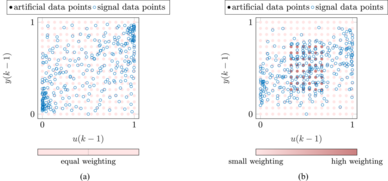
Figure 2: Input space distributions of a nonlinear first-order Hammerstein process generated from signals using the RHC-inspired approach. In panel (a), an equal weighting scheme is applied, resulting in a high-quality, space-filling design. Panel (b) demonstrates that, by employing an adjusted weighting scheme, certain regions can be given greater focus, facilitating targeted information acquisition.
All of the excitation signal design approaches presented here are characterized by straightforward practical implementation, enabling them to effectively meet industrial requirements [4].
One-Class Classifier for Data Evaluation
In the context of rapidly growing data volumes, not only is the design of excitation signals critical, but the evaluation of existing data sets also plays a significant role. Proper assessment allows for meaningful comparisons between data sets and aids in selecting appropriate training and validation data.
In the approach under investigation, the positioning of data within the input space of a model is again utilized, with an envelope constructed around the data distribution using a one-class classifier (OCC). As shown in Fig. 3, the filling grade (fg)—defined as the ratio of the enclosed area to the total input area—is used as a metric for evaluating data quality with respect to its space-filling property.
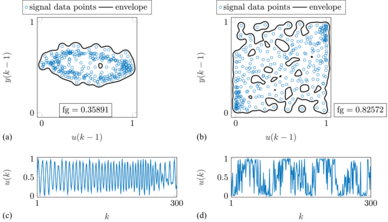
Figure 3: Illustration of the OCC envelope used as a space-filling criterion. The filling grade (fg) is calculated as the ratio of the area enclosed by the OCC envelope to the entire input space, where a higher filling grade indicates more effective space coverage.
Another potential application of the OCC-envelope lies in assessing the similarity between existing datasets. In this context, the overlapping regions of different envelopes represent the proportion of shared information between the datasets. Consequently, overlapping areas can be identified as similar, while non-overlapping regions signify novel information. This enables the selective inclusion or exclusion of data for training or validation, optimizing the dataset by preventing gaps or unnecessary clustering.
References
| [1] | Tim Oliver Heinz and Oliver Nelles. “Iterative excitation signal design for nonlinear dynamic black-box models.” In: Procedia Computer Science 112 (2017), pp. 1054–1061 |
| [2] | Max Herkersdorf, Tarek Kösters, and Oliver Nelles. “Optimized Excitation Signal Tailored to Pertinent Dynamic Process Characteristics.” In: arXiv preprint arXiv:arXiv:2410.00500 (2024) |
| [3] | Max Herkersdorf and Oliver Nelles. “Optimized Excitation Signal Design Employing Receding Horizon Control.” In: arXiv preprint arXiv:arXiv:2410.00504 (2024) |
| [4] | Tarek Kösters, Tim Oliver Heinz, and Oliver Nelles. “Optimization-Based Excitation Signal Design Tailored to Application-Specific Requirements.” In: IFAC-PapersOnLine 55.37 (2022), pp. 451–456. |